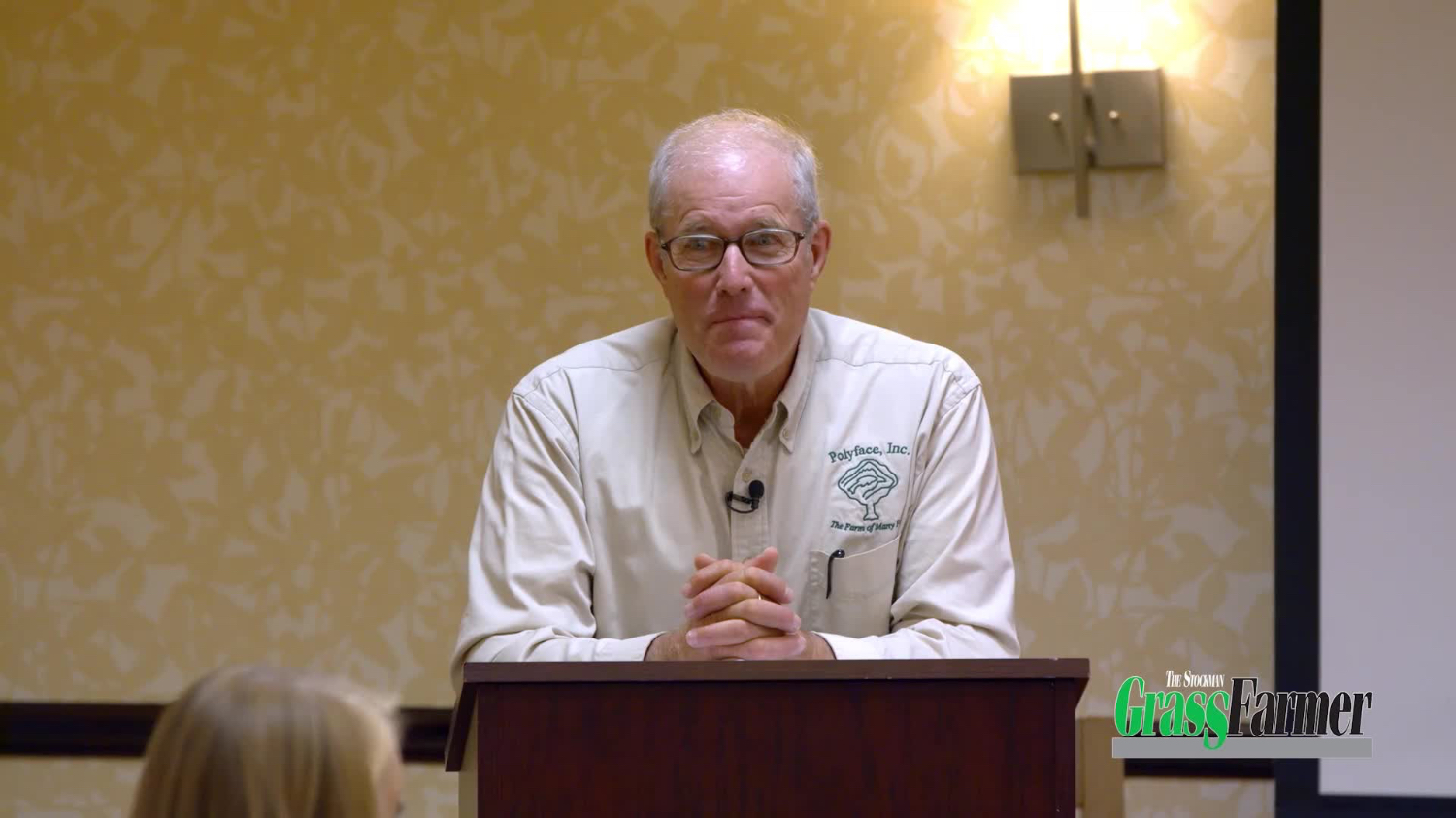
There we go. Okay. Good morning. This is with Glenn Elsinger of Alderspring Ranch in Idaho. And I'm curious how you went from seven cows to now you're processing over 400 bees a year. So tell us the background.
Wow. That's kind of a first of all, thanks a lot, Carolyn, for having me on here. I love what you and your husband have done over the years. And you guys were kind of foundational to really what we do.
In fact, I think it was an SGF article that kind of got this whole ball rolling. Carol and I had just bought a very small acreage, 60 acres and seven cows. And we had no idea what we're doing. We didn't come from a livestock background.
We had a little bit of equity in $30,000. And we're running these cows and we're looking at buying some more. And we were also leasing some calves at the time. And we put those calves on those calves, that calf crop, people call it, on a truck, you know, with a bunch of other people.
We were in this thing called the Salmon Pool, which refers to Salmon Idaho. And it was this pool where people sell their animals on the video auction, which is kind of the way things went now. You know, it's pretty much all online video sales.
And so we just throw our cattle in that pool and they'd go to feedlots in Kansas. And we didn't like that. And I'll tell you a little story about how we got to that mindset. We were, Carol's mom and dad had a farm in Indiana.
It was a corn and soybean farm, pretty conventional farm. Her dad, I will say, it was a maverick because he was always trying different twists on things. You know, sometimes even go back to growing produce.
He had grew asparagus roots for a while, but his mainstay was still the corn and bean thing. And I used to go help him there every year during harvest for like part of November, sometimes as long as six weeks, we'd leave our little ranch in Tendoy, Idaho, and we'd go work for dad.
And one time we're coming back and it's Kansas, I-70, and we're coming across the state and there's pouring rain. It's just coming down in buckets. I mean, we never see that kind of rain here in Idaho, Carolyn, but it was bucketing.
And it was one of these things where you got the windshield, the wipers going boom, boom, boom, boom, you know, super fast. And man, it was just a deluge. And we came into this area of Kansas. It's just the flat high plains.
And I had been smelling it for a while. My daughter, my oldest daughter, she's about seven years old. She's in the back seat behind me. And she said, Dad, what is that smell? What is that smell? And she said, can you open the windows?
I said, no, I can't. Two things, honey, you're going to get soaked. And the second thing is it's going to make the smell worse. And she said, what is it? And I said, it's that. And we're driving down the interstate and on the left side is this feedlot.
And it just literally goes on for a mile. Wow. And we can see these cattle over there, Carolyn. They're up to their bellies in fecal muck. They are literally up to their bellies. And you can see where some of the fecal muck is slipping into these concrete bunks that they're eating out.
It's just, it's this weird dystopian horror show, you know. And looks, and I said, I'm going to roll down the window for you just a second so you can see what's going on here because, you know, the rain's coming down.
So Crank opened the window for her and she looks and she's speechless. 70-year-old kid speechless. Unusual. Okay. Really unusual. She's just watching. And I roll that window up and Carol is next to me and she's like, oh, wow.
What are we going to do with this one? And I think Carol knew where the direction of the conversation was going. And she said, Dad, are our calves in there? Are our calves in there right now? Because she knew they went to Kansas.
She knew they had gone to Kansas. Super smart kid, right? And I'm like, oh, that question. Wow. And I said, no, honey, they didn't go to this one because I did know about where they went. They went to eastern Kansas.
We're in western Kansas. So I said, no, they didn't go. And she said, okay, that's good, but do we know if our calves are in the same situation as these calves are? And I said, no, I don't. I don't know that.
And she said, so they could be in a situation like this. I said, yeah, they could be. And we were silent for quite a bit of the drive. And it just really got me thinking about what we're doing. You know, what were we doing, Carolyn, you know, in our food system and even in our ranching system?
We were raising these calves, you know, and, you know, Melanie was out there with me all the time being the oldest. And she loved these cattle. She loved being horseback. And, you know, we just put a lot of ourselves into those animals.
And, you know, it became early on, you know, as soon as we started working these cattle and ranching early on, it was more of a husbandry thing than even stewardship, I think, for us, because we had so much like personal connection with these cattle, even though people say cows are dumb and all these things.
Let me give you an example. It still goes on. My daughter now is 32 years old and we're preg-checking 250 mama cows the other day. This is like a week ago, week and a half ago, something like that. And so we're running these cattle through the chute and it's going well.
We're doing, we're pregging like one cow, pregnancy checking one cow every like 50 seconds. And they're flowing through and they're flowing through really nice and quiet. You know, cattle stockmanship stuff used to be very stressful for us.
In fact, I know before that morning, I still had PTSD. And I was like, oh, gosh, I hate working cattle because we've had so many bad experiences. But this is one of the best experiences we ever had. And the vet's got his arm up to his armpit in this one cow.
And she's, we know her. I mean, Carolyn, we got 250 of these mama cows. And Melanie says to me, Dad, I said, yeah. She said, that's Karen. And, you know, it's not on a tag. She just knows her as Karen.
And I said, yes. So she said, you know, Dad, I love this cat. I said, Melanie, she is so mean with her calf, you know, that she will kill you if you touch her baby, like for the first two weeks after birth, you know.
And, you know, I know this whole industry has shifted gears to try to create docile cattle that are easily, you know, handling and well-mannered. We've actually gone the other way. And we could talk about, you know, why that is.
We actually like these cows that are kind of super mean and super, super good mothers to almost to a fall, you know. And I said, yeah, so it's Karen. She said, I want to pray for her before we pray. And I said, why?
And she said, I want her to be pregnant. I just want her so bad to be pregnant because she's such a good cow and she's like the best leaf cow we got. Because you can. I've been on horseback, Carolyn, up there on the range.
And you can take this Karen cow and put her up front of the herd and you'll show her where to go and give her an idea of where you want to go. And you can back off and ride, work the flank of the herd because Karen's got the front.
She's totally got the front. Do you remember Alan wrote, you know, back when he and Gordon Hazard used to interact with... Thinking of Ugg. No, exactly. Exactly. No, you're nailing it, Caroline. I thought of Ugg.
This cat is an Ugg for me. Yeah. Dr. Gordon Hazard was almost like going to pray for Ugg because Ugg was such an important part of his operation, right? So anyway, I'm surprised you remember that. You got a good memory.
But anyway, you know, I was thinking about Ugh, and I said, absolutely pray for this girl. You know, so Melanie prays. And sure enough, the vet pulls his arm out and says, she's good. She's good. She's perfectly pregnant, you know.
And that's the level that even my kids have come to be with these cows. They're in this place of. You know what it is? This friend of mine, this veterinarian from Nebraska, was talking about it once, and he said, I actually called him up about this very thing.
I think he was on a podcast or something. And he said to me, we need to move from how we view these cows, from being caretakers to caregivers. He said, you know, all of us, you know, that are kind of taking a high road on husbandry, taking a high road on stockmanship, we see ourselves as caretakers of these cows, but we're still practicing a lot of extractive things.
And it's because that's the way we've always done it. And he said, I want to move people to a new place from caretaking to caregiving. So we're just giving tonight. We're giving them the choice. We're giving them a path forward that's not stressful.
And he said, you know, feedlots, you know, can be, you know, not giving. They can be just taking, taking, and just extractive. So anyway, roll back way back to the Kansas thing. That's why my daughter reacted.
She already was there. She had already arrived at caregiving versus caretaking. And I don't know if her dad was totally there, but he certainly got his wheels turned. So anyway, that's why, you know, I responded to an article that Joel had put in SGF and I said, I'm going to call that guy.
I am going to call that guy and ask him if this is working because he wrote about direct marketing and stuff. So that was a definitive moment for us. I called Joel and we talked for over an hour and Joel's just such a great guy and he just was so encouraging.
You know, this is way back before, you know, he was like, you know, one of the forerunners of this whole crazy grass-fed beef movement back when nobody else was doing it. And Carolyn, the crazy thing is we live in the middle of nowhere.
I mean, we have no customers. I mean, there's no customers. Our county is the size of the state of Connecticut. And, you know, there's like, I think there's like 8,000 people in the entire county, state of Connecticut.
And most of them hunt elk or wild game or they got a cow in their backyard. Most, you know, like in our valley, it's almost all ranchers. So it's a very rural economy and there's no place to sell. So Carol and I started selling at the Boise Farmers Market a five-hour drive away after talking to Joel.
And that actually went well. But it got us into a mindset of connecting with these people. And it took us to this wonderful place where we wanted a relationship market. And so we built on that. We added the internet.
We dropped the farmer's market. So that's how we're selling those beef today. We're selling those cattle today. It's all online. We became certified organic, 100% grass-fed. And so now we have a customer base that's like 14,000 strong and really, really solid customers, really predictable.
And it's, you know, a lot of people talk about resilience, you know, in terms of soil biology and in terms of plant diversity. We have those things as well. But there's a lot of resilience that has to happen post-mortem on our, you know, right now, yeah, everybody's like, oh, the cow market's great.
Cow calf producers are finally making that money. But the problem is I'm watching all these people keep heifers right now. And, you know, that says all my neighbors are keeping heifers back right now, Carolyn.
That says, this is a time bomb. This market's going to deteriorate in probably three years when those calves start hitting the market. And it might take a little longer than that because, you know, we're in a low spot.
So it's going to take a little bit to build that back. But we're looking at in commodity agriculture, once again, a price cycle that's going to end someday. And everything else has gone up. Everything else is higher in the kite.
You know, it's equipment. It's just inflationary value. It's labor. I mean, if I told somebody we're paying just basic ranch hands, you know, between $15 and $25 an hour, if I told somebody that, you know, three years ago even, they would have said, you're nuts.
You're nuts. You can't do that. That's not sustainable. And they're right. It's not sustainable, but it is for us. And it's because this elimination of middlemen becoming price takers instead of makers and that continual supply of customers through relationship has offered us a resilience that the commodity market never will.
So that's how we got there. You know, I mean, there's a lot of bumps in the road. You know, it sounds like rainbows and unicorns with me talking about it now. But there were some times, you know, and many, many times where it was a crisis.
It was a crisis of confidence into whether or not this would happen and was able to happen. So, but, you know, even today, I still do recommend people to do that and build those relationships with those customers.
You know, that's a beautiful thing in what we do. You know, it's, it's just, you know, Stockman Grass Farmer has done that. I see all these names in this recent issue he sent me. It's like, I know a lot of those people.
You know, Steve Kenyon's got a callman or, you know, he's just north of me up in Alberta. And it's still like this small community, this relationship-based thing. And that's really the win for us is building those relationships, not only with the land and ecosystems, not only with the cattle, not only with soil biology, not only with the plants that we graze, but also with our customers.
So the whole thing's in one word is relationship now, and that's where we are today. Let's talk about what's unique about your herding on horseback. Okay, and I know you have seven daughters that are all involved in the business in one way or another.
So and then you don't have any predator losses. So well maybe minimal. No, it's pretty minimal. Yeah, you're right. So here's one thing. What do you attribute that to predator losses? Yeah. So here, what we weren't always there, you know, if you roll back the clock to 2012, we found out 2012 and 2013 that wolves, you know, these big characters that we're living with in our backcountry, because we graze on 70 square miles of open pasture that essentially has no fences.
And it's not just pasture, as you'd say, oh, that's pasture. It doesn't rain there. It's dry land. During summer, we're usually in a very dry, dry season of the year. We do get a lot of snow up there, especially in the higher elevations, ranges from 4,000 to 10,000 feet.
It's part of the Rocky Mountains, right? And so it's one huge grazing area that's just us up there. Most of it's BLM, Bureau of Land Management and Forest Service Land. So it's government lease ground.
We have some private up there as well. But so it's very wild country and these wolves started living with us. So the thing I found out early on was that wolves like grass-fed organic beef, Carolyn. They love it.
They think it's really good. And they don't even have to cook it. You know, it's like fast food for them. You know, where we graze grass, they graze beef. You know, so that was obviously something that was, you know, simmering on a burner.
And then we had several packs of wolves and a pack can be anywhere from four to 40 individual wolves move into the country with us. And, you know, when you got a significant amount of wolves in your country with you, they have a lot of nutritional needs.
You know, they really get hungry and they really consume a lot of whatever they're eating. So we do have tons, tons and tons of wild game. We have a lot of deer. We have lots and lots of elk in big herds that are, these are all wild animals that roam that country with us.
And so, you know, for a while, the wolves were kind of noise, you know, because we were losing, you know, single digit percentages of our cattle. And we're like, yeah, you know, I guess it's still worth grazing up here.
And we were just turning our cattle out extensively on that 70 square miles. We just basically opened the gate in the spring and kind of move them through. But the fact of the matter is when we'd go find them or try to find them, Carolyn, we'd maybe find 25% of our herd.
By this time, we grew up to like 250 mama cows and their babies. So there's like 500 head up there, you know, and this is in the teens, 12 and 13. And one year we lost 14 head. We just came back dead empty.
And I'm not sure if it was all wolf predation, but we had a bunch of confirmed kills. And it was like economic suicide to continue. The market wasn't that great in those years, but it was coming into 14 and 15 where we did have kind of a market ascendance.
You know, it's not what it is today, but things were pretty good in those cattle were worth quite a bit of money. And we probably lost over, say, a three-year period, a little over $100,000 worth of cattle to these wolves.
And if we put that on today's market, Carolyn, it'd be like $300 or $400,000. So it was a lot of money because that's how fast inflation has really happened in terms of agriculture. You know, labor was way cheaper.
We were in single digits in labor. I bet we were paying our people $6 to $8 an hour at that time. So Carol and I came back, you know, after bringing those cattle home and finding out how much we lost.
And we knew it was the wolves. And we said, you know, we can't go back there. That's a stupid decision to go back there. And the crazy thing was, you know, I was very angry and I was almost at a point of saying, let's just kill them all.
Let's just go kill them. Because that's what my neighbors were doing. They're going up there hunting them, trying to find them. And they're really hard to find. They're so sensitive to human smell. And, you know, it just, it was like, I can't afford the time to do that.
You know, we had all this stuff going on. We're homeschooling seven kids. We're direct marketing. We're trying to run a home ranch while running that range up there. We got all these horses that we use in our operation.
We had an internship program. There was so much going on. I couldn't afford to go up there and hunt them. And besides, I never liked the idea because, you know, Carolyn and I, she's an ecologist. She's a riparian ecologist.
I was a forest ecologist before we became ranching people back in the early 90s. And we both actually thought, no, they were part of this ecosystem. And yeah, they've grown up hugely in terms of their numbers.
And now they're a thing for us. But we didn't feel good about just going out there and wanting to slaughter wolves besides, even besides the fact of how much time it was. So that wasn't really a fit for us.
And I realized I had a lot of anger, you know, and it's like nobody wants to respond to the anger vibe and say, I'm going to kill them all because that's what most of my neighbors said. They were, you know, super incensed.
They didn't have any success doing that, by the way. Anyway, so we knew we had to do something different. And there was a whole bunch of things. You know, I think God just engineers this stuff and gives these snippets of wisdom to you that enable you to think of something different.
You know, if we have paradigms in agriculture, you know, I see them all over the place today. Even I struggle with some paradigms. But, you know, the biggest paradigm is this is the way we've always done it, right?
We see that through crop agriculture, through cattle agriculture. Hey, this is the way we've always done it. And for you to get out of that kind of paradigm, you really need some kind of shock value that says, this isn't working anymore.
You're going to lose everything. You know, for us, we're going to lose our cattle. We're going to lose economic position. You know, we're not going to be profitable on this kind of crazy thing. We have to do something different.
You know, so these things, these outside influences come in and pulse us hard with this realization that we're going to crash and burn. And if we don't do something different, we're out of business. So, you know, with that hardcore realization, we realized we need to start finding answers.
And it was crazy. We were Christmas caroling one night at a friend's house down the valley. They're older people. He'd retired from ranching. We actually bought his mama cows when he quit. And we're in his living room and they're older people.
Carolyn, are you living in Mississippi? Yes. Okay, so you don't worry about being cold in the winter, do you? In general. Except for today. It's cold? Yeah, it went below freezing. You know what this is?
Do you know what this one? That's the world's smallest violin saying, My Heart Bleeds For You. I know, I know. And it was something it was 80 degrees. It just bounces here. No, with that vest on and stuff, you look like you might be cold.
So anyway, the problem with Christmas Caroling at that time of year, a lot of times we're in a sub-zero stretch. So these are people in their 70s, and they got that wood stove going like it's red hot.
Red hot. We come in there wearing down jackets from the winter outside, you know. And so we're roasting in there while we're singing these songs. But they're just such great people. They always have snacks set aside for us.
We hit their house every year, and they just have become fantastic friends. But they have this artwork on their wall in their living room. And a lot of it is these old Western shots by this guy named C.M.
Russell. They're oil paintings. And they have copies of these paintings hanging on their wall. And they're of like thousands and thousands of cattle out on the open ranges of Montana. And they're being herded by these guys on horseback.
And there's pictures of these cow camps that these guys live with these cattle. You know, they trail them all the way up from the Texas panhandle to Montana. And in fact, and that seems like a long ways, but if you're today going to drive from southwest Montana or southeast Montana to northwest Montana, you know, diagonal all the way across that state, if you took that path from southeast Montana and drove to Texas,
it actually would be a shorter trip to hit Texas. So we think conceptually, oh man, he crossed all these states, but conceptually, it was actually reasonable and more reasonable rather than keeping him in Montana to do that kind of trailing route with all these cattle to actually bring them down to Texas Panhandle for the wintertime.
So it was this thing they did every year. They trail them up from Texas and they graze them out in eastern Montana and the grass was never ending. It felt like, you know, and these guys would be out there camping with their cattle.
And the reason they camped with their cattle was because of wolves, grizzly bears, rustlers, bad grass, in search of good water. So they're trying to protect against all those things, protect against alkali water.
They're trying to find good surface water to water their herds on. They're looking for the best grass that they can gain the most weight on. And so they're making all these choices. And I said to Carol when we got back in the truck to go Carol in the next place, I said, why can't we do that?
And she said, what are you talking about? And I said, you know, remember, I'm a really visual person. So I just pictured that whole thing looking at those paintings. It's like, ah, that's us, you know, and she's like, what are you talking about?
So I, you know, I kind of went through the whole thing with her. And she's like, you know, maybe we can. So anyway, you know, that was kind of the inception of the idea. And so we started doing just that.
We started living with our cattle 24-7. And we have a cow camp up there the whole summer. So we'll have like anywhere between 400 and 500 head of cattle up there with us. And we're in a cow camp, sleeping with them every night.
We put them in a little hotwire pen during the night. We call it a night pen. And it's small. It's like a quarter of an acre. You'll have four or five hundred head of cattle. And after just two weeks of training, Carolyn, they just fell right into it.
I mean, in fact, when the sun was going down in the afternoon, you'll be way up on a hill a mile and a half above cow camp. And, you know, you're grazing the night ground or the night, the night feed that's going to fill them up so they can ruminate through the night.
And it's cooled off now. And they just got their heads down. And there comes a certain point when that sun goes down and hits below their horizon. Those cattle, once we just like point them in the right direction, those cattle will actually run all the way down to the night pen, this quarter acre on 70 square miles of ground.
Okay. And they will run down there with their tail up in the air and they'll go bucking down there. In fact, it's scary sometimes if you're on horseback because the horse knows that we're going home for the end of the day too.
And they get a break. We put them on good pasture every night. You know, that's also a hot wire pasture and break back camp. And they're going to go down there for a drink. And they know they're going to shed their saddle and shed me, you know, the burden.
And so these horses want to go down there bucking too. And I don't know if you've ever run a horse full gallop going downhill. It can get scary. It can get so scary, you know, because, you know, if they trip at all, you're doing one of these numbers.
And we've all had those kind of wrecks, you know, so you're just being very judicious about how you, you know, you're paying attention to what's going on between those horses' ears, you know, if they're getting like overstimulated on all this.
But anyway, it's really cool because these cattle all get trained within a couple weeks to know that they're going to run down to the night ground and they're going to crash there and they're going to get a good drink and they're just going to lay down and they're done.
I mean, within like 20 minutes after getting to the night ground, they'll just lay down. And it's, you ever been, I know you probably have been to a choir concert at a church or university, and the conductor gets up there, you know, and this is kind of an analog for what happens the next morning.
So you come into the night pen, lift the hot wire gate, come in there horseback, and you swing your leg over the saddle. And all those cattle, it's just like the conductor came in because it's almost like the conductor says, I'll rise because you swing that leg over the saddle.
And, you know, it's like before sunup, it's five o'clock in the morning, 5.30 in the morning. Swing that leg over the saddle. All those cattle stand up. And you'll just start at the gate and work back and forth pressure, just like Bud Williams talked about all the time.
You start at the gate and work your way back through. And all those cattle just emerge and they know they're going to graze. So they really actually acclimate to this really well. We were surprised at how effective it was.
Once we learned, you know, there was so many Bud Williams techniques we had to employ. And that's a continual work for both myself and the girls, you know, with these interns especially to get them to get in the head of a cow and just treat them with respect and how they're like designed to move and how they're designed to move out.
So without adequate stockmanship, this would never work. But the stockmanship, thankfully, has made them all really, really comfortable with the whole idea. And now they look to us for where we're going that day.
You know, they'll actually look for our guidance to get that leader established, like that mama cow I told you about. Right. And we'll point her up there like Ugg and say, we're going up there today, sweetie.
And we'll send her on up. And that sets up the whole herd. And they just pull the whole herd up there. And so that, you know, that's a very simplistic kind of viewpoint of it, but it really hits at the essence of that relationship with those cattle.
You know, we have a, you know, it's, and what it is, you know, if Jim Garrish has been up there a few times with me and, you know, and I said to him, Jim, this is basically what you, what you teach. This is management intensive grazing, but instead of hotwire, you have us on horseback.
We're doing what you suggest, but our cell is actually moving all the time. We're moving that cell. You know, it's continually moving. In fact, you know, let me give you a picture of, so say you got this 450 head on a two acre piece.
I took a picture of this and timed it a few times. I would take a before picture and just click it. You know, we got these phones now. I'm sitting on horseback, click this picture before the cattle get there.
And my daughters are bringing these cattle through this graze on the forest or sagebrush, whatever we may be. And you see this lush grass that they're going to come into. It's green and beautiful. And then I take a picture of them in there.
And then I take a picture of them leaving. And so this has been just to get the vision of what that looks like, you know, a lot of times I'll talk about it in a presentation. I'll have those three shots and I'll say, okay, this is 450 head.
The pitcher size is roughly an acre that these cattle moved through. And I say, how long do you think it took to graze that one acre? How long did we spend there? And what is the interval before we come back?
And this more than anything, Carolyn, is the essence of what we've come to do up there with this herding and how it relates to adaptive multi-paddock grazing, how it relates to like a lot of savory principles.
You know, you could even call it holistic plan grazing or even cell grazing or management intensive grazing, you know. And I say, how, what's the time that these animals had duration on that piece of ground?
You know, we know there's 450 head on one acre. You know, that's somewhere around 300,000 pounds of beef to the acre. How long did we spend on one acre? And it's all green. It's fairly good ground cover.
And so I get people say it was an hour. And, you know, sometimes in an audience, you'll have people look at the people who say it was an hour and they're like, no, that's crazy. It was a day. It was a day.
And then I'll have somebody else say, no, it was less than an hour. I think it was less than or nothing. Anyway, Carolyn, it's around two and a half minutes. I'd be on that piece of ground for two and a half minutes.
And then you know what the rest period is? I do the same thing with the rest period. I said, okay, how long is the rest period before we return? And it's about two and a half to three years before we come back.
And so, you know, a lot of people are like, well, you don't have to do that. And you got to remember this is a very brittle, brittle environment. So, you know, you have this hoof impact, you have this grazing, you have this biotic input from saliva, urine, and manure.
Even hair is putting biological input in there. And so you're building soils and you're building plant diversity, but you're only doing it because your visit time is very short. It's a high impact, very short duration with a very long rest period.
And one thing that we found out is, see, we run cell grazing at home to 35-inch equivalent precipitation rate on irrigated ground. And there, you know, we'll have anywhere between a 25 and 45 day return period during grazing season.
But up here on the high ranges, the effect of precip on that pitcher might be only seven, eight inches, you know, seven, eight inches of rainfall a year. We have some areas on that grazing country where it's only two or three inches of effective rainfall per year.
And so those are very brittle environments. So the one thing I've learned, if anything, is that, yeah, your densities might be the same. Durations might even be the same, you know, in some as compared to irrigated ground or temperate rainfall ground.
But the biggest thing that we see change in these brittle environments in order to respect the land and respect the ecosystem processes that apply to those lands is we need long, long, long rest periods.
The more brittle, the longer the rest period. And it's just because those plants need opportunities to grow back and perhaps even germinate, you know, if you're trying to create that. And they need a long, long rest period to be able to build up root reserves adequate to match their need to grow again.
And that's what's happened so much on the Western Ranges is the opposite of what we're doing. We have continuous grazing, ends up being highly selective, and these plants never have a chance to build up root reserves and get a solar panel up there enough to really get those exudates going, build that soil biology, get that plant re-established.
So inadvertently, we fell into the same system we use at home to finish cattle. It's crazy. It was like, when, you know, Alan Williams is a friend of mine, as is Gabe. And, you know, they often say, these things are not new.
You know, they've been in nature forever. And all we needed to do is rehatch that. And here we were in a situation where we now have these top of the food chain predators that are actually telling us we need to move our cattle and telling us we need to put them in these, you know, bunches so that we can keep them safe.
But the reality is in prehistoric history, those animals did the same thing. They were trained by the wolves to do that to stay together, stay in herds, not use riparian areas, you know, to like a disadvantage that created degradation of riparian areas because riparian areas, you know, in those wetland areas always have this dense vegetation cover.
And wolves and mountain lions and bears, of which we have all three now, they all like to hide down there in those brush areas and just wait for the ungulate to come down so they could have lunch. So now, you know, we don't even, we encourage our cattle never to use riparian areas.
And as a result, those riparian areas are restoring into ways we've never seen them able even to do. We couldn't even conceptualize the riparian health that we're getting now. We're seeing fish extensions.
We're seeing water quality changes. And it's been really, really amazing once we embraced what nature's been trying to teach us all along. And it was the wolves that kind of forced the issue. So now, you know, Carolyn, we've actually had wolves howling right around camp.
We've had where we take the cattle out. We'll have wolf tracks walking around the tents while we're gone. I mean, these are big tracks. They're like the size of dinner plates, you know, saucers. And you see these big tracks.
Like one time there was, I don't know what they did. They got into a bag of flour or something. And so there's these flour tracks of these wolves. You know, they went into the cook shack and stuffed their nose in there.
And, you know, they're just checking the whole thing out. They could smell that we weren't around. They'd been watching us, evidently. You know, we were way on the mountain there and there was nobody in camp at the time.
So they just checked out off camp and said, hey, let's check these guys out, see what they're doing. So the fact of the matter is we don't know that they're even watching us, but they're very cognizant of what we're doing.
They're watching us. And at first that was really unsettling to me. But then I started thinking about it. It's like, you know, maybe this is as it should be. You know, and it's just this mutual respect coexisting.
And the fact of the matter was they really enabled us to really, really enhance grassland productivity and diversity and ground cover and all these things, all these things that we look at on temperate grazing, you know, where we're doing, you know, in the valley, 35 inches of effective precip from center pivots and stuff like that.
All those principles we learned there, now the wolves had forced us to do the same thing up in the big, up in the big country. So it's been an interesting journey for Sheriff. I have a question. You have seven daughters.
Yes. What advice do you have for other producers who want to keep their family on the next generation on the farm? That's a really good question. So you want kind of the whole view, you know, how I think of it holistically, or in terms of potential profitability or in terms of what do you really want to do with your life?
Right. What context? You want me to just kind of hit all three kind of? Sure. Okay. So I always had the kids involved in the operation. So like I said, we're homeschooled. That gave us flexibility. Said, hey, kids, we're going to wake up at five tomorrow.
We're going to saddle horses. We're going to ride tomorrow all day. And some of these days would be, they'd be horrific. And I try not to make them back to back. Those kids would ride 40 miles all day, you know, on a saddle horse.
And if I put, you know, like somebody my age and said, you're going to ride 40 miles. I tried this with some 50-year-old guys who said, oh, yeah, I want a cowboy with you. I want to ride with you guys.
And boy, they didn't last long. They got their butts burned. But anyway, so these kids, you know, they didn't even know they were, what they were going through. But through all that, you know, they just developed an appreciation and love for that country.
They just rode and worked in creation all day. You know, it's essentially wilderness. It's an amazing piece of country. You know, you're in these big mountains. You're snow in the tops of peaks and there's these vibrant riparian areas.
You can drink out of any creek up there. I mean, literally, you can take your cup and drink out of any of them because our cows don't use the creeks anymore. And, you know, as they got older, they started realizing how much a gift that was.
So most of them, I think it's like one, two, three, four, five, yeah, right now there's actually five of them interacting with the ranch all the time. They're, you know, they're doing day-to-day work.
Some are married and they're doing something associated with the ranch. You know, they're in another hole on the ranch. They're in their husband. But they're all very interested. Like even the one who's married to an engineer, they're working, you know, southwest by about four hours.
Right now they're having babies and it's just beautiful. But they even want to come back. Like the engineer husband says, I want to come back and ranch with you guys. You know, and I got another gal who's going to university right now.
She's working on her master's, and she actually is involved in a program that is actually kind of coalescing a connection between what we do scientifically, ecosystem study, of what we do on the land, and what her thesis is going to be about.
So she's still highly interactive. So when you say, are all seven involved? Yes. And, you know, some more than others. Some are day-to-day out there every day. You know, in fact, three of them right now are packing beef boxes to ship out on Mondays.
The whole crew pours in on that and shows up and puts those beef in boxes. So, you know, we just gave them a love for this land. You know, I didn't give it to them. I just immersed them in it. And now they can't see any other way, you know, because they're so, you know, Carol and I have taken on them on vacations all over the, you know, the country.
They've been everywhere. They've been to Washington, D.C., Golden Gate Bridge, San Francisco, Art Museum, Chicago. You know, so it's not like, you know, they're sheltered kids, but they've just seen all these things.
A lot of them have traveled abroad a lot in Europe. And they've seen all these things. And they're like, no, there's actually, it's just like Dorothy. There's no place like home, right? And they don't even have to click their red shoes together and say, no place like home.
They just say, Dad, you said there's a spot here. And I say, yes, there's a spot here. And I think that's the biggest thing. There's a spot here. And it's because, you know, when we see an ecosystem of all these diversity, you got plant diversity here.
You got soil biology here. Then we got these diverse animals, everything from wildlife, from elk and deer and moose and bear and mountain lion wolves. You know, they're living with us. But, you know, the diversity also has to do with the types of food you can produce.
So we're running lamb, we're running pork, we're running cattle. We've done a lot of work with chickens. Right now we're out of the chicken business, thankfully, because I don't like killing chickens every day.
But, you know, not to say that somebody wouldn't want to do that someday again. So that's an opportunity. But, you know, so they've all grabbed various ones of these holons that are layered on the same grab.
And when you layer these cool holons, it's crazy because you'd think, oh, that's extractive. But you're actually building more biodiversity. You know, it's exponential now because you've added these different species that do different ecosystem services.
And when you do different ecosystem services, you've actually increased your biodiversity availability above and below ground. So it compounds like your productivity, you know, and even compounds your profitability because these are all no cost investments.
We're not putting inputs in the ground, you know, we're not putting fertilizer, herbicides, whatever, you know, trying to get things to produce to support that level of production. No, instead, we're actually pulling off protein from that land.
But the land is keeping up because all that nutrition is available there for the plants to access given biology, given, you know, a biodiverse microbiota, you know, that's fungal rich, that's bacterial rich, and these are all complementary species.
You know, a lot of these fungi we're finding out, you know, these mycorrhizal fungi are just so, so, so important in these relationships with these plants. And there's different species for every different species of plants.
So like at home, you know, we have these, we have 80 plants that, you know, live and thrive on our temperate ranch right now. You know, that's where we irrigate. Up on the range, there's more like over 2,000, 2,000 different species up on that range.
Of those, probably 700 are grazed by our cattle. So when you have that biodiversity existing on that ground, it just all compounds when you stack these enterprises on there. So that's the opportunity.
So my wife and I encourage our kids to stay because there's a way forward for them. You know, they could layer all these different business and they're all complimentary. You know, and I'd like to say we're all one big happy family.
We obviously have conflict. We're just like anybody else. But, you know, for the most part, everybody gets along really well. And we don't have that much intersection except putting those products together in a box.
We have intersectioning there because everybody's part of that. That's our relationship outlet to the consumer. So that's the why, Carolyn. It's because we've been able to offer that. You know, and the irony is my neighbors don't offer that to their kids.
They say, hey, there's really no hope for you here. We can't buy another ranch because land's way too expensive. And the only way they know to scale up to provide access to the next gen is creating more expansive scale horizontally.
You know, instead of this piece of ground, adding this piece of ground, this piece of ground, and this piece of ground, those are each in control of a given sibling. You know, we don't think that way at all.
We think, how can we go vertical? How can we layer more and more enterprise on this piece of ground that's going to complement that ecosystem? So, but that, you know, ironically, thinking that way has enabled us to expand to more lease ground or enabled us to purchase another ranch in the next valley.
And it's because we're profitable. We're able to create some cash margin to say, hey, let's move forward and buy that place because we can leverage that one too to create more of this vertical integration, vertical layering.
So that's really the story of the kids and why they're still interested. And it's because we've offered possibility and a hope. I think that's what we're missing in agriculture, don't you? I think we're missing hope and possibility in agriculture.
I used to go to the coffee shop with my father-in-law in the Corn Belt. And we'd go there, and I just listened to all these old boys talking, and they were just, it was generally really negative. You know, they're mad at the Secretary of Agriculture.
They're mad that they weren't able to get their payment in kind payment anymore. And now they're relying only on the crop insurance subsidy. The price support one had dried up to some degree. And, you know, they were just, oh, and this, you know, the sea corn guys have raised their prices and equipment's getting way out of line here.
I can't afford my green equipment anymore. So it's this litany of continuance in this kind of complaining mindset. And it wasn't all like that. Not everybody was like that, but a lot of them were. And it's because they didn't have wolves eating their corn or eating their cattle like we were to shake them out of a paradigm.
So for me, it's almost like, hey, let's do what Australia did and say, hey, no more subsidies, guys. Wow, talk about a paradigm shift. What would happen? I mean, you'd have some really bad people up at the coffee shop, you know.
There'd be so much anger, but that anger would be the tipping point for maybe 20% of agricultural practitioners. And they'd have to self-examine and say, wait, I do love this life. I want to stay on.
I want to stay on. I want to stay on for me, my family, and my legacy in generations to come. I want them on this land. I'm going to figure this out. My wife and I are going to figure this out, by gum.
There's got to be a way forward. You know, so I almost feel like we need to force the wolves on the people because the wolves for us really did change things. They changed a lot of how we think. So I don't know.
What do you think? Is that a problem? I think you're a challenge and you've figured out how to go around it. And I think one of the big takeaways from our conversation is relationship with animals and with your customers.
Yeah, it's huge. Yeah, it's really huge. Thank you so much for doing this. I enjoyed listening to you, and I hope one day I come see Alder Spring. Oh, that'd be fantastic. We'd love to have you, Carolyn.
So do you ride horseback? Can I throw you on a horse for a few minutes? You do? Not well. Not well, not often, but yes, I have. Oh, we get some horses I could put you on. Yeah. So it wasn't just the iron horse.
You know, I actually always have loved trains. You know, for you and Alan talking about the train stuff, I loved the articles. You know, sometimes they'd even show up in Alan, Alan's observations. He'd talk about the train interaction.
And I loved them. I love trains. So when you guys would talk about that, I was like, that was a pretty thrilling like side hustle for you guys to like just enjoy. And so I do miss, I really miss his article that Alan's Obs, and Joel's doing a great job in his current one.
But Alan's Obs, you know, he just had so much insight onto what was going on. And I just loved reading them. That was the first thing I grabbed every time it, you know, I saw his picture up there. And he changed it every 10 years.
He didn't change that picture very often. It was like 10 years, time to put a new picture up. So anyway, there was his picture smiling there. And I'd read Alan's observations. And he gave me a lot of insight into, you know, how things work and how things maybe should work.
So he had a lot of great ideas there. Okay, well, look for other podcasts by the Stockman Grass Farmer and the magazine. I hope you resubscribe. And thank you again for talking with me. Well, thanks again, Carolyn.
Thanks so much for your time. It's been a great conversation. Take care.