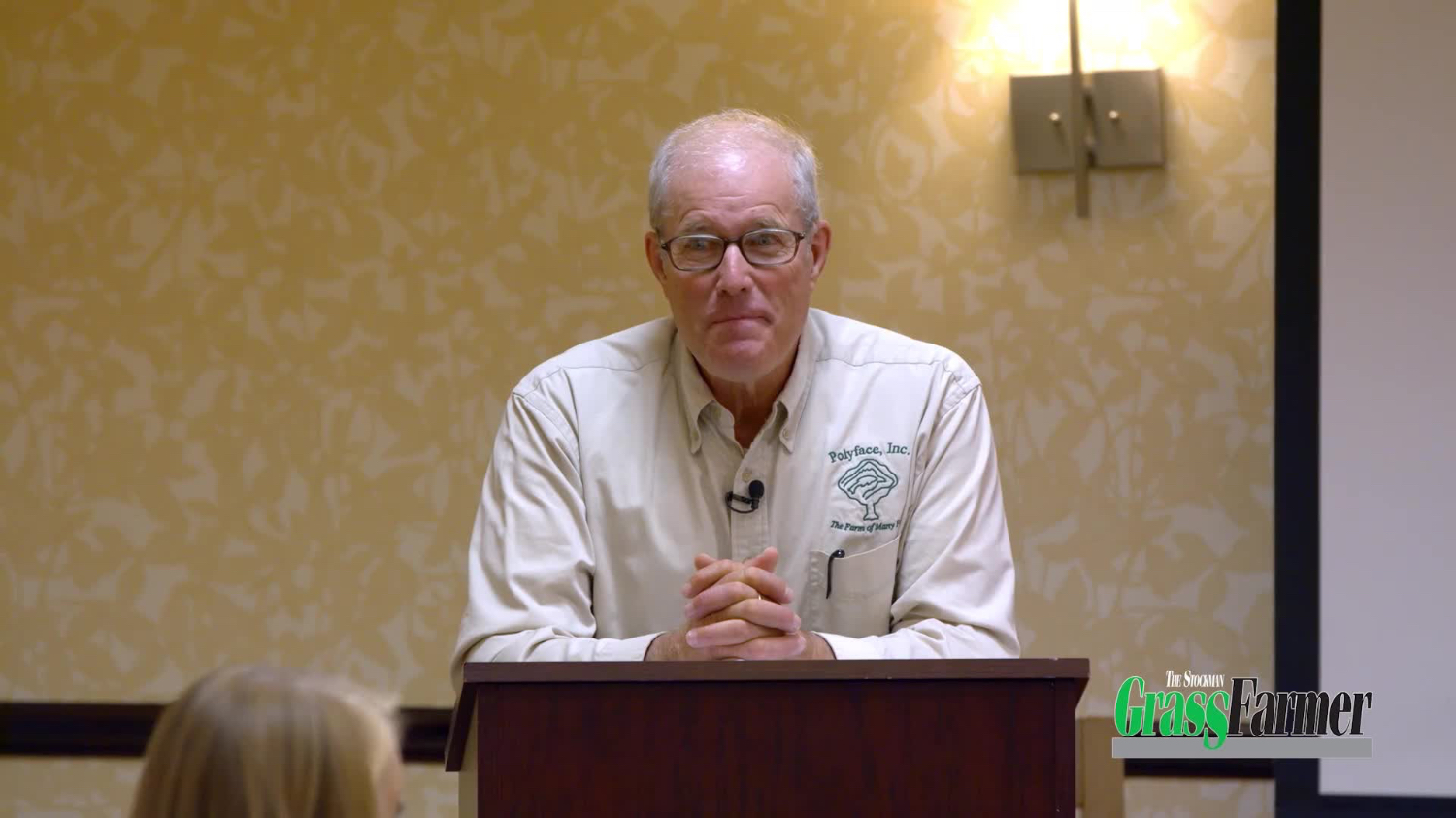
This meeting is being recorded. Okay. I'm here today with Doug McCarty of Spencer Shadow Ranch in Oregon, and he has a fascinating new program that's going to be helpful to all producers all over the United States called the Navigator.
But let's start, Doug, with your background and the background on the ranch. All right. Well, thank you very much. I'm smothered, as they say in the South, to be invited on Stockman Grass Farmer. I actually have some semi-southern roots.
I was born in Charleston, West Virginia, a long time ago, and then raised outside of Philadelphia and have absolutely zero agricultural background in my life up until the time I was 17 when I got a truck ride out to Wyoming with a neighbor and I worked on a hay ranch for the summer in the shadow of Jackson Hole, the Tetons in Jackson Hole, which introduced me to 6,000 foot elevation, big alfalfa fields,
and a giant sky. And I think somewhere planted the seed that I would always like to live out someplace west of the Mississippi on a big place with a big sky. Anyway, I didn't do that. I ended up going to college in Virginia and then law school and became a lawyer after I'd been in the Peace Corps in Korea and was sort of a New York-based attorney and was sent out to Tokyo to help open up a new law office there.
And I had had, this is a fairly checkered background, but I did a lot of languages and I did graduate school and I did law school. So I was a point guy for Korean and Japanese clients and worked out there.
And it was a tremendous amount of fun, wife and two kids, and then came back and forth, New York, Tokyo, New York, Tokyo, Hong Kong, and eventually decided that we wanted to return to the United States and set down our roots here because our kids were 12 and 10 and either they were going to become Americans rooted in a place or they were just going to become expatriate kids, you know, sort of untethered.
So that's what we did and ended up in Eugene, Oregon, which is a fantastic place for anyone to live. It's got great climate. It's got the mountains. It's got the snow. And I worked for myself trading securities and I wrote a book and was having a pretty good time with my life.
And our son went to Tokyo and was trading Japanese government bonds. And he wanted me to help him get a real estate investment in the United States. And everything we looked at didn't look very good.
But eventually this ranch opportunity came up. And I asked him, I said, would you like to go in on this with me and buy this 340 acre cattle ranch? It's the last piece of a very famous cattle ranch out here in the West.
And he said, sure. And then my wife agreed. And that was 12 years ago. And we bought the ranch. And then we were faced with the problem since I was a suburban kid from Philadelphia of what do you do with a 340 acre cattle ranch which hasn't had cattle in 20 years and has just been hayed and lots of the nutrients taken out of the soil.
So the answer was went to the library and got two or three books by Joel Salatin, who I'd never heard of, except somebody mentioned salatin tractors. And I thought, well, what's a salatin tractor? And it turns out it's a chicken tractor and it's not a tractor at all.
It's a mobile cage. But like a lot of people who get into this, you have a vivid imagination of just what you're going to do. I mean, you're going to rotate six different groups of animals over the same pasture and enrich it and trim it.
And you'd have, you know, you run the, I guess, the cattle first, then the sheep, then the goats, then the chickens, and then I don't know what comes next. But so we did that. And I got a permaculture certificate from Jeff Lawton, a guy who runs his course out in Australia.
And I would say getting a permaculture certificate was probably one of the best things I did. It was probably the best $1,000 I ever spent because it got my mind in the framework of thinking about the slope of the land and where the sun is and where the water is, and thinking about not making category one mistakes.
Because you make a category one mistake and that's a mistake where the only way to fix it is you just rip it all out and you have to start over. So if you put your chicken coop down in the bottom of the ranch, then every time you want to take manure up to the top, you've got to take it up to the top.
But if you put the chicken coop up at the top of the slope, then all you have to do is either put the manure into some water source that you'll take it down or you wheelbarrow it down. I mean, gravity is your friend.
So that was a good way to get started. And, you know, in 12 years, we have a lot of interesting stories about what we learned, how to do things and how not to do things. And then we learned how to live in the country as opposed to living in the suburbs or the big cities.
I mean, I lived in a city of 30 million people for seven years in Tokyo, and then 25 million people in Seoul for, I guess, maybe two or three years of my life. And then Hong Kong is 6 million or 8 million, depending on how you count.
And suddenly we're down in Eugene, which has about 100 and now about 170,000. But the ranch is really closer related to the town of Cresswell, which has, I think now, 6,000 people. So that's really where we've gone from 30 million people down to 6,000 people.
And your son is actively involved with the branch as well as the navigator program, which we'll talk about. Right. Yeah, we'll get that. No, he's not. He's actually, he's an interesting story. He moved to Tokyo after college and has been there ever since.
And we keep trying to get him to come back. But the way we run the ranch is you're looking at the workforce right here. And so we have to figure out a way to involve permaculture, sustainability, and a one-man show.
And so we've reduced the number of the animal groups that we have. The last one we reduced, we finally got rid of sheep when the sheepdog died. And so now we only do cattle. But at one point, we had cattle, pigs, sheep, layers, meatbirds every summer.
We had the whole polyface kind of thing going, but we didn't have any interns and we didn't have any family members. And it was basically, I would gather together volunteers to help process chickens.
And there were so many fragilities involved in doing that. The equipment could break, people might not show up. The equipment could break the morning that people show up and then they look around, they're getting frustrated with you.
So it just became easier and easier for us to sort of focus on cattle and sheep. And then when the trusty sheepdog died and we could not find a candidate that would bond with the sheep, instead, every single great Pyrenees that we got bonded with us and just wanted to hang out at the house.
So then we ended up with just cattle. So that's where we are. And James, our son, still works in Tokyo. He's an entrepreneur over there. But he called me up, I guess, in January and said, hey, dad, remember all those problems you had trying to understand the government thing?
Why don't we create a website that could help everybody, producers and agents, sort of get on the same page and get them over that hump of not knowing the way things work. And then once you do that, you get over the hump of not knowing the way things work.
You say, well, okay, let's at least get them through all the basics. Like this is what EQIP is. This is what CSP or CREP is. This is where you might be qualified. This can streamline your process. This is not sign up with this and get a check for $200,000.
It's this is the way the process works and this is where you can go and you can talk to the USDA and figure it out. So then we just went back and forth. Practically every night we have these phone calls and it's 11 o'clock his time and it's, or in the morning it's 7 o'clock, then 11 o'clock.
And then at night, it's 7 o'clock and then 11 o'clock a different time of day. And he'll take some time and sort of say, well, here's what I was thinking about. What do you think? And then it's my job to market this thing and, you know, write articles or, you know, do cold calls.
And that's kind of where we got very quickly. And now I'm talking to the head of Stockman Grass Farmer and very thankful for the opportunity. Well, we're grateful for you too. It sounds like a fantastic program to help our producers.
So tell us how it works. Okay. It works. The first thing we did was we created plain language explanations of all the important programs so that if a producer, if he hears the word EQIP and doesn't know how to spell it because there's a specific spelling, he can go to or she can go to our website and just say programs and run through, I think there are 18 or 19 programs there explained in plain English,
very plain English. In fact, I was told to edit them all to make them sound like me. And that's the hardest thing with government programs is that I think it's the hardest thing because once you go into that kind of governmentalese prose or, you know, it's like medical prose or academic prose, it's just not meant to be consumed.
It's just awful stuff. So we didn't dumb it down, but we explained it so that people could understand it. And so the first thing is an education, education is a little bit strange. It is education, but it's also a how-to program saying, okay, these are the four things you need.
This is what you need. But what I told James was, it's great to do this, but farmers are not thinking about that stuff all the time. They think of that stuff maybe once a year. I would like to get them educated and thinking about it every day if possible.
So we designed a dashboard and a dashboard is simply an updated data display of the things that are important. And normally what a dashboard would be would be national information markets, you know, boxed beef is this much, blah, blah, blah, you know, corn, soy.
But then we saw that it was possible to have the producer plug in his zip code and we would get the count down to the county information for this for this dashboard. And so like I have my ranch on it and it says Lane County, Oregon, here's your water levels.
Here's your drought warning. Here's your reporting requirements for you today and tomorrow it will update. If you've got a deadline that's 23 days away today, tomorrow it'll tell you it's 22 days away.
It'll be like a countdown. Where do you get that data? Where does the data come from? Data comes from public sources. We just have a program that scrapes it and loads it in. Okay. And then what do they do then?
Well, this is the beauty of the dashboard is, or what we call it the pulse because we thought as a, you know, if you're going to write articles, you could write an article that check your pulse. And, you know, this is your pulse of your farm.
It can be accessed by the phone or by the computer. And then also, if you just say, yeah, send me the email, we'll send you a morning email with the data for your county, your farm that day, every single day.
And it just kind of seamlessly works to get better information to what I call Mr. and Mrs. Farmer, because I assume, based on the way we run it here, that someone is out on the tractor and someone is at home doing the books and figuring out stuff.
And that if we get the information to both of those people, they can talk about it and can say, hey, you know, we could build fences. They say, no, they're too expensive. Well, you know, EQIP can, and the way EQIP and these things work, we could get 75% of it covered.
And you say, wow, that's almost a free fence compared to, you know, I don't know, $6 a linear foot or whatever it is for high quality fences. They also support water systems, you know, water tanks, which are quite expensive and complicated, creek crossings, you know.
Anyway, the concept is to create the pulse or the dashboard, which is very sticky to the farmers, Mr. and Mrs. Farmer. They can talk about it and say, before you go to work, why don't you send an email to the NRCS guy or the FSA guy or girl or whoever and see if we qualify for this program or see, you know, hey, I think we're in drought.
I think we could get a drought payment because we have this number of acres or we have this number of livestock. Can you just send them an email and check on that? That stickiness then, we hope that they go back to the website and study up on these things and say, well, you know, there's this program.
Some of the stuff is very hard to understand, I think, unless you have done it yourself. So for crop insurance, I've never done crop and I don't know anything about crops. I'm from Philadelphia. But, you know, it's, and I know what insurance is, and I know what futures contracts are, and I know risk management, hedging, and all this stuff.
But unless you actually have, you know, a thousand acres of soybeans and you're looking at, you know, the markets and you're looking at how much your inputs are and what your risk is and what you're willing to tolerate, unless you have that visceral experience, it's very, very, very hard to understand it.
Now, these producers who do that have the visceral experience, but they may not intuitively understand the varieties of things that go on in crop and the federal crop insurance. You know, the feds apparently pay 90% of your premiums for crop insurance.
So if I was a crop insurance, if I was a crop guy, I'd say, I have to buy this stuff. I mean, somebody's paying 90% of the premiums. You know, what a discount. So the fact that. A lot of producers, because they're not, they're afraid of or don't understand the programs, they're missing out.
And you're helping to make it easier so that they don't miss out on opportunities. Right, exactly. And I mean, it's not people don't have to do this, but as I like to say, especially it's crop insurance, you don't have to do it.
But if you don't do it, you might need some help. You might be crazy. Are you working with Canada as well or just the United States? Just the United States. I think it would be a bridge too far to try and understand Canadian regulations.
But, you know, if it's not, if that same kind of information is available to be scraped, as we say, scraped and then reformatted and presented to people, I mean, why not Canada if there's enough people up there want to learn this stuff?
My feeling about Canada is those places must be huge. Right now, it's a free service. So what are the frequently asked questions that producers have for you? It's a little early for that because we're just rolling it out.
I've gotten a couple of questions from the agent side of things, like, you know, is this the way the lending goes? Is this the way CSP, which is the conservation practices thing works? And there are always technical questions like based on the newest guidance from the big, beautiful bill.
How many people are involved with the navigator? Is it just you and your son? It is just the two of us. Wow, that's a lot. That's it. Okay. So how does someone contact you and get started with the navigator?
It could not be simpler. You just go to farmersnavigator.com and go to the pulse and just click on that orange button and put in your zip code. You don't have to put in any personal information. It's not really personal information anyway.
You could make up your farm. You could do it. You could have a 500-acre farm down there in Mississippi and just enjoy yourself. Except I just have a Bassett hound. Well, you could live the fantasy life of a 500-acre cow-calf operation.
Anything else you want to add before we end? Yeah, I mean, I guess overall, I would say what I've learned and what this is also part of is that at my age, I think you're looking at different things. And one of the best things about being older when I do this is that I'm not chasing after anything that is not small, that's not big.
I mean, everything is a huge concept. So we start with sustainability and moral philosophy and the function of grace in the world. And I think the FSA in particular and also NRCS here in Eugene have been so kind to me, taking pity on me because I just couldn't understand this stuff at all.
And I couldn't remember how these things were. And I thought, well, let's pay it forward and let's see if we can create something that's sort of cutting edge and people will go to and stay with and learn from.
And then they can spread the news and be talking about it at their local breakfast place or over the dinner table. And the other thing is I think in my 12 years of being a cattle rancher, I think the most important thing is to make the ranch better every year.
And that's an expensive proposition because of the cost of fencing and gates and water and everything like that. But if you do make it better every year and if you really watch your input costs and you keep creating a better marketing plan every year, it will actually organically grow and become a better place every year.
So our place is 12 years better than it was when we got it. And I think in another 12 years, it'll end up being 24 years better than when we got it. And a lot of that is going to happen just because of what we do.
But if we can understand the system and get a little bit of financial help for the hardscape on this place, then that's great. And other people should do it too. The other thing I think is I'm not in competition with anybody.
Everybody who runs an agricultural operation will, if they're doing it right, will do a specific operation that is sustainable to them. And they'll do it differently than the people next to them. And we can learn from each other without there being any, you know, it's not a zero-sum game.
It's a win-win situation for everybody. So that's my thing. I want everyone to win. So I'm trying to promote this and get everybody to use it. I think that's wonderful. I think it's a great resource.
And you can read more about it in the Stockman Grass Farmer Future issue. So thank you. Thank you, Jug. Appreciate that. Well, thank you very much. It's a pleasure to meet you and a pleasure to be part of this big deal here.
Okay. Let's see. I can't find to stop it.