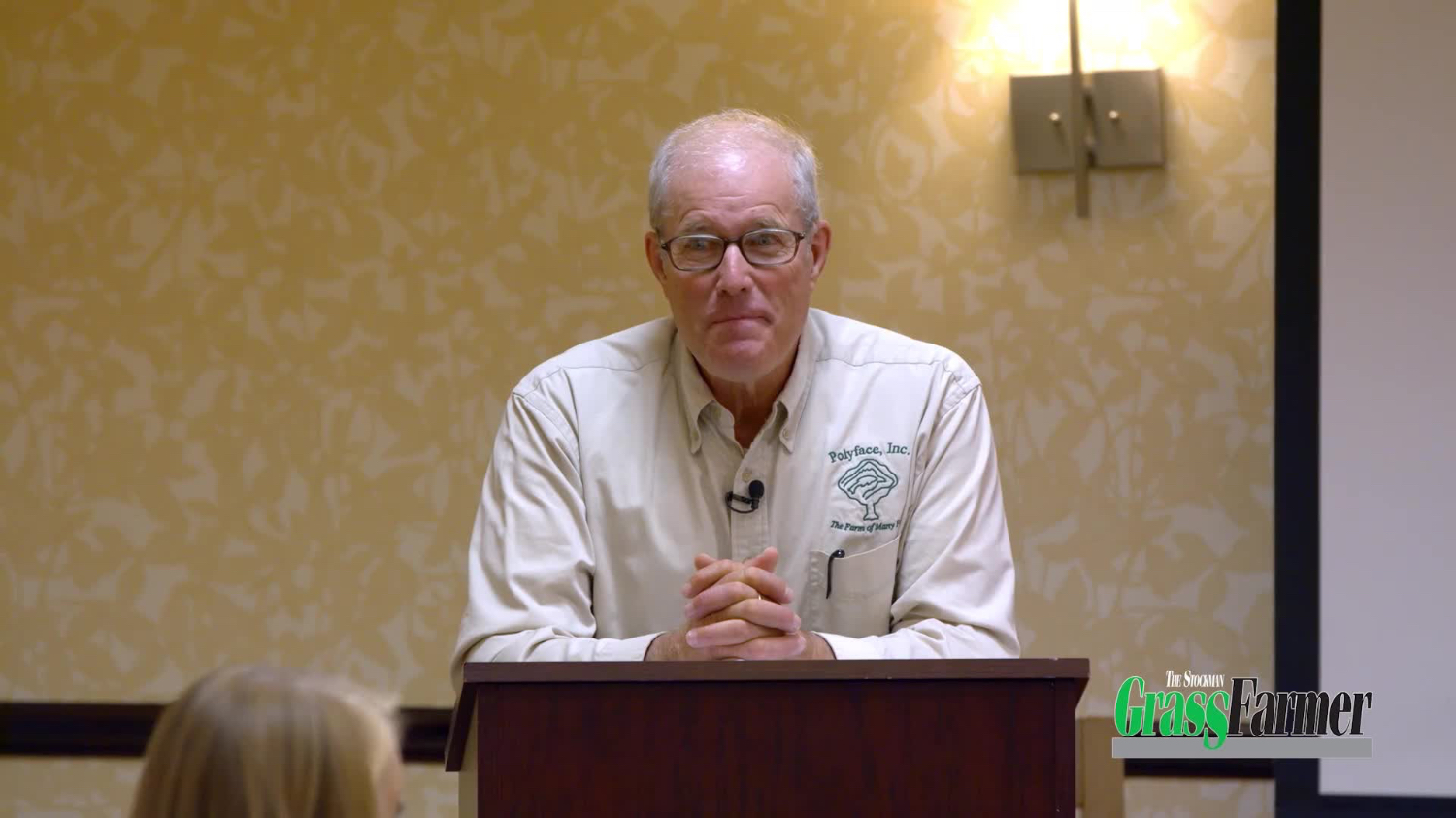
I'm here today with Rebecca Pierce, who's written a book on agri-energy. And she also has experience with grazing under solar cells. So let's start with the solar cells. How do you find out who has the cells to get permission to graze underneath it?
Where do you start? So that's a really good question because sometimes it is a lot like, you know, looking for a needle in a haystack to not beat that cliche to death. Our first contract that we got, just for some context, we currently graze about seven different solar sites in upstate New York.
And so we're spread out across four counties. Our first site that we got the contract for was actually just a friend of ours. It was actually the farmer, the pair of farmers that sell us our hay for our sheep.
They were putting in solar on a chunk of their land and they really didn't want to see the land just go fallow, right? They didn't want to, you know, they were excited about this opportunity to put in solar because it would help offset expenses and would provide them with, you know, a pretty generous lease agreement.
But at the same time, they've been farming for their entire lives and they didn't want to see that, you know, just lie unused. And so they approached us and helped kind of forge that initial connection between us and the solar developer.
That was back in 2022. So since then, we've grown our farm substantially and added quite a few, you know, half a dozen more solar sites to our portfolio. And really, it's just a lot of detective work.
So we do work with a company called United Agrovoltaics, which sort of operates as a cooperative system for farmers like ours to help them get their foot in the door and connect with other people who are grazing and connect with developers who might be looking to have sites grazed.
So we work with them for a couple of our sites, but the rest of them have really just been digging in. So looking at projects that are being constructed, reading town board meetings, talking to people who are involved in planning decisions for the communities that are local to us, and finding out who the companies are that are putting in these projects.
One of the trickier pieces of it, and I don't know that a lot of people realize this, is that often the company that builds a site and constructs it and goes through the permitting process isn't the same company that's going to be responsible for the O ⁇ M, for the operations and maintenance and management of the site once it's live.
And so sometimes it can be a little bit tricky. I always compare it to being like that old game telephone where you whisper something in somebody's ear and the next person whispers it in the next person's ear.
And then by the time you get to the end, the message is totally confused, right? And so it's really important for us to keep open lines of communication and follow-up constantly and just keep honestly being a little bit of a gnat sometimes, being a little bit annoying in trying to make these connections with solar developers to get the message out about what we're offering.
Well, you've got, you mentioned several different locations. So obviously in that area, people accept the solar farms. I know there's a lot of controversy of people who don't want it. How do you deal with that?
So I would say there's, you know, there's still a lot of controversy. I think probably anybody who's listening to this will see that in their communities to some extent or another. But what I will say is that these sorts of systems really help offset a lot of the opposition to solar.
I think one of the biggest complaints people have, and it's a valid one, is that they're worried about solar eating up prime farmland in the United States. You know, and we always counter that when we talk to people, we say, you know, not only does a model, you know, what we're offering through solar grazing, not only does it allow that farmland to remain in production for the lifespan of the solar farm,
20, 30, you know, sometimes 40 years. But in many cases, what we're seeing is the lands that we're grazing weren't actually prime farmland when they were developed. They were maybe farmland that had laid fallow for a while.
Maybe it was land that was heavily treated, conventionally farmed. Maybe it was land that wasn't farmland at all, something like a brownfield, or even just not great land in general. And what we're seeing is that we're actually capable of turning that some par land into additional farmland, which, you know, as we're losing acreage in the United States, I think that's something really valuable to pay attention to.
Is that just by grazing alone or do you have to restore the soil or what do you do? Grazing alone. And so I talk about this a little bit in my book. There's been a few different studies that have come out now.
And, you know, in many cases, it's too soon to know the long-term impacts just because solar development is relatively new compared to other forms of energy generation. But what these studies are showing is that purely through rotational grazing, which for the most part, I mean, I don't know any solar farmer who is doing anything but rotationally grazing if they're using livestock.
This isn't a system where you can just set stock and leave them. You really have to be very intensive in how you're managing those animals. A, you know, for all of the same reasons why you need to be intensive when you're doing any other kinds of rotational grazing, but also because our job as solar farmers is not only to care for the health of our animals and run our farm in that box over there,
but also we're providing a service to the solar company, which is vegetation management and making sure the vegetation doesn't reach a certain level where it's shading the panels. And so we need to be really proactive and really intensive about how often we're moving animals.
And through that, through that managed intensive rotational grazing, we're improving soil health in areas where it may not have been great to begin with. Well, you're grazing sheep alone or other animals?
So we right now are currently just grazing sheep. There are, and I say right now because there are quite a few other farms around the country who are experimenting with other livestock. Cattle voltaics is actually something not a lot of people have heard about.
We're really excited about it and it's something that we're pursuing hopefully in the near future, which is, as you might guess, grazing cattle under solar panels. Obviously, that presents some more challenges just because they're a lot bigger and they behave differently than sheep.
But I think developers and the industry as a whole is really recognizing that, you know, America loves its beef, right? And we're currently at a point in the country where we need to find a better solution to improve the numbers of our beef herds and to make it easier for cattle ranchers to make a living.
And so I think there is a demand there to start adding species like cattle. And really, you know, a lot of that just has to do with things like raising BRAs, getting those up a little bit higher off the ground to make them easier for cattle to maneuver around.
Sheep are really, like, I always call them the plug and play option for solar because you can put them on virtually any solar farm and not really have to do anything in terms of modification. They don't chew on wires.
You know, they're not like goats who are going to jump on the panels. And they do a really great job of nibbling down that vegetation and they love it. You know, I always joke that they're a 24-7 work crew that we don't have to pay workers' comp to.
So yeah, lots of other animals as well, besides sheep, besides cattle. I know folks who are doing things like pastured poultry. There's a gentleman down in central New York who is even raising pigs on solar sites.
So there's plenty of opportunity to be really innovative and unique here. Well, I would say that probably because they want to jump on the panels that goats are not the best choice for animals. Right now, I would say, you know, people ask me, does anything not work with solar?
I would say right now, goats are probably, you said it, goats are really the only ones that aren't super compatible. But also, you know, never say never. For a long time, people said cattle would never work on solar.
And now we're seeing it happen in real life. So who knows? Maybe 20 years from now, we have goat proof solar panels. I don't know, but yeah. Well, and I think you mentioned that you've seen vegetables grown underneath.
If so, how do you harvest them? Yeah, that's a really great question. And there's been quite a bit of research done in this area as well, because I think, you know, when this whole idea of agrovoltaics and agroenergy first came onto the scene, it was really sheep, sheep, sheep, sheep, sheep.
And sheep are wonderful. I love sheep. I'm a sheep farmer, but I don't know anybody who just eats lamb, right? So we need to diversify, you know, what we're able to produce under solar. And so for the most part, if we're talking, you know, things like vegetables, to date, I think what's being done at scale is a lot of, you know, hand cultivation, hand harvesting and things like that.
But with this, you know, explosion in interest in being able to broaden out what we're producing on solar farms as in terms of crops and commodities, a lot of developers are getting really creative in terms of things like, again, the height of the arrays, so how far they are off the ground, and also the spacing between the rows.
So there are quite a few studies going on, and actually people who are doing this in real time in places like Illinois, who are getting around the issue of the tight spacing simply by using smaller equipment.
A lot of the older style equipment, one gentleman told me, is really compatible with a lot of these existing solar sites, simply because it's not as bulky and it doesn't require as much of a turning radius.
There's also folks who are just experimenting with different ways of installing the panels. So maybe instead of your traditional fixed tilt, you have a vertical bifacial. So instead of the panel, you know, being installed at an angle, it's completely upright.
And so that, you know, reduces the amount of space that's needed and makes it easier for larger equipment to maneuver around it. Because of this, you know, we're seeing folks, and I talk about them in my book, who are producing everything from hay to sweet corn, tomatoes, peppers.
I even spoke with folks who are growing, who have a cranberry bog and they are producing solar power and cranberries on the same plot of land. So if there's a desire to do something, there is absolutely a way.
And I think the industry is evolving very quickly to do that in a way that is cost effective, both for the farmer and for the solar developer. Now, aside from the free grazing underneath the panels, are you paid by the solar company?
Yes. And so this is something I talk about a lot because it's really been life-changing in terms of how our farm functions. I don't think it's any secret to anybody who would listen to this that farmers in America are really struggling and it's really challenging, especially for a first-generation farmer, which both my husband and I are.
You know, we started this completely on our own with no land. We had to purchase our own land. And it's tough. Land is expensive. Without those resources, both in terms of land and in terms of just the knowledge that you need to get started, it can be a big barrier.
And so being able to get paid by the solar company to do the vegetation management, you know, we are paid in lieu of them paying a traditional landscape or a mowing crew. That's been life-changing for our farm and it helps offset a lot of the expenses that I think otherwise cripple small family farms.
Are any government subsidies involved? Not for us. No. You know, some of these sites may have been developed under previous initiatives from the federal government or the state government. We don't receive anything in terms of external funding, if that makes sense.
What are the solar panels made of? I mean, people are concerned about that and talk about that. Yeah, so there's this big concern that, you know, I hear this a lot, that people are worried that the panels are going to leach heavy metals or chemicals into the soil, right?
And I think what a lot of people don't realize, we actually had somebody out to one of our solar farms one time, you know, another person in the agriculture industry, and they tapped on the panel and they kept tapping and we're like, what are you doing?
And she's like, well, these aren't leaking. And we're like, no. And she's like, they're completely covered in glass. And it's like, yeah. So, and that's for the most part. Panels are almost entirely glass.
You know, so not only are they not leaching anything, you know, these units are designed to be hail proof. They're designed to be hurricane proof. It takes a lot of force to break one. So, you know, people will be like, well, what happens if like a tree falls on?
What happens if, you know, there's a hailstorm? What happens this, this, and this? First, you know, the first thing is that probably nothing's going to happen because they're built strong. You know, they're installing these things in places like Florida and Puerto Rico where, you know, it doesn't logically make sense to install something that is going to break so easily under weather conditions.
So that's thing number one. Thing number two, if they do shatter, it's just glass. And I say just glass because obviously nobody wants their animals traipsing around in broken glass, right? But you're not going to have things, you know, like those heavy metals leaching into the soil.
There are, you know, there are some metals that are included in the construction of panels, but it's not anything that's more dangerous than what you would find in any other kind of construction. And it's at a very, very small percentage.
So like I said, most of the panels are composed of glass. And then the rest of that, any of those other heavy metals are going to be at very, very small quantities and they're fully sealed. So they're not going to leach into the soil, even if something does happen.
There have been studies, and I actually know one of the other farmers that we're pretty closely connected with, he's gone so far as to test the meat of his animals after having them graze on a solar site, and there wasn't evidence of anything found.
So I think it's a very valid concern, but it's also really important to remember, you know, a lot of the agricultural lands that we're currently grazing on outside of solar are also really heavily contaminated with heavy metals and with PFAS and things like that.
I think it's something like 20% of all ag land in the United States alone is heavily contaminated at toxic levels. And so it's really important to remember that solar farms aren't necessarily, I know they're new and it's easy to be scared by what looks like very industrial structures.
But if you're concerned about that, I encourage anybody who is to visit one and you'll see that they are not nearly as intimidating up close once you get there. Okay, now let's talk about your book. It's Agri Energy, Growing Power, Growing Food, and it's by Island Press.
Talk about what it covers. Yeah, so I originally started thinking about writing the book in 2022 when we got our first solar contract. And the reason why I wanted to write it was because at the time, I, like a lot of people, was not a fan of solar.
I had a lot of the concerns that we've talked about today, like, you know, with the metals and with this idea of installing systems that I, you know, at the time, I was like, ah, these things are going to break down in 10 years and people are going to have to pay to clean them up.
I know now that's not true. But at the time, I had this idea that us grazing on solar was really just a financial means to an end. I was like, this is a way for us to offset some of our farm expense, to make a little bit of extra money.
But it wasn't really anything that I was like passionately and profoundly behind. So I was curious though, you know, as I had these thoughts, I'm like, what other opportunities might exist to farm, you know, around renewables or to take advantage of renewables in farming?
And so as I started writing this, I found myself shifting, you know, my perspective shifting from being somebody who viewed this solely as an economic means to an end to now I am, you know, incredibly outspoken about this and incredibly passionate about it because I really see it as a lifeline for America's farmers in a way for us to produce energy, both for our farms and for our nation, in a way that bolsters local communities,
that keeps power local, and that keeps food local, because really that's what we're doing. You know, all the sites that my husband and I graze are what are called community solar sites. So the power that is produced at those sites is, it stays local.
It's not being produced and then shipped out of state or shipped to a metropolitan area. It stays local and people are able to tap into it by getting a discount on their on their monthly energy bills.
And so I think that's a really important piece. And I talk about that a lot in my book about how these sorts of systems can really strengthen small towns and how they can strengthen small farms. So the book looks at agri-energy from my perspective and what I've done and my husband have done, kind of our boots on the ground approach.
But then I also interviewed over 50 different other grazers and farmers. So people growing everything from tomatoes to cattle to pigs, as we talked about before. I also interviewed developers and researchers.
So people who are looking at things like concerns about soil contamination, concerns about erosion, soil health, wildlife. So kind of tackling all those concerns that people have about solar, and in particular, about solar and agriculture.
I talk about all of those and then slowly pull them apart and talk about what's true, what's not true. You know, and it's not all rosy. You know, I do criticize a little bit where we still have room to improve in these relationships and where I think the industry is headed in the next few years as well.
So that's kind of the high-level overview of the book. It came out in November, so it's still pretty fresh. And how will people be able to get your book? It's anywhere books are sold. So Amazon directly through Island Press, Barnes ⁇ Noble, I believe, carries it.
A lot of smaller independent bookstores have it as well. Yeah. And we also hope to see more articles by you and the Stockman Grass Farmers. So we'll keep you in touch with that. Thank you so much for a great interview and the best of grazing.
Awesome. Thank you very much. I really appreciate it. Okay.