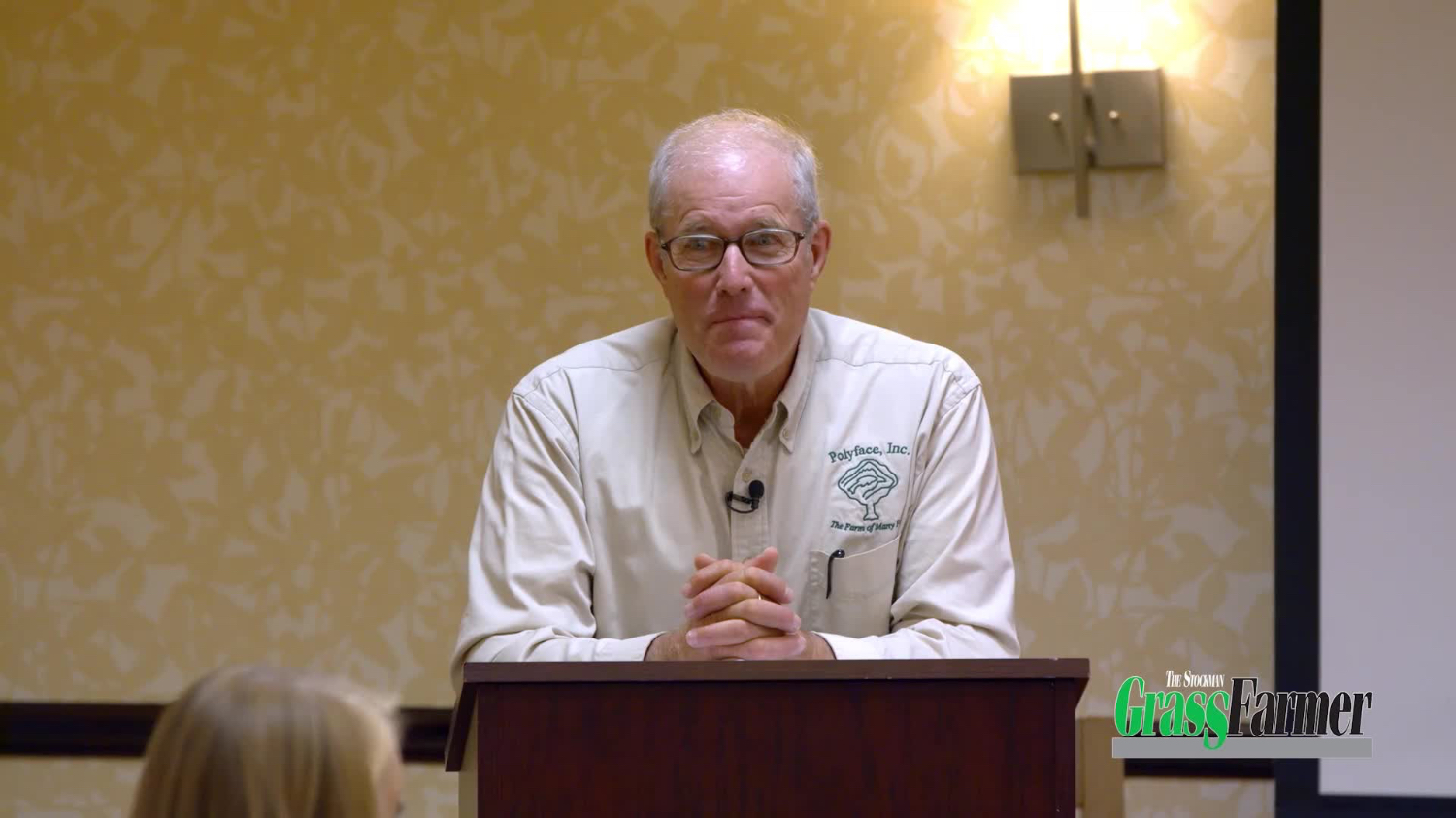
Jordan was a Polyface apprentice when? 2001. 2001. So 20 years ago. Jordan was an apprentice here. And then he did an interesting thing. He didn't come from a family with a big farm or anything. So he put an ad in Stopman Grass Farmer.
Started a little side hustle business out of here. I'll come and prime your pump. And, you know, I'll come and help you get started. And I don't know. In like 48 hours, he had like 20 calls or some outrageous thing of people that wanted him to come and help them launch their, especially with Pasture Poultry, that Pasture Poultry Enterprise.
And he had several packages, a three-month package, six-month package, and very, very creative, very entrepreneurial, and very well received. And then pulled a stint in the Marines. And after that stint in the Marines, then met Sherry's sister and got married and settled back in the area.
And they've been truly bootstrapping up a farm from the ground up. And he's now become my partner in crime in our pork production school. We do this Potman Grass pork production school. We don't pharaoh pigs.
We buy a lot of our piggies from Jordan. Jordan's really fallen into this wonderful pharaohing niche for, and it's not all been a picnic, been ups and downs like everything else, but he's a great partner to teach with at the Stockman Grass Pork Production School.
So I know we'll talk about other things besides pigs here. And if you like what you hear, you might want to sign up for a pork production school at some time in the future. That's a little ad in case you didn't, in case you missed it.
All right. So without further ado, Jordan, come on and talk to us. All right. Everybody hear me okay? All right. So it's truly an honor to be here with a lot of the legends of the regenerative grazing community.
Yeah, I really do feel like a turtle on a post. Has everyone kind of heard that kind of joke? You see the turtle on the post out in the farm and you're like, how'd he get there? But you know he didn't get there himself.
Someone put him up there. And all of us stand on the shoulders of other people who have come before us. And it's our job to take that on to the next level. So Joel kind of spoiled it a little bit there that I came through here back in the day.
Like this was so long ago that there was one rental farm. But it was a great experience. It was a much smaller, more intimate program at that time. We were heavily integrated into their family and taken in.
My roommate Brad and I, we lived in that little shed right across the pond. The apprentice cottage, which was our little hooch of combat outpost is what it became because a lot of 22s were shot out the back window into the woods back there.
I'm originally not from Virginia. I'm one of those bleep Yankees that moved into the area. I was born in upstate New York, moved here about two years before the Y2K crisis that nearly destroyed the world.
If those of you old enough can remember that. My parents took it very seriously. We moved here to Virginia. And it was about that time that a friend of ours found Joel's pastured poultry book. And like, we got to prep for the apocalypse now.
We're going to have to grow all of our own food, so we better learn how to do these chickens. Of course, the first chicken pen was made out of two by fours and weighed about 600 pounds. Okay, I made that mistake.
And we got to our first processing day. You know, this was before Featherman and all these other companies around that you could get some nice gear. So we were like, how are we going to do these things?
So we had a big, you know, apple butter cauldron over the fire, and that's what we dipped them in. And our buddy, our partner in crime in this chicken venture, he had an idea for plucking. He was like, I have a dirt bike.
We're going to mount it on the back of a pickup truck and we're just going to put it in gear. And someone will hit the throttle and it will spin the wheel because it's got this knobby tire on it and it will plug the chickens.
Well, none of us was smart enough to realize we should have put it in reverse so that the feathers were flying down. It was in drive, so the feathers were coming right up into our face. So we came down here at some point to see the farm.
Buzz was actually an apprentice at that point, so he gave us the tour. I think Joel was off at a conference. And we got to know the family. And, you know, I said, hey, I'd love to come and work on this thing.
Because at that point, I knew farming was something I really enjoyed. My first non-family job, I called it, because my parents had their own business. How many of you grew up in a parent's business and company?
Any of you guys? Yeah, so you don't remember when you started working. You were just working in the family business at some point. And my first non-family job was working on a local farm about 10 minutes from us.
I was making $5 an hour, which to me was, you know, riches unknown. You know, throwing hay around, taking care of horses and stuff. But they had two confinement poultry barns on there that I was privileged to help clean out.
And if you've ever been in a confinement chicken facility, this one was for a breeding flock. So it was, you know, 40 by 400, and birds go in it for six months straight before they come back out. And it is the worst manure rat hellscape you can imagine.
So I knew I liked farming. I did not like that kind of farming. And we saw what Joel was doing here and asked, hey, I'd like to come learn how to do this farming thing, but not in a way where I've got rats nibbling on my belt line as I'm wading through chicken manure trying to clean out a house.
So I ended up coming down here September 16th of 2001. So it was 20 years ago to the day was when I rolled in here. It was a Sunday. One of their previous apprentices had to leave on a kind of short notice.
And so they came into the home church that we were all part of. And they're like, hey, if you want to come, you can come today. I was like, I got my bags packed. Let's go. Out the doorway. And came here, spent 14 months working with them.
Learned a lot of valuable skills on how to work for other people. That's something that, if you grow up in the family business, can be a little bit difficult is learning how to work for someone else.
Also learning how to start a farm. I helped build up one of their first farms, which was Gray Gables down the road. So that was taking a farm that had just been cow calf or hay or whatever they were doing at that point, putting a water system in, putting in lanes, getting animals over there.
And, you know, we did, I don't know, maybe 8,000, 12,000 chickens. That was back in the humble days, the humble beginnings. But what I learned was, you know, there's a lot of hard work to make this lifestyle successful.
You need to be ready to be up at 5 in the morning for a load up day or if it's a processing day. You also need to be up at midnight if one of your regional distributors decides to roll in at 12.30 to load up.
Everyone who knows Bev might know who I'm talking about. And you'll load him up to go to the farmer's market. You're on call 24-7. But it can be a very rewarding lifestyle. For me, the connection that I had through here dramatically changed my life and that I met my wife through here, as a few of us, former polyface apprentices here, have done so.
But it was towards the end of my apprenticeship here that Daniel got engaged to Sherry, this girl from Texas. And I ended up leaving here when my time was up, which was maybe about a month before their wedding.
And I asked Daniel one day, I was like, are you going to invite me to your wedding? I thought we were bros. And he was like, all right, come on down. So we ended up driving down together straight from Virginia to Texas in a F-250 without air conditioning and roll-down windows.
It's a road trip. It was a good road trip. And down there, I met Sherry's sister Laura, who I struck up a friendship with and ended up dating and getting married to later on. But there were two things that I really wanted to do when I was growing up.
Homeschool, home birth, home everything kind of family. I'd say fairly sheltered. This was before the internet, if you can remember such an era. So coming here was a good experience of leaving the nest, getting out into the world a little bit.
I think you had a term you were using then, Joel, of like a greenhouse effect that you start rolling up the sides and get the young people out into the world. And I knew farming was one thing that I wanted to do.
There was a second thing I also wanted to do, though, and that was join the Marine Corps. They got me with their posters. I saw it at the county fair. It's like those dudes look like a bunch of bad mamma jambas.
And yeah, the challenge that they offer. And so initially when I talked to the Marine Corps in 2001, before I even came here, at that time, homeschoolers were basically not allowed in the military. You were treated as a tier 2 recruit, which is the equivalent of a high school dropout.
They have no recognition of your educational credentials at that point. So I ended up coming here first and doing that. Still kind of pursued the marine thing though. Went ahead and did all the testing for it and kind of had it in the back of my mind, but it was not a viable option at that time.
2003, I was here for a wedding of someone local. And Joel's nephew Nate was there, who's a buddy of mine. And we were sitting at the same table. And he's like, you still want to go to the Marine Corps?
I was like, I've been thinking about it, but what about this DOD policy? He's like, oh, no, they changed that. Because it's 2003. We're at war now. War has a habit of changing government policy, as we've learned over the last several years.
So, homeschoolers, you're all welcome. So he and I went off to boot camp together, August of 2004, Beaufort, South Carolina. Anyone lived there? Been in the low country area of South Carolina in the summer?
Woo! That's fun times. Fun times in the sand. You learn a lot, though, with military experience that you can bring back to the farm. One of the fastest-growing segments in the regenerative ag community right now is veterans who are leaving active service.
We're now hitting guys who have retired from a 20-year career. They joined after 9-11. They're like, we're going to get whoever it is, whoever they send us to go get. It was a lot of them that they ended up sending us to go get.
Not to get too political about everything, but these guys are starting to retire. And there's also guys who are just getting out. They're like, this is getting too political. I want to get out and do something more.
There's a lot of skills that you can bring from military into the farming sector. And so a couple of them I had here was the mentality of never quitting. No matter what, you never quit. One that's a little bit tongue-in-cheek is learning to thrive in suffering.
So anyone who's had to load pigs in the middle of January in the rain and the mud, all right, you know, those of you who are producers, you know, there's those days that don't go on YouTube, okay. But you learn how to thrive in that suffering, to mentally detach yourself from the situation at hand.
The way I look at it is no one is shooting at you. The pigs don't, the pigs have not developed AK-47s yet. So we don't have to worry about them. Another thing was no matter where you are, you're always learning.
Okay, no matter if you're the lowest E1 private in the military or if you are a four-star general, you are always learning the job of the guy above you. Because you never know, in combat he might be killed.
And you got to do his job. You're also always teaching. You're always teaching the guy below you what to do because you might get killed. So having this mentality of always a student, always a teacher.
Pulling those other people along with you. Military does a very good job at imparting a sense of service. And we can debate the politics of it all day. I would tell you, most people who are in the military try to stay as apolitical as possible and keep that out as much as possible.
It's about service to each other, service to a cause, service to a country, putting the protection and needs of others and their well-being above your own, even if it's for a short period of time. So the joke we like to make is there's no ex-Marines.
There's former Marines. So if you ever meet a Marine, don't say, oh, it's my buddy, the former Marine. We're either still Marines or ex-Marines. Because it's a permutation of an ethos into who we are.
It's something that day one, when you roll onto Paris Island, you sit down in the squad bay and the drone instructors come out and it starts from right then. It's integrating you into their culture and into their ethos.
For the Marine Corps, it's honor, courage, and commitment. Having the honor to yourself and other Marines that are with you, having the courage to do the right thing, even when no one is looking. And that's something they tell you in their little welcome speech.
All right, and then commitment. Commitment to each other, commitment to what you believe in, to your brothers, to your sisters. So I did that for five years. That was when Laura and I got engaged, was after I went through boot camp and kind of got things going.
We got engaged at Christmas. I checked into my first command May of 2005. We were getting married three weeks later and they were like, don't unpack. We're leaving. We're going on deployment. I was like, oh, okay.
Can I get married first? And they were like, you may. So we got married. We camped out in a hotel for four weeks. And then I was like, I'll see you next year. And I left for seven months and went on a deployment.
Laura actually came back here and lived with her sister Sherry. And it ended up working out pretty well for us. Did another deployment after that, several workups. I worked on F-18s. About the most opposite thing to farming that you could think of is fighter jets.
Aircraft carriers, all that fun stuff. The most dynamic work environment you'll ever be in is on the flight deck of an aircraft carrier. You've got what we call cyclic operations, which is one aircraft launching every minute off the front of the ship and one plane landing on the back of the ship every minute.
And that can be done on a continual basis until combat operations cease. Do that for hours, days if necessary. It's a very high-paced, very dynamic environment. But again, it teaches you things, how to cope with stress, how to keep your head on a swivel, because out there it might get cut off if you're not careful.
About 2008, we decided I didn't want to do the Marine Corps as a career. For me, it was, can I do this thing? Can I get through this challenge testing myself? We knew that farming was what we wanted to do.
I just knew that the military doesn't take very many 40-year-old recruits these days. I was the old man in my platoon and I was 23 when I got there. They're like, grandpa. I mean, a lot of them were 17, 18.
The average age of recruits coming out of the pipeline for the military is like 18 and a half. It's a young man's game. So we decided to get out. We wanted to start the farm. And this is where we'll get into kind of the meat and potatoes of the talk here, what can come back and apply to your farm.
Things that we looked for when we were getting ready to come back and start the farm. We didn't just get out and be like, oh, what are we going to do now? Start planning in the future. How many of you have started a farm in the last year or plan to in the next year or five years?
Okay. So there's more of you here on the verge of starting a farm than there are ones who are in that close-up start phase. So this is stuff that we learned over the last 12 years that helped us build our business.
And I hope you find some value here. You need to look for a convergence of opportunity and market. Like Joel was talking about and Sherry, it's very hard to do direct retail if you're in rural Idaho somewhere and there's no population base around.
But there's opportunity to graze cows under a pivot irrigation system, which is awesome. So that's the opportunity that's there and that's the market that presents itself. Look for areas where those begin to converge together.
So opportunity I define as the skills you have, the resources you can bring to bear, and the support elements that are there for you. Interesting thing about the military, there's 30 people for every one trigger puller.
So for every guy who's actually out in combat, there's 30 people who should never see combat. If they do, it's a very bad thing is happening. There's a lot of support elements there, and that's something that's critically necessary for us, especially in the direct to retail space, is this supporting businesses, support elements that do things for us like processing, feed grinding, mineral production,
all these, even down to things like VAC pack bags. There was a shortage of those earlier this year. We had to scrounge around just to get plastic bags to put chicken in. Market, to me, is the influence or control on the price that you charge.
Probably one of the most challenging things faced by the, you know, say the conventional ag community, and I do not hold anything against the conventional ag community. Many are just doing what they can to survive, or that's what they were taught and what they know.
All right. What do they not have, though, in a commodity system? It's control of price. You get what you get. You can influence the genetics and the quality of the cows when you take them down to the sale.
Sure, and that can bump you know 20 cents one way or another. But ultimately, you can never say, I feel like these stalker calves are worth $2.30 a pound. Six years ago, you would have gotten upwards of $4 a pound for some calves, but right now, good luck.
All right, so the more influence or control you can have on the price of your product, that to me is market opportunity. So we came back here. We found a farm that was looking for someone to manage it.
It was about 200-acre place, hour and a half north of here. Very typical what you will see out on the landscape. 50-year-old couple, no children, 200-acre inherited farm. They're looking for some young blood to come do something.
All right. That's what we found. And with a little bit of luck, but also a lot of naivete, we got into it for better or for worse. All right, that particular situation ended up going the worst direction a few years later.
But we had a place to start at. We had access to capital, something that does need to be addressed at some point. Equity can go a long way. You can do a lot of work at low costs, but you do have to have some money to bring into the equation at some point, whether it's money you've saved yourself.
Maybe you were in the military and they dangled you a big fat re-enlistment bonus at some point and you didn't spend it on a Camaro and you put that away and it was overseas, you got it tax-free. Pretty sweet.
When I got out, just a little sidebar, when I got out, the Marine Corps was paying E5s, which is what I was. That's a sergeant in the Marine Corps. If you were a machine gunner, they were paying you $120,000 re-enlistment bonus just in your account the day after you signed up.
That's a big chunk of change. I did consider it. Laura was like, nope. I was like, what about this one? This is EOD. All we do is take apart bombs and IEDs that the bad guys bury. No. I was like, all right, we'll get out and start farming.
And we had an opportunity of market. This was at a point where Polyface had just picked up their Chipotle contract, and they knew I knew their production protocols. Daniel knows my brother-in-law, so he can't get rid of me very easily.
And so we had these conversations, and I think it was like 20 pigs every other month or something like that. And that gave us an immediate cash flow once we got that going with which we could then start building our own retail market.
We got a little bit of efficiency right out the gate. So you get out. Military, contrary to what you may think or see on the news, we actually don't work that much. When you're on deployment, of course, you work all the time.
When you're home, 30 days paid leave every year. Every federal holiday is at least three days off, sometimes four. Christmas to New Year's is 12 days off. You have a pretty easy life when you're back here in the States.
That does not exist when you're starting a farm. We work the first two years non-stop without a break. You do what you got to do to get it done, especially when it's just you and one other person that are grinding it out.
That's the point where your expenditure of sweat equity has its maximum return is at the startup. The more you can preserve that actual liquid capital of your money and burn your sweat equity, you're not worried about efficiency at that point per se.
You're not worried about teaching someone else. You're just trying to get this puppy off the ground a little bit. We paid ourselves, this is 2009, so I know inflation is going up every year, but we paid ourselves $10,000 a year for the first two years.
And again, not a woe-was me thing. That's doing what it takes to get it done. You got to keep the capital in the business. And like I said, that first farm did not go very well. Within three years, the owner of that farm would only meet me in her lawyer's office.
All right. Something I found even more so through now is dealing with landowners, both with ones we've worked with and then other farms, other farmers that I've helped with consulting. When you are working with a landowner, you are working with emotional factors.
You're not working with a logical thought process on the property. Usually, most times you are working with emotional appeal and satisfaction for that person. And for this particular farm, they were not interested in a production farm.
They were interested in an aesthetic farm. So that farm today has a brewery on it, which they built, which does very well for them. And I think like 26 horses or something like that. And that's what's going on on this place.
So we've patched it up. We work, you know, we're fine with each other. We're cool. But it got very tense for a while. And we ended up having to diversify the land base that we were working on. We had some other farms that came on board.
And so from a production standpoint, we did fine. But in the beginning stages of a farm, expect there will be some conflict that you'll have to deal with, whether it's with a landowner, equity partner, business partner, county zoning, whoever.
There's going to be conflict because when you start pushing onto something, you will meet resistance. You'll go through a process of sifting out your true believers. A lot of times these people are in your own family.
All right, but just be ready for that, especially if you are working with family equity and capital. Okay? But we got it off the ground. Joel and Polyface was with us for a couple years on pigs, and pigs became our centerpiece enterprise.
We thought chickens would be, of course, like everyone, like, oh, we're going to be the next Polyface and have 20,000 chickens a year. Not so. Pigs became the thing that was very obvious that we were suited for.
We quickly ran into a problem, though, of we couldn't find enough piglets. It didn't help that I had a farm an hour down the road from me that was buying all the good piglets in the area already. So I had to go get the leftovers.
And by leftovers, I mean junkyards grabbing piglets from underneath, you know, the old 74 duster or whatever it is, pulling these suckers out, abscesses on them, you know, just low, low quality. One producer I was talking to, you know, we loaded up some piglets and there was like a runty female left.
He's like, oh, I'll keep that as a breeder. Especially now, I'm like, what? It was hard to find a good, consistent, steady quality of piglets. We ended up backing our way into a ferrowing operation. We needed piglets for ourselves.
Obviously, we had a problem, so it occurred to us pretty rapidly that probably other people had the same problem too. And it opened up an opportunity for us to build a centerpiece enterprise. And that became a farrowing operation.
So we started out, I think five sows was the first little group that we put together. We basically just took the best females that we had from groups already and went forward with that and started working through crappy genetics.
Any of you guys who worked with animal genetics know that when you start the process of trying to clean up a genetic base, especially inside of a closed herd, first three to five years is going to be fun times.
All the junk is coming out to the surface. So with pigs, that's hernias, you know, squirtle hernias, umbilical hernias, you know, farrowing problems because most pigs are used to having a lot of assistance and drugs in the process and we're trying to make them farrow on their own.
And so it was this process of refining and operation, but the opportunity was there because most of our farms were woods. We can't graze cows in woods, but we can run pigs in woods. That's their natural environment.
And we had the opportunity in the market. Obviously, we started buying our own piglets from ourselves right away. And then Joel and Daniel started buying some. And then other farms started buying some.
And you had to fast forward through the pig section. I won't spill too much of the beans on that because you can come to a SGF pig school at some point, maybe next year. We built it up to now where we're running 230 sows and producing thousands of piglets a year.
A lot of them come here, a lot of them go to the northeast, they go to other farms. But the opportunity for us in the market was there are farms like Joel's, like other big ones that were looking for uniform lots of high numbers.
You couldn't pick up the phone and get 50 or 100 piglets that were homogeneous size from pastured-based genetics in a management protocol that mimics what yours is so that the pigs have almost an imprint of your management program into them already and are more fence compliant and all these things.
You can't do that, at least in 2012, you couldn't do that. And it was a huge opportunity for us. We learned a lot of lessons though along the way. I cannot emphasize the importance of refining your process of simplification.
The simpler you can make the processes you do, and this is coming from the military as well. They have it so Barney style is what we called it. The average military manual to repair our warfighting machines, and this goes from nuclear reactors all the way down to M16s, is written at the fifth grade level.
It's written, it really is military for dummies. But it's kept as simple as possible because that keeps the end result consistent and also the ability to transfuse that process to someone else simple as well.
So when you get into an operation, you start working on it once you've got your sea legs under you is what we would call it. Start working on simplification as soon as you can. Make it as simple as you can, the fewest steps possible.
We also learned that we needed to simplify the enterprises that we were engaged in. By year three, I think we had eight different enterprises going on the farm. We had cow calf, we had finisher, we had ferrow, we had feeder to finish on those, we had egg-laying chickens, we had egg-laying ducks, we had broilers, we had turkeys.
We had a lot of things going on, but guess what? All of them were fairly mediocre. It's very hard to refine and become good at something when you've got too much going on. You spread yourself too thin, you're not going to be able to become excellent at something.
Mediocrity at many things does lead to failure. So fortunately for us, we kind of caught it in time and we were like, you know what, we don't have to do it all. I think we were doing lambs as well. That was another one throw on top.
We had like 120 ewes. So we ended up chopping it down and getting rid of a lot of the operations. No more ducks. Got rid of those. Praise the Lord. We even got rid of the egg-laying chickens. That was like one of the least profitable enterprises we had.
And so we stopped doing that. We stopped doing the lamb. We stopped doing a cow-calf herd. So we still finished beef, but we don't cow-calf them. We were operating on that time about 60 acres of grass.
To me, that's not, you have no scale of efficiency to be doing a cow-calf at that point. So today we do ferrow to finish with pigs, we finish beef, we do broilers, and we do turkeys. And that's what we do on our farm.
And then we want to do those to a high level of excellence rather than doing eight different things at a sub-par standard. So lessons learned from the last 12 years of getting after it here. This is talking directly to each of you that's a producer or you're a farmer in the space.
The number one thing that you need to do is to know yourself. All right, you need to don't lie to yourself. You need to understand what your context is and what your farm context is. Some of you want to just have a lifestyle farm.
There's absolutely nothing wrong with that. There's absolutely nothing wrong with homestead farming. That's absolutely awesome. Some of you want to have 30,000 acres. That's awesome too. But you would need to know what your personal context is, where your fulfillment and satisfaction lies.
You know, what kind of gas you got in the tank. Are you running on diesel in cold weather or are you running on racing fuel? And begin to build the business around what works for you, but then what works for your farm as well.
Don't be jamming square pegs and round holes kind of thing. If you bought 300 acres of mountain land that's all woods, you know, cow cap operation is not in your future. There. Pigs would be. Pigs are always good.
If you are in northern Montana, year-round farrow to finish is not ideal. Farrowing in 30-degree below zero weather, not a good idea unless you like popsicle piglets. There may be a market for that out there.
I've actually had people ask for suckling pigs that were five pounds. I was like, you realize that's like four days after birth? And they're like, yeah, but we want a price on it. I was like, all right, it's $150 because that piglet's worth $120, $130 to us when we wean it.
And the $20 kind of assuages my emotional feelings about it, that I'm going to whack a four-day-old piglet. They ended up going somewhere else. But you need to know yourself well. Second point for lessons learned.
This one might ruffle some feathers a little bit. Land ownership is not farming. All right, land ownership is owning a big piece of property. Operating on land, that is what farming is. And so many times, that's, I'm sure Joel has heard the same thing 10,000 more times than I have.
Someone retires, they've got 200 grand, they're like, we really want to get into the space. They drop the first 180 on buying a piece of property. Well, you got yourself a nice hunting ground, and you can lease it out to Greg.
You've got to keep capital liquid to start the operation. So, what I recommend to people who are getting into the space, which was like 50 of you here, start with marketing, especially if you're going to do direct to retail.
And I think probably 80, 90% of everyone here is in the direct to retail space or wanting to move that way. Start with marketing. And do you know why? Marketing doesn't cost you anything. You can actually start gathering your tribe of supporters who are out in the public before you even raise the first animal.
People are hungry for story. If you look at some of the biggest channels on YouTube, they're not actually doing what they're making videos about. They're talking about it. Anybody have kids who are big into YouTube?
You watch these unwrapping channels, okay? Literally YouTube channels that have millions of subscribers, make tens of thousands of dollars a month in revenue, and it's literally some 12-year-old unboxing toys from Walmart.
And other kids are just watching it happen. The hunger for experience is out there. People love to consume social media. We can talk about the sociology of all that and the effect on young brains and all that, but that's a conversation for Jordan Peterson, not me.
I'm just trying to help you get the farm off the ground. So start with marketing. Start with your story. You can start with the story of we're trying to get to a farm. This is the steps we're taking along the way.
You never know, your first big investor could be someone who watches that video who says, looks like they're doing something pretty awesome. I'd like to bring a million dollars over to this. You laugh, but that happens.
It does happen. So finding a farm, I always recommend starting with leasing. We leased every acre that we farmed until year 11 of our operation. We made a long time before we dropped money into a piece of property because leasing keeps that capital free in the business to flow through.
We'll talk more about that in a little bit. Leasing a farm though, where are you going to look? You're going to look on Facebook Marketplace? You're going to look on Craigslist? I want to lease a farm.
How many people have seen a farm for lease on either of those platforms? Exactly. But leases change hands a lot. But those are built on relationships, though. So you have to get integrated into that community, whether it's what you grew up in or it's one that you're moving into, because the movement of property is going to happen out of sight of the public.
It's building, leasing properties is built on relationships that you have. It's a lot easier once you've got your first one and you can say, hey, come over and see what we're doing here. This is what we're going to do on your place.
This place is three years after we came in, so you can see what's going on here. And we want to replicate this on your place. It's a lot easier when you can do the show and tell. First time is going to be the hard time.
You got to pitch it blind, shark tank style. Okay, operations, the farm operations, what you're engaged in, that is the wealth building tool. That's where you are flowing your capital through a product and you're capturing profit margin.
That is where you build wealth. Land is a wealth securing tool. So when you're ready to secure wealth, it can be secured in land. But a lot of times that solidifies your capital. It's now locked into a piece of property.
There's nothing wrong with that, but just understand that if you pull $100,000 out of your general operating account for the farm and you go buy a piece of property, you no longer have that $100,000 in your operating account.
Next point, distractions. This is so, you know, lessons learned for startups. Distractions are dangerous. Be careful what you get yourself distracted with, especially if it's a new enterprise that we want to add.
We're still trying to figure out these ones, but now we're going to get into glamping. We're going to have our glamping site for people to come in. It's great. There's probably opportunity there. There's probably market there, but you don't need to be chasing it at that point.
The distraction is dangerous. It pulls you off mission. What your initial mission is. Well, we would call in a military mission creep. Anyone heard that term? Anybody know exhibit A of mission creep in the last 20 years?
Called Afghanistan? All right, another one is target fixation. This can be a dangerous distraction because when you become fixated on that target of whatever it is, what am I not looking at? What's going on right over here?
So be careful that you don't get so focused on, you know, we're going to get the cow system so refined that it's automatic. We're going to have automatic gate openers and the cows will move themselves and all that.
You're starting to target fixate because you're not paying attention to the other things that are going on. So a story I've got on target fixation. This was from our early years. I was going out to change a fence charger on a group of animals that was out in the fields.
Opening day of rifle season. Who here's deer hunters? Raise your hand. They won't be shy. No one judges who. There's no vegans. Okay. We're good. It's opening day. The sun is going down. I got to go change this fence charger.
I go out, swap it out. We had a line of round bales by the edge of the field, and I had my rifle with me, of course. And I was like, I'm just going to go stand by these round bales. So I literally walk over there, stand there for 90 seconds, four dozes hop out into the field from me to the end of the hoop house away.
And here comes Big Daddy Warbucks right behind them. Nose to the ground, you know, coming right out. He never saw me. So that hunt was literally over in about three minutes. And I had a nice eight-pointer on the ground.
Now, what was his problem? He had target fixation. He was on mission. He was on his mission. But he was so target fixated that he didn't see me standing right over there ready to drill him with a six five millimeter Swedish mauser.
Okay? And I don't have a clock, Joel, so just let me know when I'm getting there. Focus on what your core enterprise is going to be. We talk a lot in the grazing space about complementary enterprises, enterprise stacking, and all that is legit, 100% true.
That's a way to leverage profitability on your acreage. Typically, that's not your challenge when you're starting, though. You probably have enough ground to start with. It's just getting that baseline of profitability going before you start leveraging in other operations.
So focus on the core enterprise. A lot of times, though, it's going to be something different than what you thought. For us, we thought core enterprise would be poultry. Of course, Virginia is the pasture poultry capital of the United States.
Well, what we kind of overlooked was that means it's probably market saturated. So look for something else that might come up, but focus on that first, build efficiency. The sooner you can build efficiency into a core production model, the sooner it actually starts making you money.
Because, you know, if you raise one chicken, let's say you raise 100 chickens, your labor per chicken is going to be like $15. Well, there's no way that you can sell a chicken for $45. I mean, maybe in San Francisco, but not here.
So what is going to change that and get you into a range where you can actually sell the product is going to be efficiency of scale. I know sometimes that's a dirty word in the regenerative space when we start talking about scale, but it is 100% true.
There is efficiency at scale. And that's where you can start leveraging a core enterprise to start building your capital. After you have built efficiency, then start building the complementary support enterprises.
It's really great for us. We're grazing over 200 sows in the woods year-round. We're finishing out 300 to 400 feeder pigs for ourselves. Those are grazed on pasture, you know, using premier nets like they've got down there.
And what do pigs on pasture do? They disturb, right? They're always rooting, looking for stuff. And so we looked at pigs and we said, you know what? There's a reason the pig disturbs the ground. That is his instinct to do that.
But how can we use that for something that we want to do? Well, what do guys who do crops do? They disturb the ground, right? With big equipment. Well, I've got an animal that likes to disturb the ground lightly.
And by managing his disturbance, I can plant a high-value forage that then I can bring another enterprise in to capitalize on. So during the summer, with our pigs that are on pasture, we overseed with sorghum sedan grass.
It loves nitrogen. Pigs put down a lot of nitrogen. It loves ground that's stirred up. So we seed the paddock one to two days before we move the pigs. The seed's small enough. We found any seed smaller than a sunflower seed, they don't eat much of.
They'll probably eat at some, so don't get treated seed. But they will go to work because they smell it. Like, treats. I must work. And they start ruffling through it again, trying to get the seeds, and they stir it in for you.
Pigs move away before the seed germinates. Pigs don't come back for at least 90 to 120 days. But 60 days after we do that, we've got sorghum sedan grass eight foot high. Then we can bring in the herbivores.
And that's when you can get some pretty amazing stock density on your pastures. The one example I had from last year was we grazed, it's like 60 to 70 mama cows on two-thirds of an acre for 36 hours.
But it was sort of sedan grass that was like eight feet tall. And you couldn't even see the cows in there. You just saw the maize moving around and then it's like going down. And they were very fat and happy from that day.
So you build your complementary support enterprises, depending on a lot of you are on a family farm or you already own it. For us, we were leasing everything. So this was very high in our priority list was mobile operations.
We might have to leave at some point. We try to secure our leases into long-term arrangements or lifetime arrangements. But of course, that can be broken. The most contractually airtight contracts can be broken in most cases.
So we wanted mobile operations. We call it zero footprint mentality. So if we needed to leave, we could grab everything in a reasonable amount of time, pack it up, and be off the farm and go somewhere else.
So like all the brooding facilities on our farm are sea containers, because what can you do with a sea container? It can go down the road. And what's great is you're not going to take it down the road with chicks in it, of course.
So you have great storage facilities to put all your stuff in if you have to leave. Again, it's working on relationships, finding connections for stuff like this. I found a buddy who is a truck driver down at Port of Virginia in Norfolk, which has thousands of sea containers come through it every day.
And he told me there's a guy who, his job, as the containers are coming off the ship or coming back in empty, I'm not sure. He literally stands there with a button. And if it's good, he presses that button.
If it's a bad container, like it's been damaged, he presses another button. And it kicks it out of their computerized system at that point. It cannot re-enter the global inventory of C containers. Occasionally, he hits the wrong button and a good one gets kicked out.
And my buddy, he's enterprising. He's figured out how to acquire those containers. This is where I stopped asking him questions. All of our brooders are in C containers. There is no transactional history of any of this.
And if we need to pack up, we can pack it all up and leave the property. After you've done that, you've kind of got the farm going, you've worked on efficiency, you're starting to get to some centerpiece enterprise support elements, you got to start building your team.
I know Daniel talked about this a lot in his talk yesterday. Cowboying on your own, you may have to do when you start up, but you got to get away from that as fast as you can. Do you know why the reason is?
Anybody got to guess why you should make a hire as soon as you can? Burnout. Burnout? What if you break a leg? It happens. A friend of mine just last week was airing up a split rim tire. Anyone know what those are?
Satan's hand grenades? It went off and it took his face off. Broke his arm, shattered his jaw. Fortunately, he'll be fine. He's in the ICU. They repaired all that. And they've got other people in their family that work on the farm.
So they'll be fine. But imagine if you're a one-guy shop, you've got your spouse with you. Usually it'd be the wife. She handles the marketing side. She's taking care of the kids. She can't step in and run the operation for you.
So it's getting to that point where you can start building a team. The first hire you need to make is your weakness. Whatever area you are the weakest in is where your first hire should be because you need to prioritize what you're good at.
Hire out for what your weakness is to someone else who's very good at that. You know, maybe it is a 17-year-old kid who's aspiring to be the next offensive lineman for the Steelers. And the kid is already 275, 6'6, and he likes to lift heavy things.
I've got a job for him. It's called pulling shelters. Get the squat action, shoulder action. It's a good workout for him. It's a good job for someone like that. All right. Whatever your weakness is, try to fill that role first.
Build a role out and then hand it off. So the way that we're taught in the military, and I think there's a lot of application here, is push yourself in a role till you are at maximum capacity in that role, then hire someone to do that.
That will free you up as a leadership and ownership element to go do something else. So figure out what that role is going to be. If it's moving 40 shelters a day or something like that, get that role defined.
Again, like Daniel talked, hire someone to do that. That'll free you up to go do something else. A leadership tree. How many of you guys know what a leadership tree is? You know, just kind of a chain of command, a pyramid.
Sherry call it a pyramid? Okay. I don't like to use the pyramid word. All right, but a leadership tree is built from the bottom up because you're the first person in the operation, right? So you're the first leaf that comes out of the ground.
And then you're adding other people underneath that's pushing your leaf higher and higher. Not that you're better than them, but that is the way that leadership and a chain of command works. You're adding more elements underneath that allow you to ascend to the next level of leading a company or leading a farm.
So, what I found really cool is being on both sides of the apprentice coin. So I was here, you know, 2001 through 2002. We started an apprenticeship and internship program around year three because we foolishly thought we could solve a labor problem with it ok.
That is a that is a big mistake, but I will talk more about that in a minute. But observations for being on both sides of the apprenticeship coin I have been one and I have had them. We no longer have them.
We moved away from that in our process of simplification that we do not do a program for a reason I will explain here in a in a minute, but I wanted to toss a couple things out because people ask about a program all the time mistakenly thinking it will solve a labor problem.
If that's your approach to an intern or apprentice program, your mind's not in the right place yet. You may have a very legitimate labor problem. Almost all of us do, but solving it that way isn't the solution.
It has to be a mutual commitment to each other. So if you are coming into an apprenticeship or an internship, understand you need to be 100% committed to what you are doing. All right, this is not McDonald's where you can rage quit.
This is a big time commitment. Take it seriously. If you are a producer, the same thing. It's a mutual commitment. That person is committing to burning a year of their life, more or less, for you because they want to learn from you.
So make sure you take that commitment seriously. Also, if you are the mentor in this equation, it will be costly. You will see some of the dumbest stuff you've ever seen in your life. And it's not a dig on these people.
They just don't know when they come into it. So one of our first interns or apprentices, we used the intern word back in the day. I've heard that's been changed here. Was a kid from Salt Lake City, Utah, sheltered from Mormon household, very sheltered, as we learned.
And the story I like to tell about him to kind of illustrate the levels that you cannot imagine that someone will do something dumb. So we were taking up some fence, some cow fence one day. And it was a little creek running down through the pasture.
We're winding it up or whatever. And so I came to a spot where he had been taking up fence. He hadn't put it on the spool. He had bolly yarned it up to that point. And it was on the other side of the creek.
I could see it over there. I'm like, Nitwick, get over here. What is that? And he's like, well, that's the fence. I was like, why is it not on the spool? And, you know, he's like, this recruit doesn't know.
Marine Corps, you know, throwback there for you. I said, go over there, untangle it, get it on the spool. There's a bridge maybe from here, you know, 70 yards down the creek, low water bridge that he can get over there.
What does this kid do? He dives into the creek. Ah! Into the creek. Wades across, gets out, you know, drenched from the waist down. I'm like, what are you doing? He's like, I'm lining up the fence. There will be stuff like that that you literally will shake your head at, but that, it's going to cost you.
You know, Joel and Daniel can tell you a lot of stories about stuff that cost a lot of money when someone did something dumb. Something that you would just never think of that occurring. Remember, you're building on maybe a lifetime of experience, things to you that are 100% automatic, someone else has never even thought of.
So just keep that in mind. For apprentices, if you, you know, guys who are here, if you're considering doing an apprenticeship, keep in mind that experience will be what you make it. They're not going to hold your hand.
They're not going to put a textbook in front of you and say the test is next Tuesday. All right. There's not a student counselor. There's not any of this other kind of stuff. It is a self-propelled mechanism.
So it will be what you make it. A lot of times if someone says, I had a horrible apprenticeship experience at XYZ Farm, it's because they didn't engage and they did not take the commitment seriously.
So own that experience completely. Take advantage of it 100%. Like we would say, you know, a lot of times leave nothing on the field. If you come off, anybody play football growing up? Leave nothing on the field.
You should not be coming off the field after a game and not be dirty unless you were riding the bench the whole game. Leave it all out there on the field because it is the only shot you have. If you're not giving 100% effort, if you are in an apprenticeship as an apprentice or a steward, you're stealing from your mentor.
You're stealing his time that he could actually pour into someone who actually wants to do it and wants to be there. For farmers, though, mentors, those of us that are on the other side of the coin now, do not start a program to solve a labor issue.
That's not the right mindset to starting one. Do not start a program if you are not emotionally ready to shepherd your people physically, mentally, and emotionally. You are going to be the den mother to a greater or lesser extent.
And if you're not ready to carry that load for those people and walk them through this process of working on a farm, for a lot of them, it's the first time they've ever sweat extensively in a day. And we kind of have a standard of how much you sweat.
If the belt is soaked through, that's a good sweat. When you wring the belt out and sweat's coming out, you've gotten it on. But don't do a program until you're ready to go the distance with them. If you are not leading people that work for you, especially apprentices and interns who are working at lower wages, you're stealing from them.
You're robbing them of their time and their commitment to you. So it's a relationship of absolute commitment to each other. All right, last couple tips here on lessons learned. Understand if you are starting a business, if you already own a business, many of you, you know, old salty guys, as we would say in the Marine Corps, and that is a term of admiration.
If you're an old salty, you already know this, but you understand that leadership can be very lonely at times. Owning a business, being in that leadership role, the buck stops with you. There's no one else you can go to and be like, deal with my problem.
Your spouse gets very tired of that after a short period of time. It will cost you a lot of emotional pain. And not being a Debbie Downer about this, but I hate for someone to start something and not know what they're in for.
It'll be one of the most rewarding experiences you've ever done in your life. It'll also be one of the most stretching experiences that you've ever had in your life. Business ownership is the highest high and the lowest low.
A lot of times that'll happen in the same day. All right. You got to have a lot of emotional capacity for these kind of things. Your team is looking at you to lead. Your customers are looking at you to lead.
Your cows are looking for you to lead. They're like, where is that guy? We're hungry. We need to move. Okay. Understand that in order to stand for something, a lot of us are in this movement for reasons other than just production protocols and grass and cows.
We're in this as a lifestyle, as a socioeconomic mover. We understand the value that agriculture brings to a country, to our health, all those things. But you need to understand that if you're going to stand for something, you are standing against other things.
So if you're going to stand for something, you are standing against other things and they will come after you. You will have to deal with conflict. So ownership, talking to farm owners, operational owners, it is the end of the line.
There is no one else to dump your problems on. So make sure you're ready to own it because it stops with you. All right. Do not allow your operational failure to bleed into personal failure. I see it a lot.
People who are operationally failing on a farm, I think it's like 90% something who get into farming are failing out of it. But they're allowing that operational failure, which is perfectly okay to fail at something operationally.
More businesses close than are opened. More ideas are tried that don't work. More light bulbs, all this kind of stuff. Good? Don't let the operational failure bleed into personal failure. Got it? If an operation or an enterprise on your farm is showing signs of failure, make sure to get out before it bleeds into personal failure because a crushed person is much harder to rebuild than a crushed enterprise.
You can go on and do something else. Failing at farming is not a personal failure. It's not a failure at life. Maybe it just wasn't for you. The market wasn't right. Maybe just go work for another farm.
There's a lot of farms who are looking for people to hire. I'm looking to hire. I'm sure Joel's looking to hire. Anybody else who's got a bigger operation? Sunrise Farm sitting back there. You guys looking to hire?
Fur Trail out there. They're definitely hiring. There's a lot of space to go and work in other areas. So make sure it does not crush you personally. You can do that by taking care of yourself. I know that's talk you probably won't hear in farming conferences.
Hey, buddy, you need to take care of yourself. See, you've been working on the John Deere until midnight every night. You need to go spend some time for yourself. We don't like to get into the emotional kind of side of things.
The joke is the reason most farmers are farmers is because they prefer the company of John Deere's to people. The tractor is you know their favorite place to be. The best way to fulfill mission all of us whether defined or not you are on a mission of some kind maybe not very well defined, but you are on some kind of mission.
The best way to fulfill that mission is to make sure that you are fulfilling yourself as well. That you're emotionally in the game, you're finding fulfillment, you're finding satisfaction, you're finding challenge, you're not living in the comfort zone.
You do want to get out of your little bubble and move, but make sure that you are healthy. A unhealthy person cannot operate a healthy business. And stress, acclimation to stress. Everyone has a different capacity for stress.
I mean, who has the cow in the herd that you literally could fly a jet by it and she'll just look up and be like, moo. All right. Who has the other one? You step in the field and tail is going up. All right, that's her stress, right?
It's the same with people. We have different levels of stress. Some of us can handle a lot of stress. Other people cannot. You need to know where you're at. Can you handle a high stress environment? And what triggers do you need in place to handle that?
You can also, though, train yourself to handle stress. You know, for me, handling stress is fairly easy for me. So I don't have a lot of good tips on it. It's always been, yeah, the world can be ending and I'll be okay.
But other people, it's like, I might not make a sale at the farmer's market because it's supposed to rain and they're having a meltdown. I'm like, what's your problem? Get up. Let's go. You can put yourself into stressful situations, though, that start to train you how to deal with it.
All right. How many in the crowd would consider yourself an introvert? Put your hand up if you're an introvert. All of you are lying because introverts wouldn't put their hands up. Okay? All right? Introverts are not always shy people.
They're not always reserved. They're people who recharge their batteries by being by themselves or being away from other people. Extroverts, where are you guys? You guys should be putting up both hands.
Yes, we're here. Extroverts, they recharge their batteries by being with people and being around a crowd. So you are probably going to have a full battery by the end of this event and ready to rock and roll.
You can put yourself into situations, though, that start to get you used to being stressed. If you're an introvert, stand in front of a crowd of people and give a talk. If you don't like selling, put yourself into the stress of selling.
Go out there and actually feel a little bit uncomfortable, which for introverts is going to be much higher. But you will learn that you can handle it. People don't want you to fail. People want you to succeed.
Even if they're not interested in your product, most of them will let you down easy. They'll be the one person who's just a complete jackass about it. Or maybe coming from an area that you're not even sure about, like one kid at a farmer's market, he's looking at our stuff.
And I was like, hey, man, you interested in what we're doing here? And he was like, nah, bruh. I'm a veg. Right on. That booth is down there. You can get yourself acclimated. Okay. Blow through some of this last stuff here.
Did you say it was 30 minutes before, Joel? Yeah. Okay, so 20 or so. All right, a few business principles. What is your mission? Define this for yourself. What is your mission? There's no wrong mission.
I mean, there are wrong missions. I would say, you know, the Taliban has a wrong mission, but none of you are Taliban, right? What is your mission? You know, for us at our farm, we found it something that's changed.
You know, the mission that you had at the beginning is survive. Your first mission statement is very simple. Survive, okay, as you get out the gate. Obviously, that's a little tongue-in-cheek. Right now, our vision, our mission for what we do is we believe in the value of relationships to bring healing to declining farmland, stewarding the resources of our farms, and advancing the cause of regenerative agriculture.
That's for us what we're all about right now. Relationships, so much of success is built on relationships with other people. Set your business principles. Set your, what we in the military would call, you're going to get some military acronyms here.
I apologize if that is not your style, but that's what you're getting. Set your area of operations or what we call AOE. This is the area that you're going to go out and patrol in. You're not going to worry about what's going on over there or over there.
You're just in this area. So back on the farm, this would be the type of agriculture that you're engaged in. I worry nothing about crop production because I don't produce crops. That's outside of my area of operations.
I don't worry about the seeds that are going on and the shortage of fertilizer. That might hit me a year later when I need to get grain, but it's not something I worry about because it's outside of my AOE.
Application of your protocols, I really don't worry what the chicken house guys are doing in their barns or the outbreaks that they're dealing with. Or like our neighbor has two huge turkey houses. And this last year, there was such a shortage of turkey pulse that they were flying them in from France.
I mean, I didn't think you could buy a plane load of turkey eggs, but apparently you can. But I didn't worry about it because that's outside my area of operations. Worry about what's in your wheelhouse.
And then your actual area. You know, it's the farm that you're on, the community that you're in. I'm not too worried about what's going on in the direct-to-consumer world in Australia. That's outside of my AOE.
I mean, it's cool to hear what they're doing and get some ideas, but I'm not going to lose sleep over it. All right, second thing is set your rules of engagement. This is what we call ROE. It's very critical in the military.
These are the rules that you go war with the bad guys over. Very rarely does the enemy have ROEs, but we do. To the point where I had friends that were in Iraq in 06 and 07, and you know, the media likes to go with the troops now.
You know, ever since Vietnam, that's kind of the way war is done, is there's always a camera right there with them. Their commanding officers were so worried about a civilian incident that they were patrolling streets and combat areas of Iraq with empty weapons.
They had magazines in their carriers, empty ones in the guns, so it would look like they're ready to go. There's no rounds in there. That was their ROE. And of course, we're talking about it like, what is this?
Okay. But what are your rules of engagement for your farm? First one would be, what's your umbrella of ethics? You know, defining what your farm is all about. Are we going to feed grain? Are we not going to feed grain?
Are we going to move animals? Are we going to have a confinement facility? A lot of people I talk to operate confinement facilities. It is a reality in agriculture. They're here. That is their rules of engagement.
That's how they're going to do ag. Define what it is for you. I like to call it the umbrella of ethics. Once you've set the umbrella of ethics, you're free to operate in that area. I'm not worried about, you know, when we look at any enterprise, I'm not worried about movement or management because we already have that rule set.
We are going to move. We are going to manage them on the field. That's a given. We don't need to redefine it every time we look at something. What are your principles as a business? What are you going to stand for?
What are your just basic protocols for your operation? How are you going to interact with your team? What are your expectations of them? Is there going to be drinking on the job? I had a guy that worked for us for a while.
He literally walked by me on his way to work and a bag of weed fell out of his pocket on the driveway. Like, what is that? He's like, that's not mine. He literally said that. He's like, that's, isn't that in a cartoon?
It's in Toy Story. Yeah, it's Puss and Boots. That's not mine. Be professional. Business principles. Be professional. This is a professional vocation. So often that is forgotten by so many in the farming community that this is a professional vocation, that you owe it to yourself and to your others to conduct yourself with a level of professionalism.
A great book if you have not read it is Extreme Ownership, written by guys who become my friends now, Jocko Willink, Lafay Babin. That will set the tone for how to be professional. Awesome book. Term Jocko uses is discipline equals freedom.
If you want to have financial freedom, be disciplined about money. If you want to have health freedom, be disciplined about health. If you want to have operational freedom on your farm, be disciplined about operations.
The best money that we've spent, and I think that you could spend on your business as it's growing, is on proper accounting. If you're not keeping track of where the beans are flowing, they will flow into other people's bean patch.
Government is after you on money issues. State, local, federal, all this, everyone who wants to be up in your financial business, you can either spend your time doing all that accounting or you can spend money and have actual professionals do it.
To us, it was the best money that we ever spent starting early on was having professional accounting handling our books. So whenever I get a letter from the IRS, and how many of you guys own a business?
How many of you have gotten a letter from the IRS? It's like standard correspondence for them. They're like, you didn't fill out this form. And you're like, I didn't know I needed to fill out that form.
They're like, yes, you do because X, Y, and Z. And I don't do X, Y, Z. Well, you need to fill out the form anyway. We literally had $19,000 tied up for three years one time because our bookkeeper at that time, who we ended up getting rid of after that, did not submit a form with zeros across it.
And it tied up 20 grand for three years. Flexibility in your operations over rigidity. This is the exact opposite of a confinement model. If you look at how a confinement model works, especially for pork and chicken, it is the pinnacle of efficient production.
Can't argue with that. They know how to get it done in the most efficient way. But it is the most rigid model that you will ever see. A couple years ago, we helped retrofit some old poultry houses that one of our lease farms, they had bought this poultry farm next to them because they didn't want confinement chickens next to them and they had the money to do that, which was pretty cool.
And we retrofitted these houses to put egg layers in in the winter. We're like, oh, these were broiler houses. They got feeders. They got drinkers. It'll be fine. Nope. We put egg layers in there. They completely destroyed the equipment because the equipment was designed for broilers, not for egg layers.
So the process of efficiency and production had refined them to the point of rigidity that the infrastructure could only do one thing, and that was broilers. It could do nothing else. Keep yourselves flexible.
If you can have an 80% solution for your infrastructure and gear that covers multiple enterprises, that's far better than the perfect piece of gear for one. I'd rather have a shade structure that can work for any species than one that is perfect for just the cows or just the pigs and so on.
Okay, let's wrap it up here. Every one of us has the challenge of being a farm builder, of building farms. A lot of farms that are, new farms that are being built today are not takeovers of existing operations so much as they are restarts of collapsed operations.
They're buying in property that has gone by the wayside, no fencing, no water, maybe forested. To buy prime ground is super expensive. The Farm of My Dreams exists 10 minutes from our house. It's 850 acres of river bottom land.
Awesome house, awesome facilities, $8.5 million for 850 acres. I'm not that loaded. Anyone here looking to buy a farm? Come see me afterwards, okay? We bought our first farm last year. So, you know, 8.5 or 850 acres, $10,000 an acre.
We bought our first farm last year for $2,700 an acre, which is pretty cheap for this area. But it's a piece of woods. It would be considered hunting ground. For us, it's where we put our sow operation, and it's a pig heaven for them.
But we looked for where was the opportunity, where is an area where we're not going against what is conventionally accepted knowledge and protocols. Every one of us has that opportunity to become a farm builder, though.
The way that when you go to Paris Island, you come into your, you're there and receiving for a few days, and then you're handed over to your drill instructors to go through 13 weeks of instruction. You come in, you sit down cross-leg style, school circle, and your drill instructors walk out.
It's three to four guys. They are going to be your daddy for the next 13 weeks. You will be real tight with them. And the senior drill instructor, he's the most experienced guy there. He starts it out with a speech.
And it's a rehearsed speech. It's practice. Drill instructors have to memorize a 300-page manual verbatim. Almost every command they give has been written down by someone and they've memorized it because they've refined that process of training people into a program.
But at the end of his little speech, there's an awesome video on YouTube of a drill instructor delivering it in the most epic way, which I won't try to emulate. But they end it with, we offer you the challenge of recruit training, the opportunity to become a United States Marine.
So they're offering you the challenge and they're saying, this is the opportunity of what you can be. All of us have an opportunity to build a farm. So pursue that opportunity. Even if it doesn't mean directly working in the field, there's immense opportunity in support elements.
Like I talked about earlier, it's 30 men in the military for everyone who's actually out in the battlefield pulling the trigger. There's a lot of support elements in what we do, and there's a lot of need for help, whether it's processing, feed, all of these other things.
There's so much space for people to come into this space. Continual learning. Always be learning something new. Joel is awesome at this, that he's always learning something new. I guarantee he took more notes in this talk than anyone else here, and he has more experience than anyone else sitting here.
I'll leave it for you old salts to debate that. Decentralize your command, having people underneath you, but also in a community sense and in a national sense. Decentralization is food security. We saw what happened last year with the collapse of vertically integrated processing, how there was a meat shortage because of what shut down.
You can go into a whole other talk on what happened there. But it was clearly demonstrated the insecurity of our food system. Decentralization is key. Embrace risk. We don't like to take risk. Most people are very adverse to taking risk.
You're taking a lot of risk to do something like signing up for the Marine Corps and going down there and be like, well, I'll see what happens here. Starting a farm, if you think starting a farm is risk-free, keep learning.
It's very risky, but you have to learn to embrace that risk. Bring it in close. Don't keep risk away from you because you don't know what it's doing there. Bring it in close. Know what that risk element is, what you can do about it.
Remember, there's no growth in the comfort zone. Do something that makes you a little bit scared. If you're not a little bit scared about the next step of what you're doing, you're not living up to your potential.
Every day is you betting yourself against those who would have you fail. There are people who want you to fail, whether they know it or not. It could be market forces that are working against you, regulatory forces, what have you.
It's not always overt, but there are people working against you for you to fail. And remember every day when you wake up, you're betting yourself that you're better than them, up before the enemy, if you're in Jocko's line of thought.
So all of us here, we're offered the challenge to become better, become more effective in achieving more than you could possibly imagine. I think all of us who have been in the business more than 10 years will tell you there are things that we never thought were possible that are now on the horizon or have already come to us of opportunities, of relationships, of ability to have a wide sphere of influence.
So all of us know someone named Napoleon, right? Anybody studied history? One of his famous quotes was, an army marches on its stomach, right? No one's going to be in the mood to walk 15 miles if they haven't had breakfast.
Food plays such a vital role in both a military sense, but also in our communities and in our families. To me, it all boils down to service. You know, the military, we talk about it a lot, service, service, country, service, country, blah, blah.
Agriculture, to me, is as much a service to a country, a civilization, and a family and self, as is being a warrior, being in the Army, being in the Marines, something like that. Service is both a sacred privilege.
We're privileged to be here. I was privileged to serve in the military. It's also an obligation. If you can carry a load, you're obligated to carry that load. To do otherwise is not living up to your potential.
And even the scriptures say to whom much is given, much is required. If you are given an opportunity, you are obligated by the universe. You are required to give it your all. So at the dinner the other night, this will be the last thing, who was the guy who was asking, what gets you up in the morning?
Okay. Yeah, yeah. He was going around asking, what gets you up in the morning? Jim Gersh, what gets you up in the morning? Okay. It was awesome. I was thinking about it last night, like trying to figure out how to wrap this up.
You know what the answer should be to what gets you up in the morning, no matter what you're doing, whether it's farming, whether it's working as a butcher, whether it's working as an accountant, whether it's working at Walmart.
Some, you know, might be working at Walmart right now. You got to pay the bills. The answer should be, I get to do this. All right, we're all alive. All of us are here. You get to do this. You get to farm.
So many people throughout history do not have that choice of even what they're going to do with their life, let alone if they're going to have a life. Look at history. It's very brutal. We are in such a place of unique relative peace and prosperity and opportunity that millions of people would probably give an arm to have that same opportunity.
So that's my mindset. I get to do this. When it's raining, it's a muddy morning, it's cold in the winter, I get to do this. When you're depositing that first $50,000 check you get from a big contract, I get to do this.
Okay? All of it, having the attitude of service to each other, and that I get to do this. This is a position of privilege that I do not want to take lightly. There's still so much room for service in our country and to our communities and to our families.
So look at your buddy to the right or the left. Say, I get to do this. All right, say this online. I get to do this. All right? One more time. I get to do this. Awesome. That's all I got for you guys today.
Thanks so much for being here for the event. We hope to see you next time. Thank you, Jordan. Wow. Pretty cool, huh? Good stuff. I think my ink pen is on fire. That's good stuff. You can see these are, having been in this program now, we've done it for what, 25, 26 years.
We do take it seriously. And we take it so seriously, Teresa says, you know, this apprenticeship program is kind of cool. It's a way to have more kids without having to go through labor. That's our commitment.
That's the way we look at it. You know, Napoleon, one of the stories about Napoleon talking about simplification. Napoleon is said to have, every time he wrote out an order for one of his generals, he would bring a call of private in and he'd show it to the private.
The private would read it and then have to tell him what it meant. And if the private couldn't tell him what the order meant, he'd rewrite it. He'd rewrite it until the private could read the order and tell him what it meant.
That's theory. That's theory, isn't it?