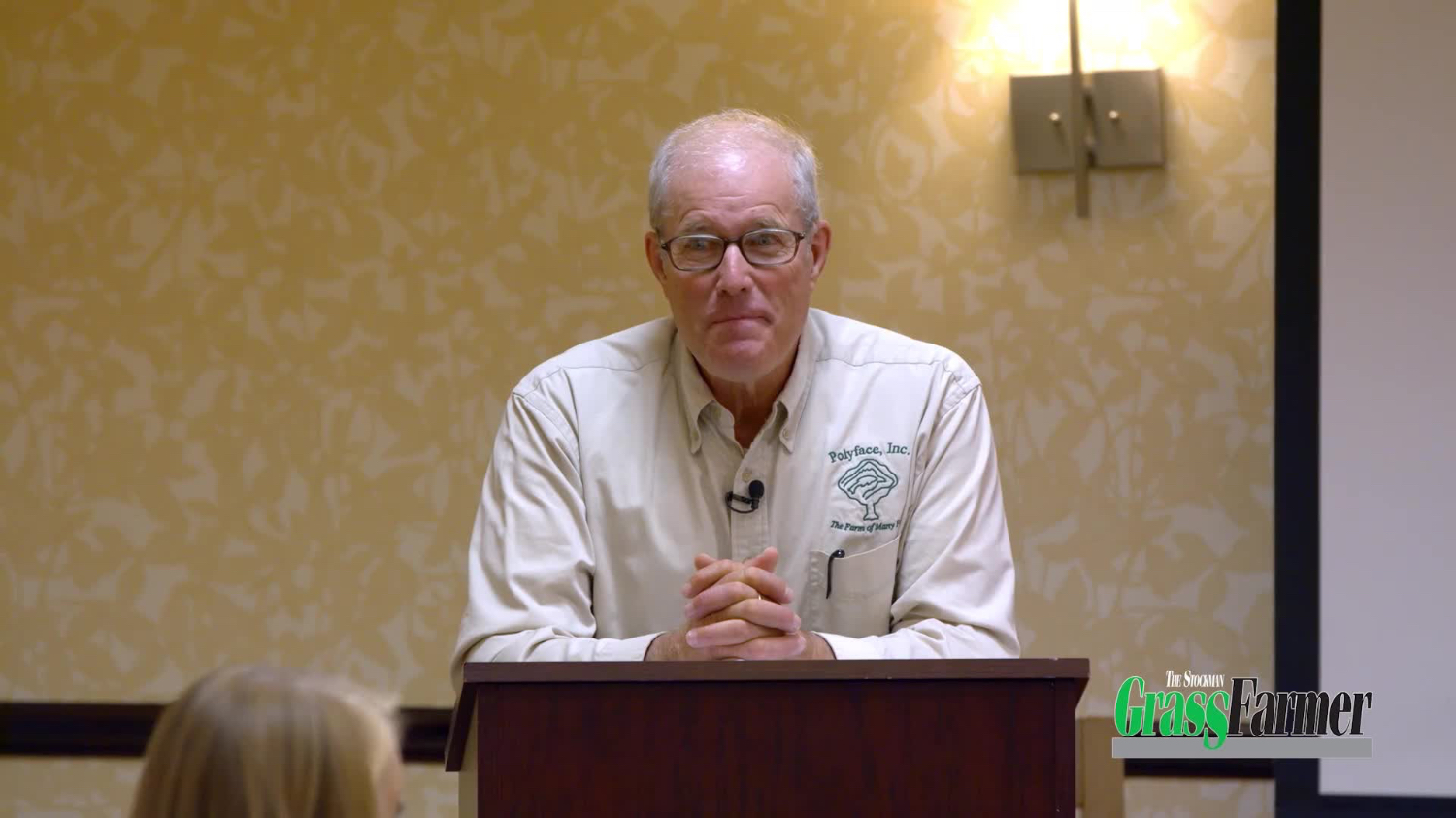
Marketing Livestock by Bud Williams
When we're young, we buy something or we're giving something, we play with it, we outgrow it, we break it, we throw it away, and we get another. So we don't learn much about selling. When we get older, especially in the livestock part of it, we buy something that we want, we keep it, sometime when we're forced to or at a certain time of year we sell it, so we still don't learn anything about selling.
When it comes to marketing, the key is selling and then buying back your replacement. That's when you should make your money. You should never buy something. Hope that you keep it for a while and make money on it.
Whenever you buy something, that's when you should have made your profit. So basically, this is what I try to get across to people. Now, there's another thing that's hard for people to understand. They talk about how many cattle there are, how many of this there are, and how many of that.
Well, that's helpful sometimes, but it also is how many of those are for sale. You can have too many cattle and still have high prices. In 1973, we had the highest numbers of cattle that we've ever had.
We had the extremely high price. In fact, compared to what it was just before, it was way, way above anything we've ever had before or since. And yet it was at the highest numbers we had. The reason the price went that high is because nobody would sell them.
And when they held them long enough and then they had to sell them, the price went down like that. Whenever you're pricing a product and you will not stop at any level until you have priced your product out of the market, you're going to take a terrible beating.
So you should almost hope that the price does not go up very much, even if it goes up. If you market properly, you'll make more money when the market goes down than when it goes up. It is far easier to make money in the livestock business when the market is going down than when the market is going up.
If you're going to stay in it and keep operating. If you're going to just do one shot deal, buy one group of cattle and then sell them and you're out of it, then that wouldn't be true. But if you're staying in it and consistently in it, this is true.
Now there's another thing that's happening in the livestock market is we have a 10-year cattle cycle. I'm not going to stand up here and say that that doesn't exist anymore because it doesn't exist, but what we've done because of the way we market our cattle, now we're creating cycles that are yearly cycles.
In fact, we are getting it down to where we may have weekly cycles before we get done. In the last year, last December, fat cattle were at 60 cents. By the middle of February, they were at 73 cents. By June, they were back to 60 cents.
Now they're back to 73 cents. Maybe even a little higher today, but they started the week at 73. So we had two cycles in one year. Because of the way that people market cattle now and the way that they look at how we're supposed to do it, we're creating a horrible, horrible situation.
All right, so if we are going to survive in that, irregardless, now, I listen to what some of the other speakers say and I don't disagree with it. I try not to listen too much because it kind of screws up my mind.
It's not too good anyway, and if I get it screwed up, it's not worth a darn. But it doesn't matter what you do if you don't market properly. It's tough to make money. Now marketing, to me, is all of these things combined, not just one of them.
Marketing is not buying an animal and selling it. Marketing is buying properly, selling properly, doing it with the right kind of animals, grazing your land properly, using your feed situation properly.
All of these things, not just one of them. Being able to work your cattle properly, everything. It's just one thing. Marketing is not just buying something and hoping you sell it at a profit. Whenever you talk about it, it is tied directly or indirectly to every other part of it.
I went to Canada to teach people how to wean calves successfully in a feedlot up there. The first three years I was there, they probably did worse than if I hadn't have been there. After I'd been there about five or six years and had made very little progress, I finally got really upset and I started literally having to change almost everything there to make any progress on the one little thing that I was going to work on.
I got involved in the marketing, I got involved in the feeding, I got involved in all of it. It's very difficult to run a ranched livestock operation and just look at one part of it. They're all tied together.
I have been kind of forced in order to just work animals, which is what I prefer to do, to get involved in almost every part of the livestock industry except the technology part of it, which I will never get involved in, just to help people.
Because all of these things are interwoven. If you buy animals and you can't take care of them properly, you probably aren't going to make a profit no matter how well you do your marketing. It's important we are able to hammer animals, we'll be able to sort our animals, we'll be able to load our animals, move our animals, do all these things.
That's a very important part of it. We need to learn how to be better at working our animals as well as the marketing part of it. These are the things that we don't do very well either. We really do well with mechanical things.
We do well with technology. We have went with technology to so far beyond what we've done with the, I call it cleaning out the barn type deal that it's unbelievable. So we have really gotten behind in these little areas.
Now I'm just an old common person, so those are the things I still work on. I still work on cleaning out the barn. In other words, I'm willing to go out there and walk every day with the animals or go out there and do those things even yet.
In fact, if I had my choice, that's what I'd be doing every day. The thing you've got to realize, if you want a higher price for whatever you're producing, you usually only can do this with a limited amount.
Once you start getting any amount of volume, then it's hard to get very much of a premium price for it. Also, there's another thing that you want to realize. Whenever you get a premium price, people tend then to jack up their costs because they've got lots of money now.
So they start getting this that they'd like to have and they start getting that that they'd like to have and the first thing you know then that's not enough money. So then they've got to raise their price again.
And if you keep raising your price, then you just price yourself out of your market. That's why the little old guy in Japan, I will take less. That sounded real stupid to me at the time. But it doesn't sound stupid to me anymore.
The thing is, the most successful businesses that we have in the United States sell for less than their competitor. Walmart got as big as it's got no matter how you feel about Walmart by selling for less.
Not by selling for more. And they're very, very, very profitable. Now they're not profitable because they're big. They were profitable and very profitable when they had one store. So the thing of it is, profitability is not just getting big, even though most of your universities will tell you you've got to get big.
I don't believe that. I don't think that you have to get big to make money. But I think we do have to do a better job. And I go all over, I talk to lots of people, I'm out, and if there's one thing that we do a terrible job, and that's in marketing.
And the people that do most of the marketing for the livestock in the United States do an absolutely horrible job. So what we want to do then is learn how to take advantage of that for ourselves. We're not going to change them.
We're not going to change the system. But we can profit because of what they do, and we can do it very easily. If the stock prices fluctuate, the easier it is for you to make money. I don't like to read stuff, but my old memory ain't as good as it used to be.
It used to be I could have got up here in front of you and talked for three hours. Probably never said the same thing twice and not missed anything. But I can't do that anymore, so I kind of got to look at my notes now.
I kind of got my first off my chest, so now I'll go from there. To me, marketing is producing something that other people want and doing that at a profit. Now, I'm going to read that again because I think you want to listen to what I said.
Marketing is producing something that other people want and doing that at a profit. To break even is no good. You can go broke, breaking even. So you must make a profit. Also, you want to sell what other people want.
It doesn't matter what you want. If the person you're trying to sell it to doesn't want it, you're not going to get very much for it. Also, then, if that's what you want, that's what you're going to buy back and you're going to pay a premium for it because you want it.
When I was a little kid, my dad was trying to pay for a farm through the depression years. And we would go to the auction, and this is when I was four, five, six years old. He bought anything that other people did not want.
He brought it home, give it to us kids, and we kept it alive. Whenever he had anything that anybody else wanted, he sold it. And he was able to pay for this farm right through the Depression years. The thing is, is if you're going to buy what you want and you're going to try to sell what other people don't want, it's tough to make money.
So you want to buy what they don't want and you want to sell what they want. And that is a very important thing. If you're, I mean, the magazine's a grass farmer. If you're a grass farmer, basically what you have for sale is the grass that you grow.
That's basically what you're selling. Now there's different ways that you can sell that. You can rent the pasture out to somebody else. You can put pasture cattle on it. You can put cattle on for so much gain.
Or you can buy the animals and graze the grass. We have our labor and we have our marketing skills for sale. And we have our graphs. So many people think that they're selling cattle and they don't think about the other part of it.
But no, really, we're just using the cattle as a way to sell our grass. So how much grass we grow, how well we graze it, how well we take care of it, these are very important things. Because basically that's what we're selling.
So we better take really good care of it. Now if we're going to sell it through animals, we better take really good care of them too. Since there's a limit to how much feed we can grow, unless you're going to buy another ranch like was suggested earlier, we seem to make the most profit by buying animals.
This is also the most risky, but is the best way to profit from our labor and marketing skills. You want to use your labor so that you get the maximum benefit from it. You also want to use your marketing skills so you get the most benefit from it.
Because you can only grow so much grass, the animals can only gain so much weight, so therefore you can make the most money by your labor and your marketing skills. If you have animals and they eat all of the grass you have and you sell them for less than you paid for them and you don't market properly when you're doing that, then you're not going to make a lot of money.
So your marketing skills are important. Very, very important. We have control over how we sell, some control over cost of gain, and control over how we buy. We don't have control over the weather. We don't have control over those things.
So then we want to pay very close attention to how we sell and how we buy. Because that is the key to whether we make money or whether we don't. In order to get the most out of these three things, you should know and understand yourself.
Now that may be the most important of all. You know, I don't know a lot. I didn't get a lot of education. But there's one thing that's helped me more than any other single thing, and that's knowing myself.
I know what I will do. I know what I won't do. I know what I can do, and I know what I can't do. I do not try to do what I can't do. I don't try to do what I won't do. If you want to be successful at anything, you best understand that.
Now, Gordon Hazard, which is probably one of the most noted guys on stalkers in the country, he was telling me one day, he said, you know, if I would run heifers, I could make more money some years, but I won't run heifers.
He knows that he won't do that, so he doesn't try to do it. He also knows that he would do a little better some years if he would, but he also knows that he don't want to, so he doesn't do it. And that's what I mean by knowing and understanding yourself.
You should never attempt to do something that you honestly know you won't do well or don't want to do. Because you will do it badly. And then you'll feel bad about it, so then you'll do something else badly.
So that's a very important thing. Know your cost to produce your product. Most people don't want to know their cost. You know, we worked on a place one time and the guy would not count the cows. He wouldn't let us count the cows because he didn't want anybody to know if he lost one.
And if you'd never counted them, you'd never know if you lost one. So it's pretty hard to know what your costs are if you didn't even know how many you had. Very few people know their true cost to do these things, their actual absolute cost.
That's something that's extremely important. You must know what your inventory is. Now, your inventory, if you have a farm out here or a ranch, your inventory is your grass. Your inventory is what money you have.
Your inventory is what animals you have. If you were starting out and you go buy a place or rent a place, okay, you've got this grass growing there. Now, if you're going to buy animals, you've got to have some money to do this.
So those are your inventory. The money that you have is as important a part of your inventory as anything else is. The graphs is an extremely important part of your inventory. Now, to run a successful business, you must maintain inventory and maintain cash flow.
Those are two things that any other business, it's critical. So it's got to be as critical in the livestock business. This is an extremely important thing. We must maintain our inventory and we must maintain cash flow.
Now, in order to do these things, we have to know what our inventory is. We have to know what our costs are. We have to understand these things. Now, they're not difficult. It's not hard to figure these things out, but we do need to do it.
Your inventory, feed, equipment, money, and livestock. You can sell all of your livestock and take the money that you sold them for, and that's a part of your inventory, and so you still maintain your inventory.
You can keep graft, not use it, that's still usable. There's times, this one friend of mine one time, he leased this ranch. It was a ranch big enough to run a thousand cows on. And he just got this place leased, and I was supposed to go down there and get things ready for him to move the cattle in.
And so he came to me. He came in about 6 o'clock in the evening. He drove about 150 miles to get there through dirt roads. Got there about 6 o'clock in the evening. He said, buddy, he said, we were just looking at these 1,000 cows.
This was in 1973. He said, they're $525 a few. He said, don't buy them. What do you think? I said, don't buy them. Well, he said, we just leased this place. We've got to buy them. I said, no, don't buy them.
He said, well, what should I do? I said, don't buy anything. He said, well, you can't run a place if you don't buy them. Yeah, yeah, I said, you can. I said, don't buy them. So anyway, we argued through the night.
And at 7 o'clock the next morning, he finally said, okay, I give up. I won't buy the darn thing. I don't lose arguments because I don't quit, you see. The only way that anybody can beat you in an argument is if you quit.
So finally, what I did is I just outlasted him. So he gave in. So he did agree. The best I could get is he bought some heifers. Paid 40 cents a pound for these heifers. The next year, in 1974, those cows were selling for about $225 to $240 apiece.
So if he would have paid for 1,000 cows, $525. Now, if he'd have left these grass and not eat his grass off, man, he'd had all that grass. Cattle were cheap. He'd have been in great shape. So the best thing that he could have possibly done is bought nothing.
Nothing. And this is the thing. He should have kept his grass and his money. This is the thing that you want to understand is we do not have to buy cattle to maintain our inventory. We do not have to eat up a grass just to get rid of it.
You know, I've given one of these schools and later somebody was talking to me and he said, well, he said, you know, I leased this grass that I can't just leave a third of it set there. I said, well, I never told you to leave a third of it set there.
In fact, I said, if you end up and got one blade left, that'll satisfy me. And I said, I'll tell you what you do. At the end of every year, you just send me a bill for that one blade of grass and I'll pay for it.
You just don't want to run out of grass. You don't want to use up all of your grass to put into something that you can almost guarantee is going to lose your money. Remember, don't throw your inventory away.
Your grass, your money is as important part to pay attention to as the livestock. Maybe it's better to not have any livestock. Make sure that you always have plenty of feed. Try to never run short. It is always better to have feed left than to run out of feed.
Manage your pastures as best as you can to get the best growth and still always have feed when you need it. One of the reasons that we have to feed hay is because we basically run out of grass. It's very expensive then.
Don't run out of grass on a grass place if you can possibly any way keep from doing it. If you have extra dry year and you're going to have less grass, then sell your animals when you first realize that it's getting dry.
Not after you've run out of grass. Because when you run out of grass, your neighbors are going to run out of grass and they're going to have to sell and you're going to have to sell when the market is tougher.
If you keep your grass because you sold your cattle early, then you can buy cattle when the price is down. Always think in those kinds of terms when you're doing these. Have as little equipment as you can, but try to have what is necessary.
Try not to buy any more equipment than you absolutely have to, but do have as much as you need. You know, you probably need a hammer and a pair of fence pliers, so have that. Try not to have any more than that, but at least try to have that.
Don't go all nuts over equipment. It's very expensive. It usually doesn't produce a lot, and it very seldom pays for itself. So these are just some little things that always have a reserve of money. This is any money that is readily available.
If the market is high, don't borrow more than 50% of the value of the animals. If the market is low, don't borrow more than 75% of the value of the animals. If the market goes down, you must have money to pay the bills and replace the livestock.
Since the new livestock will not be worth as much, it will be harder to borrow money to buy that after you have sold. Build up a reserve of money when the market goes up, as you may need it when you livestock numbers on the bottom half of a cattle cycle.
Go, or at least try not to increase your numbers when the price is high. If you're going to increase the numbers of animals that are running, try to do that at the low end of the cattle cycle. Now, those are not difficult things to figure out.
If the price of feeder cattle are at 90 cents during the year and at 75 cents during the year, it's pretty easy to figure out what's the low part of that and what's the high part of that. Even I figured that out, you know.
So I think that most people can figure that out and do it quite quickly. Try not to increase the numbers of animals that you are going to have when the cattle cycle is up toward the high part of it. Now, there's something about the cattle cycle that you want to realize is we do operate on more or less a 10-year cycle.
But we are getting so now there are huge cycles within the year. Like I said, this year, this last year, we had big cycles every six months. So we're getting these cycles are getting bigger and they're getting more frequent.
So you've kind of got to pay a little bit of attention now. Now, I'm not a big follower of cycles. I pay almost no attention to the 10-year cycle. When I say that, I don't mean that other people shouldn't pay attention to it.
I'm just telling you that I don't. And the reason that I don't is because the way that I market cattle is kind of irrelevant. So I don't. If you don't market cattle out of way, then it can be really important.
The thing that you want to understand is if you buy, quote, a cow at $500, cows go up to where they'd sell for $1,000 and come back to $500, you're not even. You lost a big part of $500. Because when those cows went up to $1,000, other costs went up.
The price of the things that you buy to operate your place went up. People pay more for the leases for grass. They pay more for property. They pay more for equipment. They pay more for irrigating equipment.
They pay more for all kinds of things that you use. Because when those cows get up to selling $1,000 a piece, everybody wants in, so we're running out and buying irrigation stuff and this and that so that they can get more grass so they can raise more cows.
So your costs are going to go up. When it comes back to $500 for that cow, those costs may not come back down. So then you better get some of that. That's a really important thing to understand. That doesn't mean that you've got to be jumping in and out or anything like that.
It just means that you better find a way to take advantage of it. To me, there's three major divisions in the production of livestock. You've got the cow-calf, stalker, and the felots. They say the cow-calf operator makes a profit three years out of ten.
So for every ten years, we should only have cows for three of those years. Now, I didn't say that. I said somebody else said that. I'm not against cows and calves. But you still want to think about that.
You want to think about the fact that the smart people say that you make money three years out of ten. Like I said, I didn't say that. The smart people say that. It is more difficult, probably, to make money with cows and calves for most people than it is with stalkers.
But most people prefer to run cows and kegs. That gets back to doing what we want. There are lots of places that are good for cows and calves, and there's lots of places that are not good for cows and calves from a profit standpoint.
But most people still prefer to have cows and calves. They say you can be profitable every year with stalkers. And actually you can be profitable every year. Also, you can lose a lot of money with stalkers if you want to go at it properly.
And some people have gotten real good at that. So anytime that it's easy to be profitable, it's almost always easy to lose money, too. Every time that something like that is very profitable, then we tend to get influence coming into it that makes it more difficult to be profitable with the conventional way of marketing livestock.
That's why it's better to understand a better way of marketing so this doesn't happen. In the feedlot, at some time during each year, cattle are making or losing money, it seems. Feedlots have more to do with the wide swings in cattle prices than anyone.
Whenever the market is going down, the feedlots always hold cattle and make it worse. Whenever the price is going up, no matter how high it gets, they always want more. It wasn't too long ago that fat cattle were selling for just over 60 cents.
If they got 62 cents, they wanted 64. If they got 63, they want 65. If they get 64, they want 66. Now they got it up last week, they got 73, so this week they want 75. Now, let's just stop and think about something just a little bit sensible for a minute.
How high can we push it before people quit buying? Pork right now holds around what? 30 cents. Chickens are not too expensive. If we get beef up there high enough, people are going to buy something else.
We can push it right out as a deal. So at what point would they say, look, this is high enough. We can make a nice profit here? There is no point that they'll say that. There is absolutely no place that the feedlot will say, this is enough.
Now, if they were staying in business, if they weren't making any money at 60, which would have been their fault if they weren't, but if they weren't making any money at 60, were they making money at 65?
66? 67? Where were they making money? When they got to that point, did they say, man, this is great. We're making money. We're just holder here. No, no, no, no. We're going on. Now, I'm not picking on the feedlots when I say this.
I have no desire to bash anybody. That's what we demand of them. The customers demand that. Get more if you can get it. Get more if you can get it. We should be able to price our product. There is no, hardly any other business of any size that gets to price their product.
You go down here to a store to buy a shirt. You go into any store you want to. And if the shirt is higher than what you want to pay for it, you walk out without buying the shirt. So if they price it high enough that you won't buy it, they ain't going to sell it.
So pretty soon if they want to sell it, they've either got to come down in price or they don't sell it. So very few places, new cars now, they price them. They write their passion dealer. Then you give you $5,000 back if you'll just buy it at that price.
Well, you know, we could probably price the cattle at $1.5 a pound if we just give people a dollar and a quarter of that back. God, what a deal that'd be, huh? The thing of it is, whenever you overprice your product, people quit buying.
The feed lots do this because this is the way it is. This is the way you do business. And they're having great fun with the customer's money while they're doing it. It is a real fun deal. Now, here's what happens when they do this.
March 15th of this last year, the cattle on feed report showed February markings were 88% of the year before. The price had been going up since December because of holding these cattle back. They got up around 73 cents.
On March 22nd, which is seven days later, this market report come out. As a result of the top three end talk, show lift ballooned all across the country this week in a classic case of everyone trying to go out the door at the same time.
This contributed to 10 straight days of lower futures prices. They held the cattle off the market, wouldn't sell them, and they moved the price from 62 cents up to 73 cents from December to February.
But those have got to be sold someday. And when everybody thought, boy, this is how it's going to go, they all rushed to sell and down it went. You can't hold things away from your customer for any length of time without paying for it.
People don't eat yesterday's steak today. If you didn't sell it yesterday, they're not going to eat it today because they're going to eat today's steak today, if they're going to eat steak at all. So once you've held it off the market, then when it comes, you've got way too much.
The thing is, these are the things that create some real problems for ordinary marketing. That's why we've got to market different. The Texas cattle feeders have lost in the last 18 months, this came out in April, this little deal here, in the last 18 months they lost $550 million.
That's in Texas. Nationwide they lost $2.5 billion. Now, the National Cattle Beef Association is taking action by having Congress investigate the Packers and increase surveillance of the futures market.
Now that'll do a lot of good. In 1973, they went after the supermarket and the housewife. And that did a lot of good. The National Cattleman's Beef Association working with Chicago Mercantile Exchange and the Commodities Futures Trading Commission on short-term solutions for the record market then.
There isn't one solitary thing that the Futures Exchange can do, and there's nothing they could do. They haven't got anything to do with it one way or the other, so there's nothing they could do. But those are the things they work on.
So you've got to be careful that you don't get wound up in this when you're trying to market stuff. There's only so much money in a 1,200 pound or 1,400 pound animal when it's slaughtered. This must be divided up between all of the people that have owned it and all of the outside costs like medicine, trucking, this kind of stuff.
You must learn how to always get your share. The thing of it is, when you sell that animal of sold at the feedlot, all the way down that chain, the feedlot's going to get so much out of there, the stalker operator gets so much, the cow calf operator gets so much, the trucking, the drug companies, the vet, all of these things, they all take their little bit out of there.
So in order for you to be profitable, you've got to make sure that you get your share of that. And in order to get your share, you have to market in such a way that you get it. When you're buying animals, we have no animals, then what should I buy?
What kind should I buy? How much feed do I have? What can we handle? Now, whenever you talk about buying animals, the kind of animals that you can handle is just about as important as anything. If you buy animals that you cannot handle on your place or with your facilities or with your operation, then you're not being very smart buying those animals.
Some people can handle cows and calves and can't handle stalkers. Some people can handle calves that's been weaned for a couple of months but can't handle freshly weaned calves. Some people can handle five, six hundred pound stalkers, but they can't handle 300 pounders and so on and so on and so on.
You better understand which ones that you can properly handle because if you can't properly handle them, it can be a very, very expensive lesson that you're going to get to learn. Believe me, I know because I've spent a good pure of my life going around working with people that didn't buy the right thing.
Which is overpriced and which is underpriced. Now this is something that we really want to understand. Whenever we go to buy animals, we do not want to buy the premium priced animals. We want to buy the discounted animals.
Now when I say that, I am not saying to buy junk. I am saying to buy the discounted animals. You can have really good animals that are discounted. So you buy the underpriced, not the overpriced animals.
So a lot of times the only difference between an animal that's a good animal and an animal that's a bad animal is just how much feed it's getting. Also, there are ways to protect your investment. You can forward contract or you can use the futures market.
I'll get into that a little bit later. There's ways to improve the game. Work our animals better. Manage our pastures better. You know, sometimes I wonder if I know anything. But occasionally somebody will tell me that I do know how to work animals.
So if there's anything that I'm supposed to be able to do, it's supposed to be able to work animals. Working our animals better is a really important part of it. A really important part of it. Now, I've spent a good part of my life going from place to place and working with problem animals.
And I absolutely know, and I've done this with thousands upon thousands of animals, that if I just worked them better, immediately their performance went up, the problems went down, they did so much better, and they do it with less feed.
When animals are not doing good, they use more feed and you get less gain from that. So that's ways to improve. Manage your pastures better. Now this is one of the things. I started in on this in 1958.
The reason I got into it was kind of, like I said, I get into everything through the back door. Back in those days, the Western Livestock Journal actually put out a paper that had some information in it that was worth something.
And they put out a monthly magazine and would have some decent articles in it. Now, I used to get that. And there was an advertisement. And it was selling a pasture mix. And they were saying, you know, that you plant this pasture mix, and this was in Southern California, and you had this one pasture come on when it was cool, and another one come on when it was hot, and so like, so you had pasture growing year-round.
Well, where I was at, that didn't have any value to me, but there was one thing there. They said there was this dairy. They had 28 acres. They'd split it into 28 patches. And they rotate these every day, these dairy cows, and talk about how much more this pasture produced.
Well, they're talking because of this pasture mix they had. But I'm thinking, I can do that here. Now, we were working on about a 50,000-acre mountain ranch that didn't have any fences out there at all.
You could go for 30 or 40 miles and not come to a fence. And I tell you, I can do that here. So we start bunching all of our cows up and we move them over here and I move them over here and I move them over here and I move them over here.
And holy smokes, you talk about the calves come in that fall 50 pounds heavier than they'd ever came in before. The cows were fat. We had all kinds of feed. That winter, normally they fed lots of hay.
The only thing I had to do was keep shoving them up in the snow because there was so much grass. They was giving so much milk. The calves were getting the scours for milk, not the sick kind, but silk.
So I kept driving the poor cows up into the snow so they wouldn't eat so much. And boy, I was sold on that then. Now, that was in 1958. By 1978, I had three people who would listen to me on this, so I'm really good at selling that part of it.
You know, that's why I didn't push it much longer. I leave that to people like Alan, you know. Because I don't do very good at pushing the bastard deal. But it was truly amazing to me how that by just working the animals.
Now, I couldn't build any fence. I couldn't change anything because I was working on somebody else's place. But just by moving those animals, and in those days, I didn't do it very well. At least now I hope I can do it a lot better.
And you can still get those kinds of results. It was absolutely amazing. Well, it started, other people started seeing it. So the first thing you know, then they've got me doing this and doing that. Now, how to sell.
You must profit when you buy. Now, there's something that you want to realize about owning livestock. You get up in the morning, and if you don't sell those animals, you just bought them. And if they're too high for you to buy them, then why aren't you selling them?
And it's really about that simple. Because every single day that you have animals, if you don't sell them, you just bought them. Now, I know it's not quite that simple, but yet if you can think that a way, it can really help you.
Because really, that's the way it really is. If you have some animals and they're way overpriced, why are you paying that much for them? If they're that much overpriced, why aren't you selling them and buying something that's underpriced?
You must maintain inventory and cash flow. You must sell a premium. Know the spread or cost difference between what we sell and what we buy. You must know this. You must know what your costs are. There's no way that you can know what you're doing if you don't know that.
So if you sell an animal, then you must replace that animal with an animal that when it reaches the size or the value of the animal that you just sold, that there's a profit there. Whatever you figure your costs, you want to put a profit in there.
You want to put a reasonable profit in your cost. Because without a profit, you're not going to do very well. So it's extremely important that you put a reasonable profit in your cost. Because breaking even will do you no good.
You will get nowhere breaking even. So don't figure a break even. We want other people to do things that we don't want to do. Usually what we try to do is pick out the things that we like to do and get other people to do the other things.
Now they'll do these things at a price and usually not very well. We want to stand around and complain about it. If the cattle industry is in a mess, which I don't think it is, but if it is, we got there because we want other people to do the things we don't want to do.
You know, when I was a little kid, my dad sold most of the animals off of our place, butchered. He butchered them right there and sold them. My dad running a couple hundred sheep. We had 30 milk cows.
In fact, we had a little over 30 milk cows because we tried to milk 30 cows all the time year-round. He had some range cows. We had about 10 sows. And in those days, in order to sell lambs, you had to ship them to San Francisco from where we live.
You had to have enough to fill a car load, and we didn't have enough lambs to fill a carload. So dad butchered them and sold them right there. He butchered the calves that we sold. We have a two-year-old heifer that wouldn't breed.
We had good irrigated pasture. He'd put them on. They got in good shape. He'd butch them and sell them. But you know, it wasn't long until people didn't want to do that. They wanted somebody else to do that.
Well, we've got other people doing it. Boy, are we complaining about it? I don't know why. But we sure didn't want to do it. The thing of it is, most of the things we complain about, we turn it over to somebody else and now we're upset because of the way they do it.
Remember that. When you want other people to do something because you don't want to do it, don't expect a real good job from it. There's another thing we love to copy. You know, as I say, I study things.
I spend most of my time either thinking about things and studying things. But people don't particularly like to do that. We love to copy. We really like to copy. And we're good at it. So I'm not saying there's anything wrong with it.
We just like to copy. So think about this just a little bit. Whenever we like to do something, guess what? We're going to do it. Be sure you only copy what's profitable. If the people you're copying are complaining about how much money they're losing, guess what you're going to be doing?
You want to keep in mind this. We like to copy. We like to sit around and talk with the people who are doing like us and they're complaining about losing money. It would seem like that we'll probably do much the same.
So in order to be really successful with something like this, you want to be sure that the people you copy are people that are not complaining about losing money, that are doing things profitably, and then you will be too.
I am not a person that thinks that you have to get bigger and bigger to be successful. I don't believe that at all. How big somebody is or how small somebody is. I think that if you have a small operation and you will run it wisely, you can make a very good living.
But you may not be able to do it by copying the people that are complaining about losing money. Also remember this, that if you are doing something and you are successful and the other people are complaining, they're going to resent you and they're going to give you a bad time.
And if you're not careful, you'll drop back like they are so that they'll be happy with you. I spent my entire life having people unhappy with me. I kind of like it so it doesn't bother me. But most people don't like that.
Most people want other people to agree with them. They want other people to look up to them or to think they're all right. That never bothered me. But then that's the way it is. Now, I don't know how we're doing.
We're going along all right? Okay. Okay. What I want to talk about, I'm just going to talk about the futures market a little bit. In order to try to teach somebody how to use the futures market, if you have two or three years, why come around and we'll go at it?
Probably what I would say is I would suggest that you don't use it. If you do the futures market now and you're successful at it, that's wonderful. If you don't use it, probably you'd be wise not to.
It is something that is a very good thing to use if you understand it, and it's pretty wicked if you don't. And if you're not willing to take the time to understand it, then you probably ought to just leave it alone.
Now, there is a couple of things that I think it is good to explain to people about it. It's not the villain that it's made out to be. The cattle market goes down and they start screaming about the short sellers in Chicago.
And all these horrible guys don't own cattle and they drive the market down. Well, the huger's market was set up for this reason. You go back to the days when they, this would have been in the 1860s or so, and they would grow wheat around Chicago.
When they got through with harvest and they'd haul the wheat into Chicago to sell it, it might be 10 or 15 or 20 cents a bushel when they got there. By January or February, it might be 60 or 70 cents a bushel.
So as a way to let the producer get some part of that, they developed this forward contracting, this futures market, and it set it up in a way so that it wasn't just dealing with an individual that would renegone on the contract if the price went up or something like that.
And so then if you're a producer, you got this crop of wheat, and in January the price is up to 70 cents a bushel, you could sell your next year's crop. Well, we don't understand that. We like to buy.
There's hardly anybody that is in the normal person. That lets me out, I know, but normal people like to buy. They don't like to sell. So they never used it. If a guy in the livestock industry is using the futures market like they should, they would be the seller.
If the guys in Chicago could drive the market down, that would be to the producer's benefit. His cattle up here puts the futures contract down. He's making money on that. So he's making money on both.
So if the producer used the futures market like he should, the futures market going down would be a positive thing, not a negative thing. But ranchers being like ranchers are and felt people, they think the market is going to go up, so they own cattle and they buy the futures contract.
Well, the guys in Chicago, they're glad to sell that contract to them. And of course, the market goes down. And guess what? It's a horrible, horrible market. It's crooked. It's this, it's that. And how can you sell something you don't own?
You know, we've been selling something we don't own for ever since I was a little kid. If you have some 600-pound stocker cattle and you contract to sell them in the fall at 800 pounds, you just sold something you don't have.
You got a 600-pound animal, but you sure don't have an 800-pound animal. So you just sold something that you're going to have, but not something you had. You drive into a car dealer, and you want to buy a pickup.
He sells you a pickup, he'll deliver it in two weeks. He just sold you something he didn't have. Or he can get it, but he don't have it. So this is done constantly that we sell something that we don't have.
There's another thing. A lot of people talk about the futures market. Well, they didn't predict it. I mean, the futures market out here, and it was at such and such a price, it wasn't there. Well, there's one thing you want to realize about the futures market.
In order to make a contract, you have to have a buyer and a seller. You have to have both. You cannot make a contract without it. Okay? Then guess what? The contract is at 75 cents. You have a guy that bought it.
Why did he buy it? Because he thinks the price is going to go up. You have a guy that sold it. Why did he sell it? Because he thinks the price is going to go down. So that's the one price they agree it's not going to be.
There's for a short time there, an instant, but there's two people agreed that that will not be the price in the future. So the futures market means that these things will expire in the future. They do not mean that they predict the future.
Now, if you're going to hedge at the top of the cattle cycle, you can hedge 100%. In other words, if you're going to sell them at 800 pounds, you can hedge them at the full 800 pounds if you want to.
In other words, when I say the top of the cattle cycle, if you have stockkered cattle that fluctuated between 90 cents and 75 cents and it's up around 90 cents, well, you can hedge it 100%. I have a problem with that.
If it's in the middle, you can hedge around 75%. If it's at the bottom, I would not hedge over 50%. In other words, if you bought 400-pound animals, I would only hedge the 400-pound. I would not hedge what you're going to have when you get ready to sell them.
If the price of fat cattle moves up 10 cents a pound, feeders can go up 15 to 20 cents a pound. This could be $125 to $160 per head margin call. So think about it a little while. This is why it's important to know what is overpriced or underpriced before you hedge.
You have to be very careful about how you hedge when we're at the low end of the cattle cycle. When the cattle are high is when people think it's going to go higher and they don't like to hedge. And when the cattle is low and they're scared and panicked, they think they have to hedge.
And of course, then you have going against you. The cattle go out. Making the money. So you have to be pretty careful how you do this. Don't hedge cattle because you're in a panic. Do it in a very sensible way if you're going to do it.
Now, forward contracting, if you're going to have to protect yourself, that's a better way to go. The forward contracting is not near as flexible, but it certainly is a lot safer. Also, the thing that you want to realize about the cycles, understand where the animals you want to buy or sell are in their cycle.
Each group has cycles, but the timing on each is different. The cows work on a different cycle than the calves do. The calves sometimes work on a different cycle than the heavy feeders do. They work on a different cycle sometimes than the fat cattle do.
These cycles are not maybe miles apart, but they could be months apart. If the animals in one group are overpriced, it is not necessarily at its high part of the cycle. They may have already passed their high or not reached it yet.
If animals in one group are underpriced, it is not necessarily the low part of its cycle. They may have already passed their low or not reached it yet. Always keep that in mind. You know, if you've never traded commodities, you ought to take 10 or 15 or $20,000 and just try it.
It's a lot of fun and you learn a lot before you run out of money. And you'll learn a lot about what's high and what's low. When I first started in, I was trying to learn the futures market. So I didn't have hardly any money.
I scratched up a little bit. And I could trade a contract or two once in a while. So soybean meal got over $100 a ton. And it had only been over $100 a ton twice before in history. Now this was back around 1972 or 3.
And so I thought, well, man, it just can't go any higher. So I sold a contract. And I don't know, you know, I have kind of a sixth cent that kind of keeps me going.