What is Regenerative Grazing? by Steve Kenyon
BUSBY, Alberta
Regenerative Agriculture is the answer to so many issues in agriculture. From health care, to climate change, we can do so much. Let’s look at the basics. I have ten points that will help new producers understand what regenerative grazing is.
THE GRAZING CONCEPTS
- Graze Period. The amount of time your animals are grazing on a paddock.
We want to prevent overgrazing. To do this we need to keep our graze period short enough to stop the “second bite.” The animals need to be removed from the paddock before the plants are able to put up new leaf after the first bite. Depending on your environment and the time of the year, this “second bite” could occur after only a few days. If the plants are using up stored energy to put up that new leaf, the energy reserves will be empty when the second bite occurs and the plant will be over-grazed.
- Rest Period. The amount of time that the paddock has to recover between grazings.
The rest period is also manag ing to prevent the “second bite”. Adequate rest has to be given to ensure the energy reserves of the plants have been replenished before the plants are allowed to be grazed for a second time. Again, depending on your environment and season, this could be anywhere from about 25 days to 365 days. We all have different environments but we still need to make sure the rest period allows for the energy stores to be replenished.
- Animal Impact. This is the physical and biological effect that the animals have on the soil.
The physical stimulation is by the animal’s hooves. Animal impact can help with new seedling development, it can help recycle nutrients, it can break up capped soil and help develop a polyculture of forage plants. Positive animal impact can give you a tremendous improvement to the land as it will step a lot of litter into the ground. But be careful, negative animal impact can also occur. The biological impact is also very important. This is how we build biology in our system. The manure is the best compost you can ever get. The urine is the best biological tea you can buy. Even the phlegm and saliva from the animals are adding biology to your soil. This is what you can’t get from equipment on the land.
- Stock density. This is the number of animal units per acre at a given time.
Basically, how tight together or how spread out your herd is when they are grazing. I measure this in Animal Days per acre but there are other ways to measure this as well. This is not to be confused with stocking rate, which is the number of animals you have on a pasture for the entire season. The higher the stock density, the better it is for the land. The two benefits to a higher stock density is that it will improve your plant utilization and give you better manure distribution. If you have high plant utilization, every plant is either bitten or stepped on. This allows every plant the same opportunity to regrow. We also get better manure distribution around the paddocks to improve nutrient recycling.
- Soil Armor. The protective layer on the soil surface.
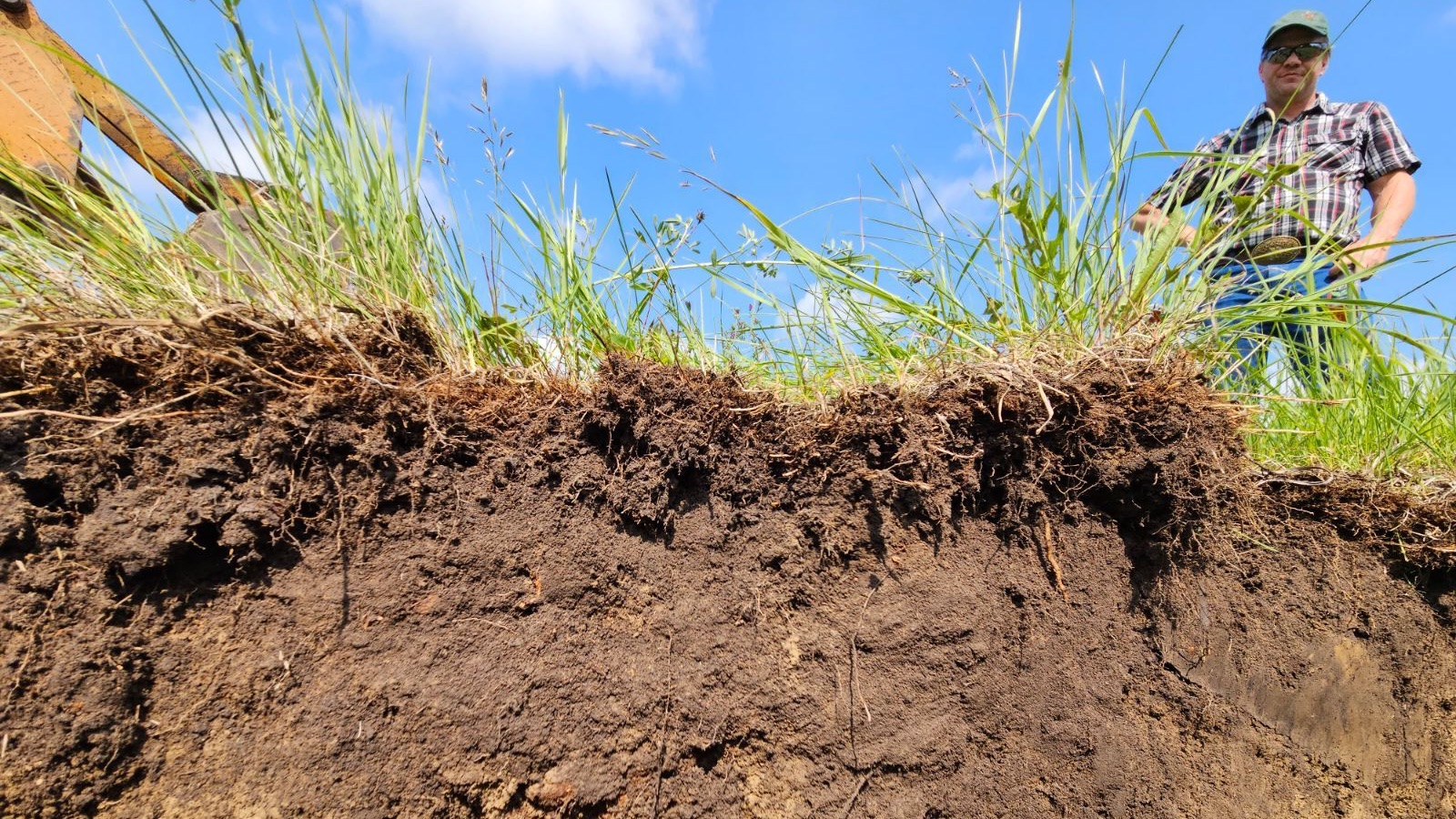
Residue is one of the most important aspects of good grazing management. However, many producers have a hard time accepting this “Wasted Grass.” I guarantee, it is not wasted. Think of this residue left over as next year’s fertilizer. This residue will break down and provide nutrients to your crop in the following years, but it is so much more than that. It is the protective layer that allows the soil to function. It provides food, water and shelter for our soil biology. It creates the environment suitable for all my underground employees. It is also a key component that allows for us to maintain a healthy water cycle.
- The Water Cycle. We need to fix this, on a global scale.
If we can reduce run off, reduce evaporation and slow down infiltration, together, we actually have the ability to manage the weather. If we can increase the soils’ water holding capacity, we can manage climate. Severe droughts, flash storms, flooding, fires, can all be reduced in num- bers and severity if we could only fix the water cycle. An unhealthy water cycle is the number one thing we need to improve for our farms and for our environment. My best advice I can give a new grazer is to leave more residue.
- Sunlight harvesting. We need to collect as many sunbeams as we can.
Where I live, we only have about 4.5 months of the year that we can actually do this. During our short growing season, I want to collect as much sunlight as possible. I want to get an early spring start. I want the moisture available, the nutrients available, and my energy stores of the plant full and ready to grow. I also want to make sure I am collecting sunlight late in the sum- mer as well. I want a healthy stand of vegetative plants right up until that killing frost hits. I also want a more dense pasture to make sure that every sunbeam comes down and hits a live green growing plant. If they hit bare soil, the sunbeams are reflected.
- Recycling Nutrients. We need to stop exporting nutrients from our soil.
Most of our agricultural practices simply mine the soil. We harvest a crop and remove it from the land. Then we have to pay to replace it. Only in a grazing system do we get to recycle up to 80% of the nutrients back to the land. Not only are we leaving residue to be recycled, but the livestock return about 80% of what they consume back to the land through the dung and urine. We only export 20%. How do we replace that 20%? We need to build biology.
- Building Biology. It is not about adding fertility to our land, it is about building biology.
Not only do they help with breaking down the residue and manure from the 80%, we need the biology to get us the other 20% to keep our system sustainable. And they do it for free. Bacteria, fungi, earthworms, dung beetles are just a few of my employees that help get me free fertility. Here is the kicker. A lot of our modern agricultural practices are detrimental to our soil life. Take care of your soil life. They are the best employees you will ever have if you treat them right. If you want to produce nutrient dense food, we need the biology.
- “Weed” management.
There is no such thing as a “weed.” If one species of plant is taking over an area, it is only a symptom that is telling you something is favoring them. The system is out of balance. A few of these undesirables here and there is not a bad thing as they are adding to the polyculture that we desire with regenerative grazing. We need to manage regeneratively and these symptoms will not be an issue. If we solve the problem, the symptom will go away.
There you have it. A ten step guide to regenerative grazing. Help me spread the word. No matter where you live, these concepts will work in any environment with a growing season. You might just have to adapt them to your environment.
God bless.
Steve Kenyon ranches in Busby, Alberta, Canada, and can be reached at skenyon@greenerpastureranching.com. Www.greenerpasturesranching.com or on Facebook at Greener Pastures Ranching. His book The Calendar of the Year-Round Grazier is available from the SGF Bookshelf.
Stay connected with news and updates!
Join our mailing list to receive the latest news and updates from our team.
Don't worry, your information will not be shared.
We hate SPAM. We will never sell your information, for any reason.