Tree Crops for Feeding Livestock By Austin Unruh
MORGANTOWN, Pennsylvania
Here is the job description for a grass farmer: Use plants to capture solar energy, turn that into feed, and allow livestock to harvest that feed. It’s easy to learn, yet takes a lifetime to master.
Even though we call it grass farming, grass is, of course, not the only plant in the toolbox. All manner of forbs and legumes, along with the occasional leaves from shrubs and trees on pasture edges, all go into one great salad bar producing high quality meat and milk.
Yet trees and shrubs, those other solar capturing plants, have been underutilized, because they haven’t been as easy to establish, they take awhile to yield a return, and nobody has put much effort into growing trees that address the needs of livestock producers. But trees can play an immensely valuable role on a grass farm, allowing that farm to capture more energy, and convert the energy into types of feed you cannot get from forages.
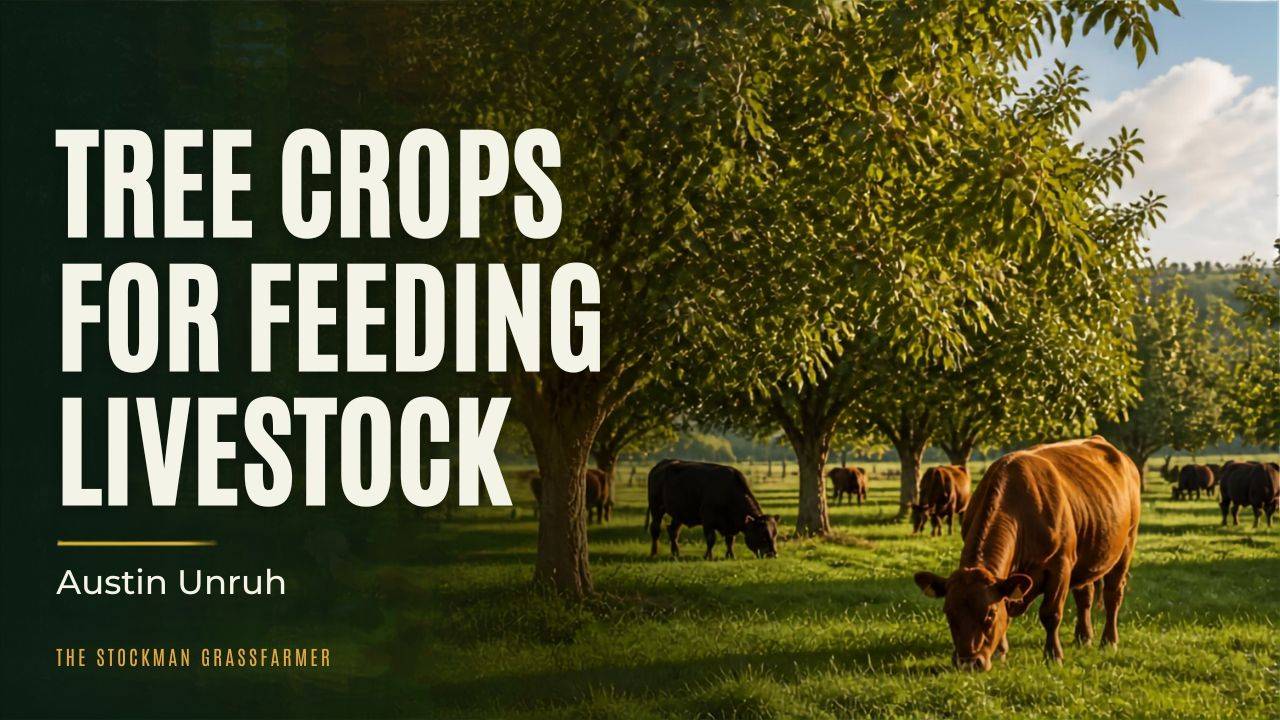
Let’s start with the fact that cool-season perennial forages, which make up the bulk of for ages for the Eastern half of the USA, cannot make full use of all the sunlight that reaches them. Research from Virginia Tech has repeatedly shown that they do just as well at 50% shade as in full sun, and in the summer the cooling presence of trees can help forages grow better. In other words, an open pasture can support a moderate, savanna-style assortment of trees without losing any production. When done right, it’s only gain.
We value trees for the shade they provide, cooling livestock in the process and increasing weight gain and milk production. But rather than using maples or magnolias, which look nice but don’t produce, the real game-changer is to harness the power of trees that take excess solar energy and turn it into feed.
The next step is to look at what types of feed are needed, and when. It wouldn’t make sense to aim for more forage production in the spring, since that’s when there’s already tons of forage available. Instead, we want to plug gaps during the dormant season and in droughts. For ruminants on cool-season forages, we also want to use high-energy feeds whenever possible, as most for ages have plenty of protein and energy is the limiting factor. This leads us towards honey locust pods and persimmon fruit for the dormant season, and a wide variety of cheap, fast-growing, vigorous species for fodder during droughts.
This gets even more interesting when we turn to the needs of those animals not gifted with multi-chambered stomachs to digest fibrous forages. Pigs and poultry need feed that is much more digestible than what cattle can handle, which is why on most farms, forages make up only a small portion of their diet, and much more comes from grains imported to the farm. That’s where trees come in, as their superpower is to transform solar energy into easily digested feed energy that is specifically designed to be eaten by animals, whether in the form of fruits, which are just a tasty way for trees to attract animals to spread their seeds, or nuts like acorns or chestnuts, which trees want animals to find, bury, and forget about so they can grow new offspring. That ability to transform solar energy into easily digested feed energy is a trait we can harness to produce feed for pigs and poultry, on the farm, at low cost, with no inputs, year after year.
The most easily scaled of these is obviously trees for ruminants, given that cattle in particular already cover roughly 100 million acres of grazing land that is also suited for planting trees. Plant enough trees for dispersed shade and winter feed, but not so many that you reduce forage growth. It’s a simple strategy, and it requires almost no change in management. But the biggest change, the most revolutionary opportunity, is to use tree crops to feed pigs and poultry with feed that freely drops from the sky. Those fruits and nuts would let graziers raise multiple livestock types with feed grown on their own land, not bought in.
Beyond these feed benefits, livestock raised on tree crops would be corn-free and soy free. Think of the marketing edge of poultry- and pigs-raised on mulberries, persimmons, and acorns. You would have a product so different from what anybody else at the farmers’ market has. How many folks can say they can offer mulberry-finished broilers, acorn-finished hams, or persimmon-finished turkey? Talk about a product that markets itself, even before you account for the good vibes people get about planting trees.
We are at the start of a tree crop revolution in the world of grazing, building off of the good work that thoughtful graziers have already done and taking it to new heights. It won’t happen fast, because we’re talking trees here. High-quality nursery stock of trees that will yield consistently and generously is the biggest bottleneck at this moment. I wish we were further along in the production of completely thornless, high-yielding honey locust trees, but they have proven to be slower to propagate than we wish. Persimmon cultivars that drop early, middle and late in the season will be here before long. In the meantime, mulberries are the first species we’re excited to roll out in quantity. They are the most important, most valuable tree for pigs and poultry, because they drop buckets of nutritious, high-protein fruit during the early summer, a time of year almost nothing else is dropping. They are also vigorous and will stand up to abuse. Not only that, but their leaves are among the most digestible fodders out there, making them a true multi-functional species.
Austin Unruh is the founder of Trees For Graziers, a company helping farmers in Pennsylvania and beyond take their grazing to new heights using silvopasture. Learn more at TreesForGraziers. com, 484-796-1513
Stay connected with news and updates!
Join our mailing list to receive the latest news and updates from our team.
Don't worry, your information will not be shared.
We hate SPAM. We will never sell your information, for any reason.