Nature has No "Weeds"By Steve Kenyon
BUSBY, Alberta
I would like to take a step back in time. The first article I ever wrote was on "Weeds" back in 2008. I sent it to Allan Nation to see what he thought. I have been a writer for the Stockman Grass Farmer ever since. Thank you Allan. But that was a long time ago, I think it is about time I shared my thoughts on the subject again.
My favorite comment about "weeds" is that they are just plants that have not learned how to grow in a row. In agriculture, we would consider a weed to be anything that is undesirable for the current crop. I disagree. I don't believe there is such a thing as a weed. Every plant has a purpose, every plant has a job to do. If it is there, it is because the conditions are favorable to it.
I also don't like the term weed. I prefer to call them pioneer species. They are tough like my grandfather’s generation. They came in and established a home in some very tough conditions, which makes our lives much easier today. That's what these pioneer species do as well. They make the conditions easier for the desired species to survive.
Let's define what a pioneer species might be. These are usually plants that are strong and aggressive and can survive in harsh conditions. If there is a disturbance to the land, these pioneer species come in as nature's way to heal the land. They act as a scab to heal a wound. When the surface is injured, nature puts up a scab to help it heal. If given the right conditions and some time, the scab will heal the soil and then disappear. The problem with agriculture is, we keep coming in and ripping off the scab. We never allow it to heal.
Some of these pioneer species can be fast growing and they quickly cover bare ground to protect it. The roots hold the soil together and keep it from eroding away. Some are aggressive and set seed early or they are undesirable to animals so that they are not eaten. This gives the system ground cover to help hold onto moisture and adds seeds to the seed bank. From nature’s perspective, this is a good thing.
I mentioned above that pioneer species do well in harsh conditions. This could mean a few things. The soil could be lacking in soil moisture, organic matter, or nutrients, maybe the conditions are just favoring them because the desirable plants are overgrazed. These pioneer species are adapted to deal with poor conditions. Other pioneer species help heal the soil by accumulating nutrients from the subsoil and bring them up to the surface to be recycled when they are eaten or die. Many of these species have strong root systems. They could have deep taproots or deep fibrous roots systems that add organic matter to the soil, provide channels for rain and air to penetrate, and create tunnels for worms and other beneficial soil microbes. Another plus we get from these undesirables is that many are quick to flower and attract beneficial insects.
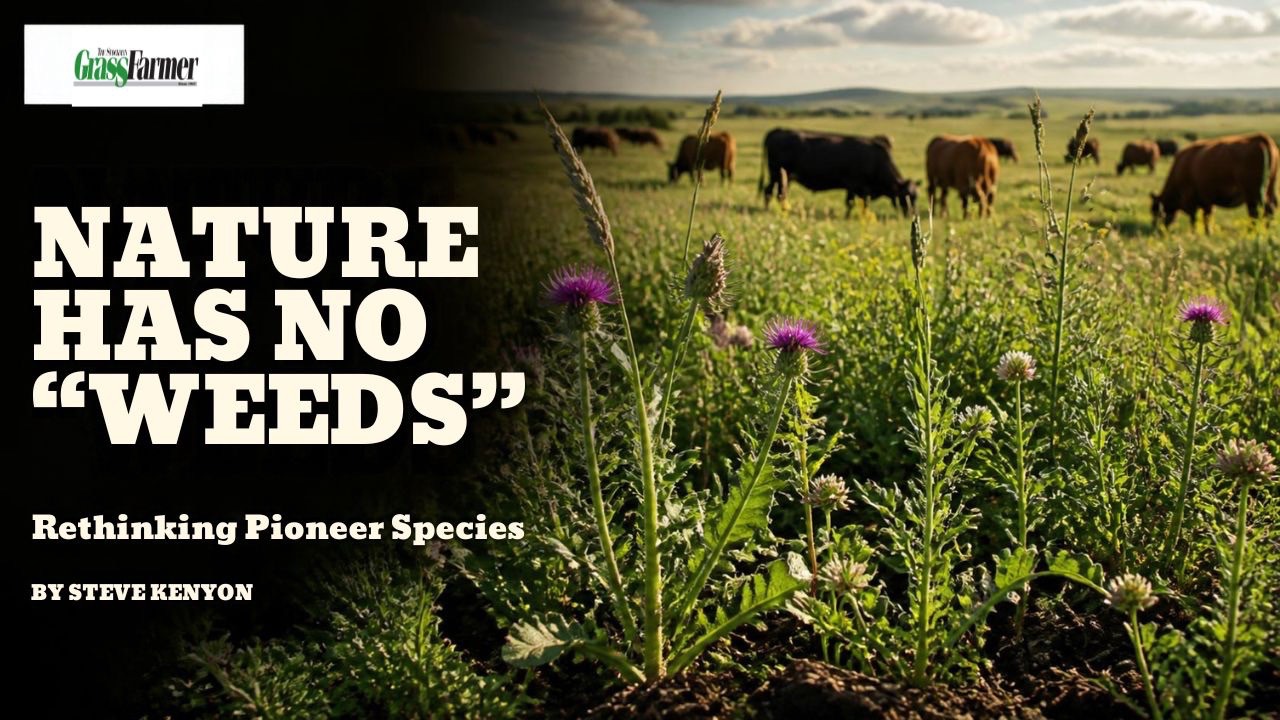
Let's use Canada thistle as an example. And for the record, it did not originate in Canada. It came from Eastern Europe. It has a very strong taproot and is not usually the preferred forage for livestock. It likes harsh conditions. If the soil is low in moisture due to lack of rainfall or evaporation, this plant can reach deep down into the soil to reach moisture that other plants might not be able to access. This plant is then able to put up a canopy that will start to cover the ground to reduce evaporation and run off. At the end of the season, when the thistle dies, the plant material will help form the trash layer or we call it a soil armor. These big tap roots also bring up nutrients that were not previously available at the surface and will now become available to other plants in the next growing season.
It is because of the pioneer species, that the conditions are now more favorable on the soil surface for more desirable species to establish. In time, as the conditions improve for the higher transitional plants, they will simply out compete the pioneers and take over the area. This is of course if we manage them properly and do not overgraze. We don't want to rip off the scab! If we try to attack the symptom of having these plants taking over an area by spraying or with tillage, we are not going to solve the problem. All we are going to do is set back nature's attempt at healing the land. The problem is the lack of favorable growing conditions; the symptom is the weeds. If you can favor the conditions for the desirable species, they will out compete the pioneer species. If we continue to allow selective grazing, which causes the desirable plants to be grazed over and over, we are favoring the conditions for the undesirables. Which type of plant will persist?
I'd like to quote one of my favorite authors. "It's pretty easy to understand why the “weeds" get the upper hand if you continuous graze. You are giving the “weeds” the perfect growing conditions to grow and reproduce and at the same time wiping out all their competition by overgrazing the good plants."
So how do we out graze a weed patch? Easy. The five most important things that any grazier needs to know. These are my Five G.R.A.S.S concepts.
Graze Period
Rest Period
Animal Impact
Stock Density
Soil Armor
Graze Period. Here is the quick and dirty on the grazing concepts as they pertain to weed control. The graze period needs to be managed so that the animals are not taking a second bite. This means that the animals are removed from the paddock before any new growth occurs after the first bite. Overgrazing is a measurement of time only, nothing else. It does not matter the number of animals or the number of acres. If you allow the animals to take a second bite, they will be selectively grazing the best plants, giving the less desirable plants or weeds the advantage. Which ones will survive? A short graze period is important.
Rest Period. The rest period is managed so that the plants have had adequate recovery time between grazings so that not only are there new leaves to graze, but also so that the roots have replenished their energy reserves. When I manage the pasture, I am actually managing the roots of the plants, not the tops. Again, overgrazing is a measurement of time. If you don't overgraze the desirable plants, they will out compete the weeds. A long recovery is needed to maintain a healthy system.
Animal Impact. Animal impact refers to the physical stimulation of the soil surface by the animal's hooves. This animal impact can stimulate the growth of new seedlings. These seedlings are the new generation that will replace the older plants, which will keep the forage strong and healthy. If we never have a second generation of plants coming in, what will happen to the forage stand? Older plants will die off leaving open spots. Nature will fill in the holes with a species that can survive. The animal impact can keep our pastures rejuvenating.
Stock Density. Stock density is a measurement of the number of animals per acre at a given point in time. Not to be confused with stocking, rate which is the number of animals you have on the pasture for the entire season. In reference to weed control, the higher the stock density, the better the utilization of a paddock. If every plant in the pasture is grazed or knocked over or stepped on, each plant has the same growing conditions for re-growth. If the stock density is high enough, the weeds do not get the advantage of selective grazing. Compare very high stock density to a haybine cutting the forage. Every plant is cut or knocked down. That is good utilization.
Soil Armor. Soil Armor is the protective thatch layer on the soil surface. It is like the skin on our body that protects all of the internal processes. It helps to maintain a healthy water cycle by reducing runoff and evaporation. It also regulates soil temperature to maintain working conditions suitable for our underground employees. If we have water holding capacity, the pioneer species don't have the advantage of accessing water with their deep roots. The forage stand has plenty of moisture so they can remain competitive.
If you can manage your forage stand to maintain strong, healthy roots, the more desirable species will simply out compete the weeds. However, it takes time. It may take multiple years to deal with a symptom and some years may just favor one species more than another. And yes, I do have areas on my ranch that have some pioneer species. I am only concerned about them if they are taking over an area. They are part of my polyculture and as long as they are not overpowering the rest of the stand, I don't worry about them.
Now before I get any phone calls or emails about how to deal with this weed or that weed, I may have different weeds than you do. My answer will be to read this article again. Manage for the desired species. Use the G.R.A.S.S concepts. Increase your stock density on those areas and trample them to the ground. If you don't have the patience to wait, or your local county or municipality is on your case about the weeds, then go ahead and mow them. Knock down and leave the material on the ground but just time it so you are not hurting the desired species. That mowing is like a grazing, so be mindful of the graze period and rest period. We don't want to set back our desired species.
Thanks again Allan for taking a chance on this "pioneer species" back in 2008. I will continue your work of trying to heal the industry of agriculture one article at a time. It has been an honor to be working with the Stockman Grass Farmer all these years. Rest in Peace my friend. God Bless.
Steve Kenyon ranches in Busby, Alberta, Canada, and can be reached at skenyon@greenerpastureranching.com. Www.greenerpasturesranching.com or on Facebook at Greener Pastures Ranching. His book The Calendar of the Year-Round Grazier is available from the SGF Bookshelf.
Stay connected with news and updates!
Join our mailing list to receive the latest news and updates from our team.
Don't worry, your information will not be shared.
We hate SPAM. We will never sell your information, for any reason.