Multiple Benefits of Silvopasture By Dale Strickler
COURTLAND, Kansas
One year I had a pasture rented next to a house with numerous apple and pear trees in the yard. The woman who lived there despised these apple and pear trees, because they interfered with her lawn mowing in the fall when the fruit dropped, and the rotting fruit smelled and attracted wasps and bees.
“No problem” I told her, “I can pick those up for you.” My motive was not entirely altruistic. Nearly every day in September I loaded the bed of my pickup with discarded plastic mineral tubs filled with fallen apples and pears, after picking a few for myself and the family of course, and hauled them all of fifty feet and dumped them across the fence to my cows.
The feed came at a very fortuitous time, because by late summer my warm-season grasses had nearly shut down for the year, my cool-season perennials had not yet really begun their fall growth cycle, corn fields had not yet been harvested so corn stalks were not yet available, and my fall planted winter annuals were just emerging.
This feed source falling into my lap (well, on the ground more accurately), there for the picking up was fortuitous. I was quite grateful for the feed, but loading by hand enough of a feed stuff that is 80% water to provide a significant portion of the feed for 100 cows every single day proved to be a daunting task.
To put the math into perspective, 100 cow-calf pairs need about 50 pounds of dry matter per day. That is 2.5 tons per day of dry matter. At 20% dry matter, it takes 12.5 tons of apples and pears to feed the herd for a day, or essentially a full semi truck load. It takes three apples to make a pound. It takes 6,000 apples to make a ton; that means it would take 75,000 apples to feed a cow herd for one day if they were the only feed source. Obviously, hauling enough apples and pears by hand to make a noticeable contribution to my feed supply in the evening after working a full-time job was not really feasible. Then an idea struck me, how much easier would it be if I just put an electric fence around the yard and turned the cows in?
Well, it turns out the lady liked the idea of cowpies in her yard even less than rotten apples in her yard, even if it did save her the trouble of mowing. She stressed to me that she mowed her yard to make it look good, and having a yard full of cowpies would not look good.
I just can’t wrap my head around that kind of backwards thinking. My idea of beauty is a grassy area (what some folks might call a “lawn”) covered with livestock and a cowpie deposited on each square foot every month or so, followed by enough rest to let all the flowers bloom before grazing again and cycling it all back into cowpies. But to each their own I guess, afterall it was her yard and not mine.
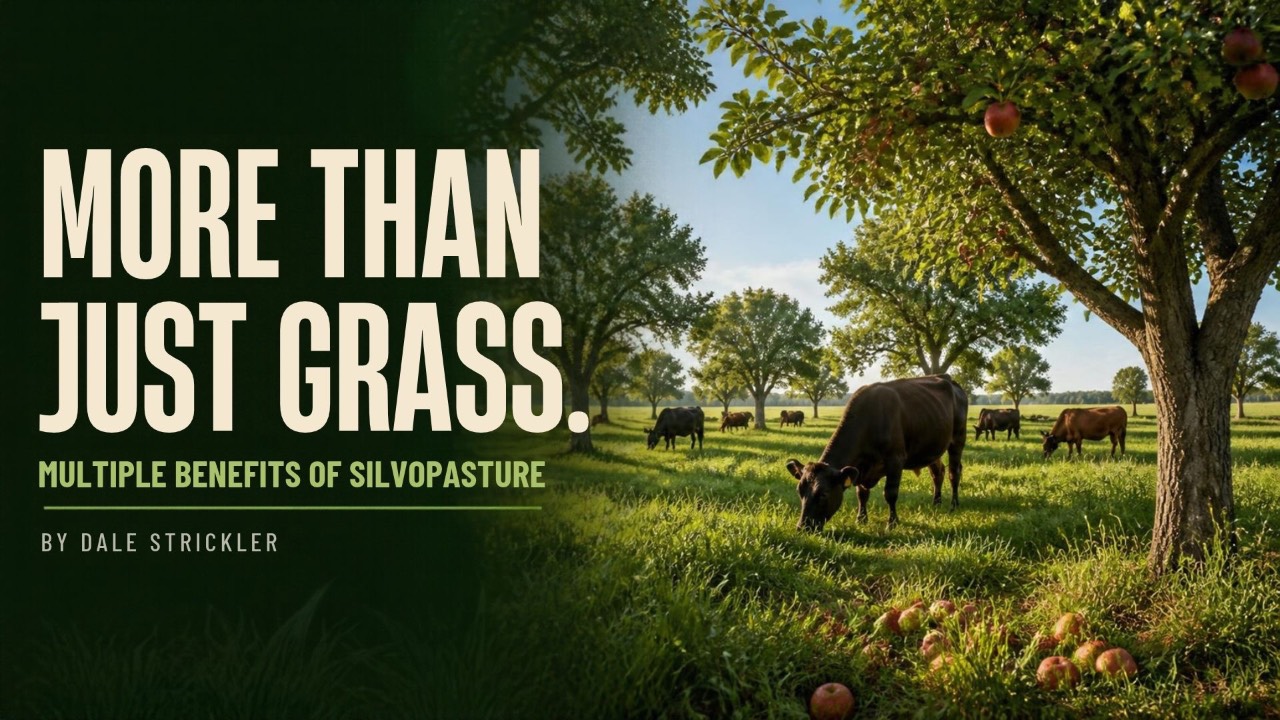
Then a different idea hit me. If I can’t bring the cows to the apple trees, what if instead I bring the apple trees to the cows? What would happen if some of my pastures were covered in apple trees on a widely spaced grid?
This is the concept of silvopasture. Perhaps the most seminal book I ever read was Tree Crops by J. Russell Smith, first written in 1929. Smith proposed replacing the growing of corn to feed livestock (and the associated soil erosion and organic matter degradation and massive level of annual inputs) with savannas of fruit and-nut-producing trees that would drop fruit in sequence throughout the year, on which animals could simply eat from the ground, without need for labor or input from us. He developed these ideas after traveling throughout the world and seeing systems in which, for example, pigs were fattened in the fall on chestnuts in Corsica, or acorns in the dehesa of Spain, or on mulberries and persimmons in the southeastern USA.
Smith’s ideas never became mainstream, despite their uncommon level of common sense. Think about it: the forests of the Eastern USA dropped abundant crops of acorns, chestnuts, persimmons, mulberries, walnuts, and a host of other fruits and nuts, all without any need for fertilizer, annual planting, weed control, or laborious harvest, and the soil got deeper and more fertile every year. A pig, fattening calf, or chicken are all too happy to pick these nutritious feeds up off the ground.
Somehow, our ancestors felt a sick compulsion to cut these feed-producing trees down, use teams of oxen to pull the stumps out, plow the soil, then every year laboriously hand plant, cultivate and hand pick corn to feed the same animals that used to get fed for free, and watch the topsoil wash away in a generation. Does that sound like an intelligent trade of land usage? Obviously, the uncommon-ness of common sense is not just a modern phenomenon.
Silvopasture is not just a theory, it has been a historical practice in much of the world. Its modern usage is based on layer upon layer of scientific principles of animal husbandry, soil science and botany. You see, many forage plants, particularly cool-season grasses and clovers, reach peak productivity at only about half the sunlight levels they receive in mid-summer. They produce just as much in half shade as they do in full sun, and the extra sunlight that falls upon an open pasture of cool-season grass just goes to waste. However, if the pasture is covered with widely scattered trees, that surplus sunlight can be used to produce high energy feed that drops at a time of great need, or to produce leaves that can likewise produce browse at a time of great need.
The aforementioned apples, for example, can produce around 15,000 pounds per acre of high energy fruit. Even at 80% water content, that is an extra ton-and-a-half of almost pure digestible energy per acre, all without reducing the yield of the forage below the trees. Additionally, the trees can provide shade under which animals can seek relief from the hot summer sun, then as the weather cools in autumn the trees drop their leaves, not only adding to the feed supply but enabling full use of the sunlight by the grass in the shorter days of the fall. Coniferous trees can be arranged to provide protection from bitter winter winds for protected winter grazing.
Dale Strickler’s family farm is in Courtland, Kansas. This is an excerpt from his blog. He is in the author of The Drought Resilient Farm and Managing Pastureland. He can be reached at Regenerative Wisdom, 620-617-6307, info@regenerativewisdom.com
Stay connected with news and updates!
Join our mailing list to receive the latest news and updates from our team.
Don't worry, your information will not be shared.
We hate SPAM. We will never sell your information, for any reason.