How to Manage Cool-Season Grasses/Legumes For Maximum Health and Profits By Jaime Elizondo
CRESCENT CITY, Florida
Cool-season grasses and legumes are VERY different in composition than warm-season perennials. When lush and growing fast they are very high in protein, low in fiber and their energy is in the form of sugars, which causes acidosis and it’s the reason that the manure forms a white crust when this is not addressed. The reason is that sugar is very high in oxygen or soluble carbohydrates on a dry matter basis, and if we consider the acidosis plus the excess ammonia produced in the rumenwe can see why more health problems develop.
When such forages are digested the microorganisms in the rumen digest the carbohydrate portion of the excess amino acids belching, so to speak, the ammonia which being a gas goes through the rumen walls and enters the blood stream causing high pH. This excess ammonia gas is also the main cause of frothy bloat.
While the rumen is having to cope with the lactic acid produced by the digestion of the highsugar content in these forages the blood and urine become alkaline, and we know that most pathogenic microorganisms in our cattle require a high pH to thrive and multiply.
Most common problems in this season on lush/green cool-season grasses/legumes are:
- Mastitis
- Pink eye
- Foot rot
- Strawberry wart
- Scours
The excess pH also means that many nutrients and especially trace elements required to fight off infection aren’t able to get into the bloodstream from the digestive tract. We can observe this by checking the blood at a good lab.
Excess ammonia has symptoms much like nitrate poisoning but
milder:
- Panting
- Lower heat adaptation
- Lower fertility
- Higher morbidity
All of these lower our profits, impacting their health. Any microorganism requires the next conditions to grow and multiply:
- Correct temperature
- Food source
- The microorganism
- Moisture
- The correct pH
The only factor we can control to better their health is the pH of their system, and we can do that with our management to where health problems diminish by four times and forage conversion efficiency improves by around 30%.
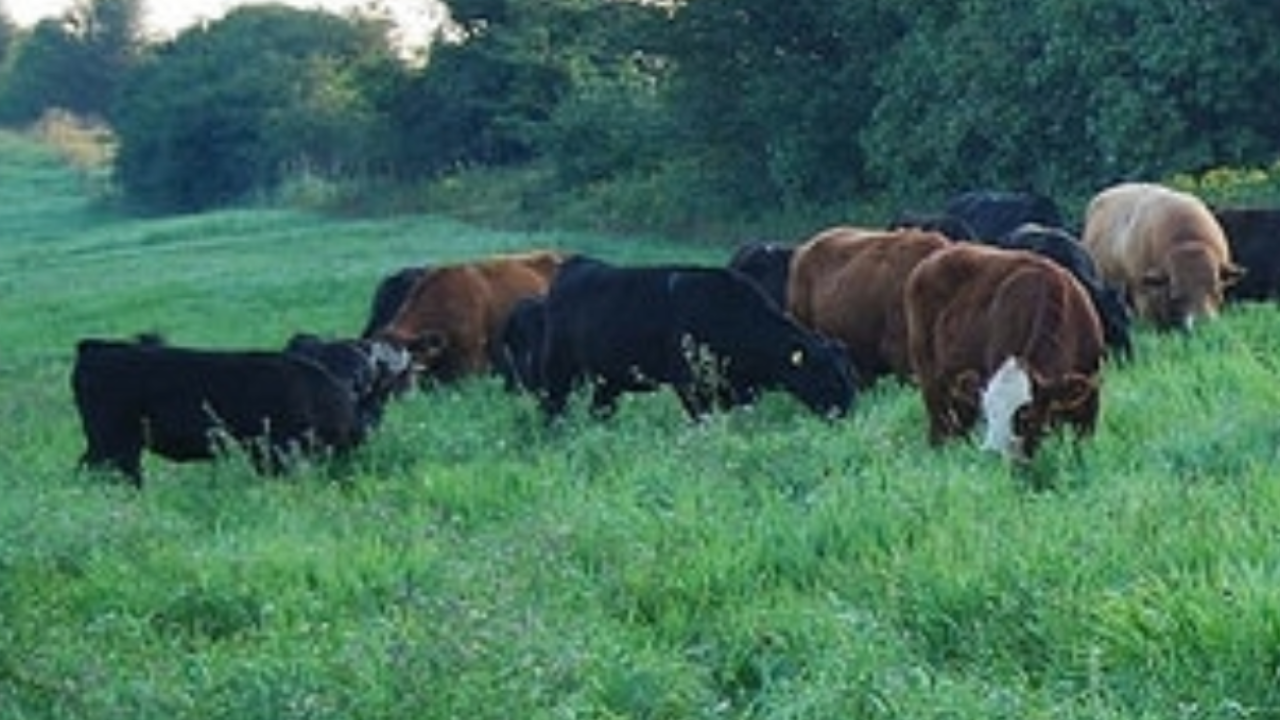
The best way is to allow the cool-season forage to mature some more or have some brown with green to be non selectively grazed. If allowed to select they go for the sweets first with the bad consequences to their health. If that’s not possible, then we can have them consume five to eight pounds of straw or low protein/high fiber warm-season perennial grass hay the first thing in the morning. Then, after they have consumed this nice smelling straw or low protein/ high fiber hay we can start giving
them their breaks, which in this instance could be three per day as the straw feeding counts as one break. The optimum would be feeding straw at 8 am, first grass break at 11 am, second at 1 pm and last at 4 pm. It’s important that they are hungry early morning and full at last break. Be observant to follow my motto, which is “ fat cows, fat cows, fat cows.” A fat cow can give us profits while a thin cow most always is difficult to sell!
If we give them a new break after 4 pm they may not be hungry enough to consume the straw in the morning. The same would happen if the grazing is selective instead of non-selective.
To increase stocking rate and our cattle’s health it’s important we understand how different forages, C3 or C4, are digested in the rumen. C4 forages’ energy is mostly in the form of oils or fats while C3 forages’ energy is mostly in the form of sugars or soluble carbohydrates.
By providing good straw early morning we also allow the cool-season forages to increase their energy levels by allowing photosynthesis to work since early morning is when energy is the lowest and nitrates or ammonia producing excess protein the highest.
Remember: fat cows, fat cows, fat cows means good body condition and not overly fat. ■
Jaime Elizondo has been a rancher all his life, in Mexico and Florida. Since 2008, he has been mentored by Johann Zietsman, who studied under Jan Bonsma. Jaime has taught Regenerative Ranching and consulted from Manitoba, Canada to Colombia,South America, as well as in Europe. He teaches how to keep costs low and profits high while improving the land. He may be reached at fcedemexico@hotmail.com or 832-776-0886, or visit Facebook page: Regengraze.
Stay connected with news and updates!
Join our mailing list to receive the latest news and updates from our team.
Don't worry, your information will not be shared.
We hate SPAM. We will never sell your information, for any reason.