Growing Soil By Steve Kenyon
BUSBY, Alberta
When I went to college many years ago, I was taught that it takes 100 years to grow an inch of top soil. That’s a long time. Why would I even try? After 25 years of working with livestock, plants and learning about soil health, I know now this is not true. We can grow soil a lot faster.
The thought process behind academia is that we leave residue on top of the soil and have that dead plant material break down and turn into soil. Most of this carbon cycles above ground back into the atmosphere. That is not how I grow soil. Leaving residue is very important but that is for managing the water cycle, not for growing soil.
Let’s take a look underground. We normally start with a combination of silt, sand and clay. This is our base. None of these are soil. What we need to do is convert this into soil by adding carbon to it. It’s pretty simple and our only tool that can accomplish this is the act of carbon sequestration. Carbon sequestration can be broken down into three processes.
- Photosynthesis is how the plant takes carbon out of the air and turns it into glucose. Most of this glucose is used by the plant for growth and reproduction.
- Next we need exudation. The plant will push about 40% of this sugar out into the soil as exudate. This is food for the soil biology. The plants provide glucose to the biology and in return, the biology brings nutrients, and they help to maintain overall plant health.
- Lastly, we need biological conversion. We need this biology to convert some of this exudate into a long term stable soil carbon. That’s it. Pretty simple. It is our job to use the livestock to manage the tops of the plants, to allow the roots to do their job.
As a producer, I get everything I need if I focus on sequestering carbon. The more carbon I add to the soil, the more water holding capacity I have, which means more production. As I add carbon, I also get free fertility because of the soil biology. Arbuscular Mycorrhizae Fungi is an example of this symbiotic relationship with the plants. In return for nutrients they gather from the soil, the fungi gets glucose to survive and converts it into Glomalin, a long term stable carbon that stays in the soil for decades. Another job of this soil biology is to balance the Carbon Nitrogen ratio. In the soil, my biology will balance this out at about 24 to 1. So, as my carbon increases, so does my nitro gen availability. It is a win, win, win. This exudate is what glues the silt, sand and clay together and causes good aggregation. We are building soil structure. It doesn’t matter what your soil base is. We are going to use the plants to literally convert whatever your base material is into soil. We add this exudate to sand to make soil. We add it to silt to make soil. We add it to clay to make soil.
It is simple, if we want to grow soil, we need to sequester carbon. If we want to grow soil faster, we need to sequester more carbon per day and for more days of the year. To sequester more carbon per day, we need to capture more sunlight. Our job as a producer is to increase albedo. This is a measurement of how much sun light is coming down vs how much gets reflected back. Don’t waste your sunlight. Don’t let it reflect. We need more living plants covering the soil to absorb more sunbeams. I don’t want sunlight to hit bare soil. We need a full canopy of green living plants for as long as possible.
How about increasing the number of days that we are collecting sun beams? I don’t want a crop that only grows for 100 days. We need living roots in the soil for a longer season with more ground cover. As a rancher, can you keep your pastures in a growing vegetative stage for as many days as possible? If you are a crop farmer, how do you get a green living plant in your soil during the shoulder seasons? Early spring? Late fall? Do you have living roots in the soil then? Can we get 200 days of sequestration? 300 days? A big reason for this is to feed the biology. If you have an active soil biology during the summer, and you suddenly remove the crop, what will they eat if exudation stops? They start eating carbon. Don’t let them eat your hard-earned carbon. You added it, now do whatever you can to keep it. Keep that living root in the soil for as many days as possible. I live in Alberta, Canada, and I can sequester carbon through the snow late into the season.
Of course, this is easier in a wet environment. Just keep your graze period and rest period in check to keep those plants vegetative and exudating glucose as much as possible. Of course, in very dry environments, this is a lot slower to get started, but it is your job to change the environment. We need to first fix the water cycle to hold on to more water. Then we can start maximizing albedo and sequestering more carbon.
But the proof is in the puddin’, right? I have a couple of examples from our ranch that shows how fast we can build soil. The first one was a research project with the University of Alberta. We were one of 30 different locations that compared a continuous grazing system to an advanced grazing system. The two pastures were chosen because of their similar history, topography, soil type etc. The only major difference was my change to regenerative grazing management 15 years earlier on our land. The other pasture has always been continuously grazed. We are in the grey wooded soil zone, which has a very heavy clay base and we start with very little top soil. After 15 years of my advanced grazing system, the average SOC% was 11% on our side of the fence, which compared to the continuous grazed pasture at 5.2%. There is a very distinct, dark Ah layer on our side that averaged 10.8 inches deep. There is no visual Ah horizon in the control. Here is the puddin’. We grew almost 11 inches of topsoil in 15 years and more than doubled the SOC%. It does not take 100 years!
Just to show that this is not a fluke, we had another pasture demo that was done by the Gateway Research Organization. We took soil samples in 2006 that showed an OM% of 2.6. After 17 years of our management, the Average OM% was up to 7.1% in 2023. And again we have between 6 and 12 inches of beautiful black topsoil. Again, we are in the grey wooded soil zone. We converted our clay into soil through the root systems.
How did we do this? I will give credit to the five grazing concepts. G.R.A.S.S. Graze period, rest period, animal impact, stock density and soil armor. By managing these concepts on a perennial polyculture we were able to sequester carbon at a much higher rate than what academia thinks. As Gabe Brown says, “Nothing builds soil faster than a well managed perennial polyculture.”
As a society, we need to start looking at net carbon as a whole system, rather than just trying to measure emissions at a single point in the carbon cycle. We just need to sequester more than we emit. There is no magic bullet when it comes to carbon. It’s a cycle. Matter cannot be created or destroyed. It just takes management and as farmers, we are one of the very few industries on the planet that can actually sequester carbon.
Regenerative Agriculture is not a recipe. We are looking at a whole system that works together to build soil. The livestock, the plants and the soil life, all working together. It’s just a simple mindset change. Instead of growing plants from the soil, let’s aim to grow soil from the plants. God bless
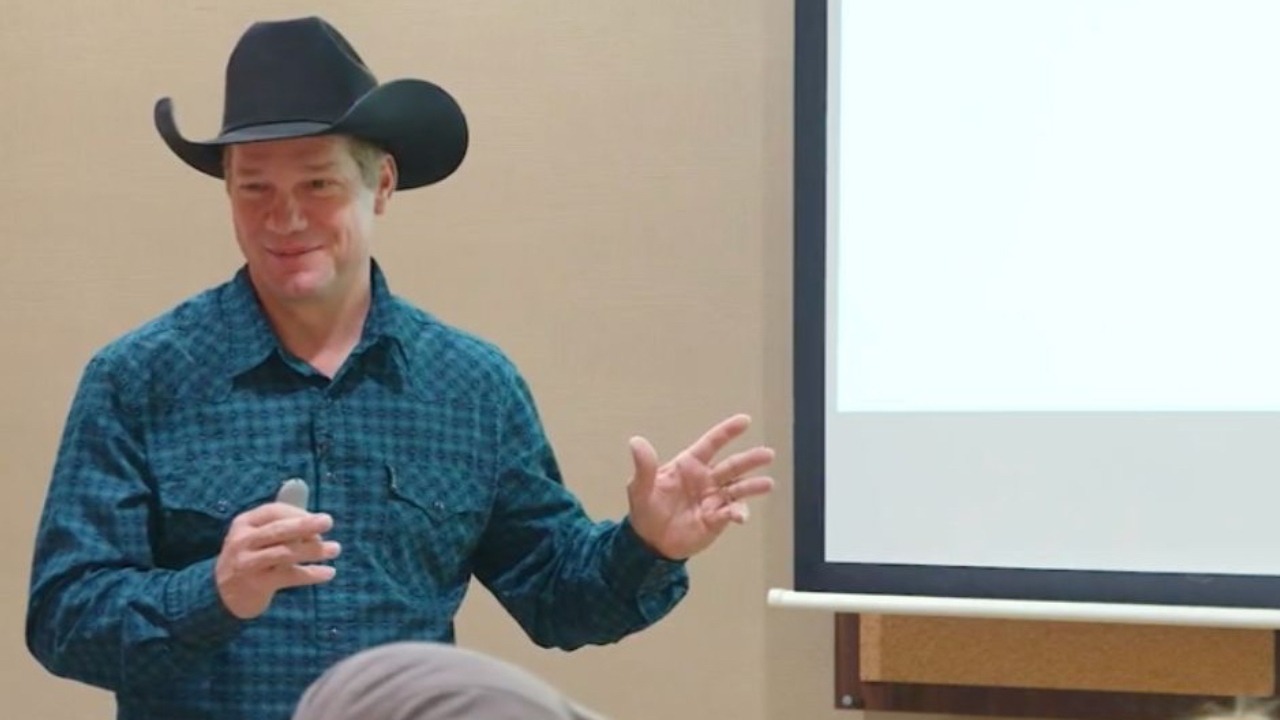
Steve Kenyon ranches in Busby, Alberta, Canada, and can be reached at skenyon@greenerpastureranching. com, www.greenerpasturesranching. com or on Facebook at Greener Pastures Ranching. His book The Calendar of the Year-Round Grazier is available from the SGF Bookshelf.
Stay connected with news and updates!
Join our mailing list to receive the latest news and updates from our team.
Don't worry, your information will not be shared.
We hate SPAM. We will never sell your information, for any reason.