Grazing Cover Crops with Sheep By Jeremia Markway
Eugene, Missouri
Sheep seem to be the perfect animal to integrate in row crop operations particularly when there are cover crops such as cereal rye, oats and brassicas available to graze. What makes them so well suited? Let’s dive into a few of the reasons why they fit together so well.
Reduced compaction and pugging.
One of the biggest fears most crop farmers have is that livestock will compact and pug their fields. It is a valid concern, particularly in fields that use conventional tillage versus no-till. However, sheep don’t track up the fields like cattle do due to their smaller size. Most of the time when we remove the sheep from a no-tilled field, you can barely tell that they were there, except for the beautiful dark green foliage that results after removal. Granted, conventional tilled ground with light seeding rates can be more susceptible to hoof traffic due to poor soil structure, so avoid those situations if possible.
Low water requirements.
Some say that sheep grazing lush cover crops don’t need water. That may or may not be true depending on the situation. However, I sleep better knowing they have access to water. Usually, if it’s not extremely dry, those water needs can be met by water standing in a terrace chan- nel or drainage from a tile outlet. If it’s too dry for that, we have cut fertilizer totes in half and offered water in the field. By doing so, you can monitor their water con- sumption and adjust accordingly. We have found that the sheep use very little water while grazing rye and similar crops, thus making them ideal livestock for grazing them. Still, it’s better to have it and not need it than need it and not have it. Plus, the guard dogs need to drink.
Minimal facilities to operate.
In the crop producing area we graze our sheep, most of the good old woven wire fences, a remnant of diversified farming operations of yesteryear, have been removed. This means to graze the cover crops, we have to build and take up electric fence every grazing season. Our cover crop grazing season usually starts sometime in the fall (depending on corn harvest, planting date of the covers and rainfall) and ends around April 1(when the farmers wish to terminate the covers to plant soybeans). While constructing fence that would comfortably secure stocker calves and let us rest easy at night would be a bit daunting, we have found that two strands of either soft or high tensile 14 gauge electric fence wire works well for containing our sheep. The key is ensuring they have plenty of quality forage to graze.
Fiberglass posts spaced at about 45 feet and a good solar or battery powered charger are all that is needed. We use old hedge posts that mark field corners or construct corners with 1” fiber- glass rods and hand tighten the wire. It is a simple, effective sys- tem. It doesn’t take long to construct a mile or two of this type of fence and it’s even faster to take up if you have the right equipment. When it is time to gather the sheep and take them home, some portable panels, electric netting and/or snow fence and a good stock dog is all that is need- ed. You really don’t even need the stock dog but they sure make life easier and more enjoyable. We simply build a portable pen in the field along a gravel road or farm lane and load the sheep right onto the gooseneck stock trailers. More substantial facilities would be needed to gather cattle, thus giving the advantage to sheep.
Weatherproof.
People often ask how the sheep handle the winter weather on the cover crop fields. The answer is remarkably well. This past winter, for one group of over 500 ewes, I unrolled one bale of hay while they were grazing a rye field. The main reason was that we had 1/4”-1/2” of freezing rain, then it sleeted 2”, and finally snowed about 5”. I felt sorry for them and unrolled a round bale of mixed grass hay. The snow and ice stayed on for almost three weeks. During that whole time, those dry ewes didn’t miss a beat. They didn’t eat the hay but rather spent their days pawing through the frozen ground covering to reach the tender rye hidden below. I’ve seen them paw through snow before, even up to 11” to reach forage below, but I had not witnessed them pawing that aggressively through ice to get to good feed. Seeing how well they came out of win- ter after several spells of such weather, I gained a whole new appreciation for their ability to thrive in winter weather.
Most of the fields we graze have some shelter such as trees along a drainage ditch or field edge that offer protection from the wind. But even if they don’t, the sheep seem to do just fine. Often, they will get below the crest of the hill or in a grass waterway or below a terrace to get out of the wind.
Excellent nutrition.
The old timers used to say a fat ewe going into winter is like money in the bank. I would have to agree. We lamb on pasture in May and dry ewes going through winter on cover crops is as easy as it gets. Cereal rye, oats and brassicas offer excellent nutrition to get ewes and ewe lambs to flush before we turn rams in around December 7. Ewes coming off cover crops in the spring tend to be in excellent condition, which sets them and their lambs up for a productive grazing season the rest of summer. Better nutrition means more lambs and healthier lambs as well. Additionally, ewe lambs grazing cover crops have a better breed up due to the higher quality forage and level of nutrition.
Wrapping up.
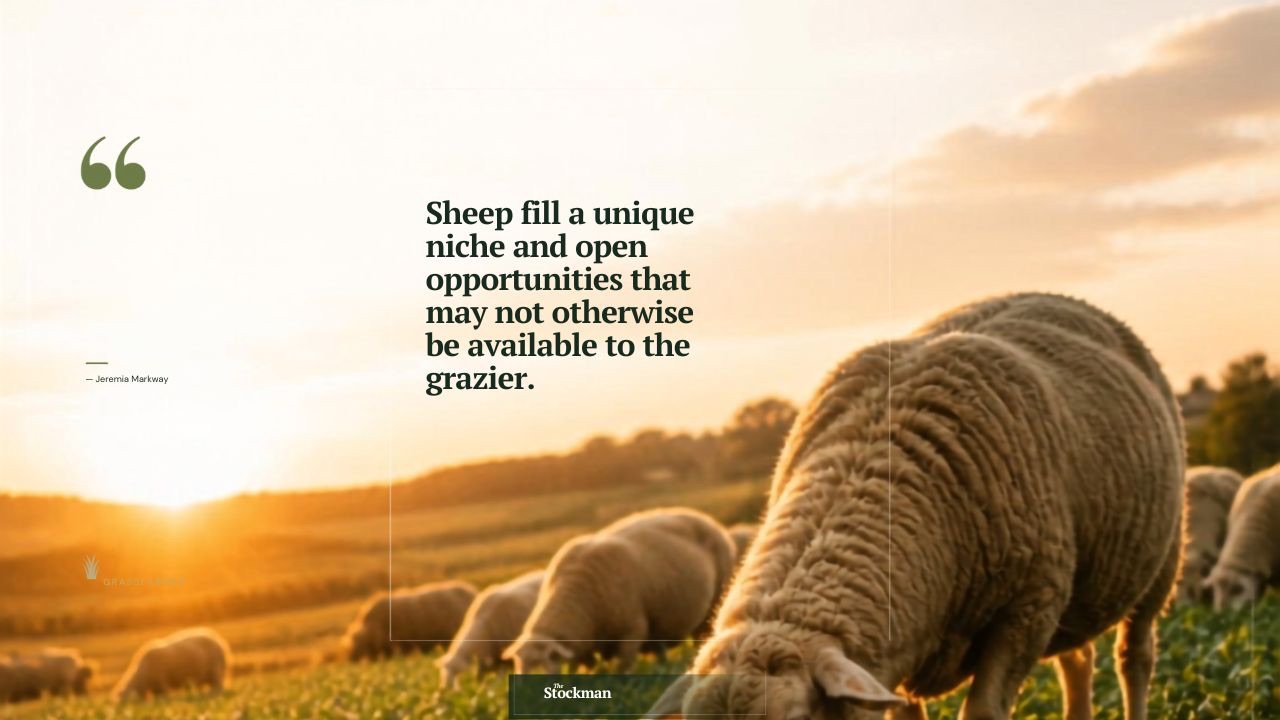
Hopefully, I have stimulated your interest in grazing cover crops with sheep. All livestock will help speed up the biological process of turning crop residues and cover crops into fertilizer and building soil health. However, sheep fill a unique niche for the reasons discussed above and open opportunities that may not otherwise be available to the grazier. Grazing cover crops has allowed us to expand our flock and provide more grazing days at home for other livestock, while supplying excellent forage for the flock. Similar opportunities are available in many areas, you just have to do your homework and find the right crop farmer to get your foot in the door and give cover crop grazing with sheep a try.
Jeremia Markway ranch es with his family in central Missouri raising breeding hair stock and cattle for the profit minded producer. Contact him at markwayranch.com.
Stay connected with news and updates!
Join our mailing list to receive the latest news and updates from our team.
Don't worry, your information will not be shared.
We hate SPAM. We will never sell your information, for any reason.