Getting Started with a Grazing System - The Order of Things - Part 1 By Victor Shelton
INDIANAPOLIS, Indiana
If you are considering updating your pas- ture system or more importantly, considering converting a crop field to pasture, there are things to consider and a good chronological order of how you should do things. Critical infrastructure for a grazing system starts with two things: external fence to set the boundaries of the system and to keep the livestock on the property and to make water available where it is needed. When possible, a pressurized system for water is usually ideal because it allows you to put water exactly where you really need it. Ponds and springs can also be a part of the system, but quite often limit where water can be gravity flowed and limit flexibility. But, if a pond is present, utilize where possible. Pressurized systems usually include buried water lines. Getting these installed, filled back in, and leveled back up is a fairly major soil disturbing activity.
Watering facilities such as permanent tanks, hydrants, quick couplers, etc. are usually installed in the same time frame as the pipeline. Sites with permanent tanks that will be used under wet conditions or used frequently, also called all-weather type tanks, need a rock or concrete pad around them to stabilize and maintain the site. All of this activity with the watering system needs to be one of the first things done. You certainly don’t want to seed or reestablish a field to turn around and disturb it when installing your pipeline.
You also don’t want internal fences installed prior to the water- ing lines so you don’t have to cut or try and go under them. External fences can be started and finished as time allows. Your biggest decisions on these fences are deciding the best locations for external gates. You really want them located for easy access to roads or driveways and if they are tied to other pastures or systems, they should be placed where they will complement the rotation.
That last statement reminds me that I need to step back for a second and emphasize that before you start installing much of anything besides external fence, you need a plan. Most grazing systems don’t have to be that difficult and depending on the site, can be quite simple and that’s a good thing.
It’s not as simple, though, as just dividing the field up into some random number of paddocks, there is more to it than that.
The number of paddocks in the system, especially if they are permanent paddocks and not sub- divided, influences the amount of rest a paddock will have prior to being grazed again. If you have four paddocks in the system, twen- ty five percent is being grazed and the remaining is resting/recover- ing. Livestock would need to be moved about every seven days in this system to provide an average rest period of 30 days. That rest period is normally about 14-15 days in the early spring under good conditions, then closer to 30 days until early summer and then it is closer to 45-50 days rest that is needed.
A typical eight paddock system, which used to be extremely com- mon, with an average rest of 30 days, would have livestock usual- ly being moved about every four days. If you take the average rest period that you need and divide that by the number of planned paddocks, you get your average move period. Okay, that said, I must state that I’m totally against moving livestock from paddock to paddock by the calendar, e.g., every four days, every seven days. If you do this, you will either be overgrazing or undergrazing most of the time. To treat everything in the system well, those moves need to be based on the forage. The best way to do this is to monitor residual forage height, the forage left after a grazing event.
I call residual forage measure- ment “stop grazing” heights. This amount is the shortest forage present, NOT the tallest. For reference, most cool-season forages, e.g., tall fescue, orchardgrass, red clover, should be three to four inches.
A simpler system, one that I often refer to as a linear grazing system, does not advocate set paddocks, but rather longer, more narrower fields, with planned advantageous water locations, where there is never a set amount of allotment. The size of the allot- ment that the livestock are using is determined with each move based on the number of animal units present and the amount of forage present.
Both of those numbers change over the season, calves grow, and available forage is also constantly changing. Temporary fence provides the boundaries of these allotments. I personally prefer that the permanent long divisional fences be no more than about 300 feet wide. It’s less fence to put up, take down and move, especially if you are moving animals every day. You also get less walking back and forth along the fence line than you get with long narrow strip allocations and less negative impact.
It is important to think about the movement of the animals from one paddock or main paddock that’s being strip grazed like described above to the next paddock. In the linear system, the number of main divisions may be influenced somewhat by what end of the field you want to end in. If you want to finish on the same end you started, then you need an even number of sub-fields; if you want to end up on the opposite end, then you need an odd number of fields.
You really don’t want to have to make animals cross over fields that have already been grazed, so how the fields are laid out takes a little thought. Occasionally, a short lane may be needed to help move animals from one point to another, bypassing fields that are not yet ready to be grazed again or ones that you want to skip for the moment.
It is also important while laying out the paddocks to think about slope, aspect, soil types, drainage and shade. Not all fields are perfectly level and have the same soil and condition. The way livestock graze an area or field is highly influenced by nutrient availability, location of water, shade, slope and even soil moisture in some instances.
Long slopes, especially steep ones, are sometimes better broken up into terraced fields so the livestock are not having to go up and down the hill as much and walking more with the contour. Water is then placed within or along this boundary and if there is any trailing, it is adjacent of the slope, not with the slope, reducing potential for erosion.
Areas that tend to be wetter, such as creek bottoms, are best separated, if practical, and utilized when they are drier. Such areas make good areas for summer on hot days because they usually
also include some shade. It is also beneficial to manage poorer areas, such as steep or thin soiled areas, separately so you can work on improving them.
Shade is another entire topic to consider. Most livestock can benefit from some shade, especially when temperatures are above 85 degrees F and/or humidity is over 70%. If both are 85 or higher, then shade becomes critical and animals need to have fresh, cool water available during the heat of the day to allow them to cool down. Even if they don’t seem too hot, intake will be reduced along with production for that time frame.
Fields with woods or trees located on the West or South side will have some shade during the heat of the day. If shade is limit- ed, you may want to try and save paddocks with good shade for the really hot days or consider adding some more trees or portable shade to the system for the long run. It takes a little more work, but it’s not unreasonable to move the live- stock to areas with no shade in the late evening and then move them back to areas with shade during really hot time frames.
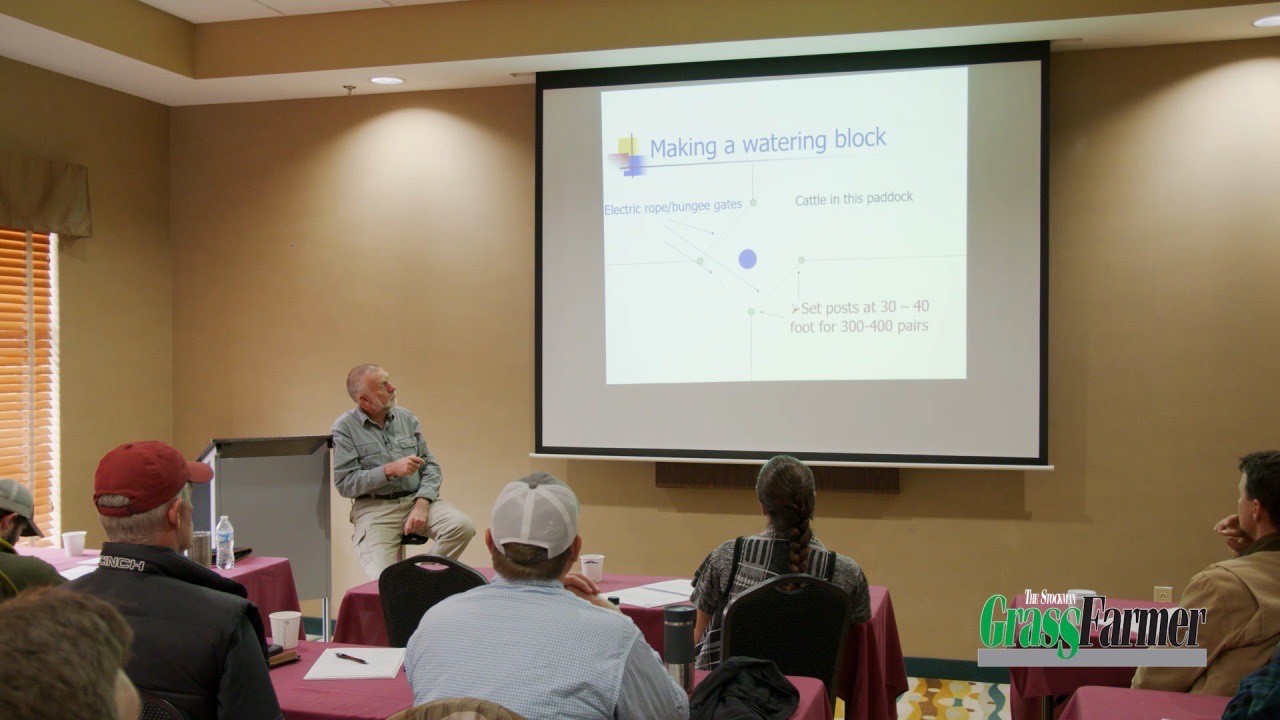
Once you have decided how you want to lay out your paddocks and how you will rotate through them, you can then decide where water points need to be. I will say right off, I have never regretted a single watering site I ever put in, but I have regretted some that I didn’t. You can’t have too much water.
Keep on grazing! ■
Victor Shelton is an NRCS State Grazing Specialist in Indianapolis, Indiana.
Stay connected with news and updates!
Join our mailing list to receive the latest news and updates from our team.
Don't worry, your information will not be shared.
We hate SPAM. We will never sell your information, for any reason.