Beneficial Bale Grazing is an Art and a Skill By Steve Kenyon
BUSBY, Alberta
The year was 1999. I was working long hours, six days a week off farm and still trying to feed cows. I had to figure out a way to feed once a week. I just did not have the time.
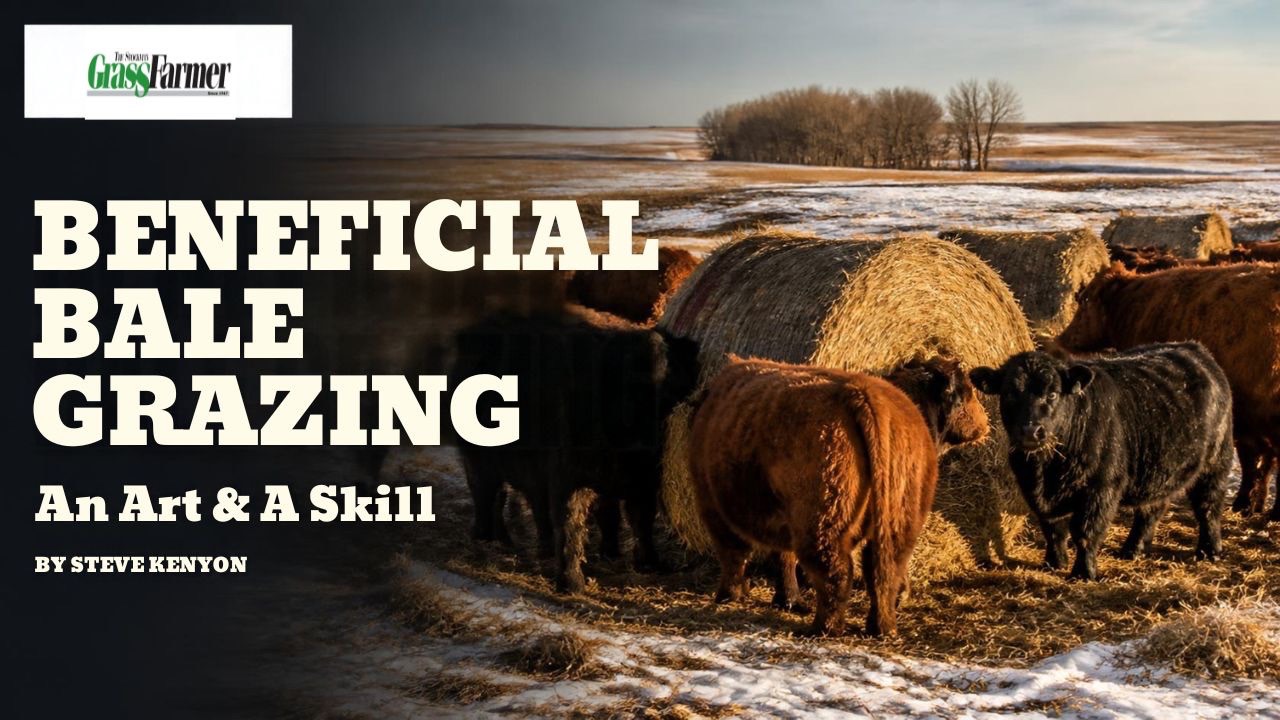
I already had my pasture broken up into multiple paddocks for sum- mer grazing so I decided I would put out enough feed for 3.5 days in two of my paddocks on my day off. Then I would only need to open a gate once during the week. It worked well. I played around with the number of days a bit, worked on understanding electric fence in the wintertime, and had some pretty successful results. Each year I learned a bit more, made a few mistakes but I was quite happy with the results. The fertility added to the pasture was amazing. I easily doubled the production of the forage where we placed the bales.
In 2001, I bought some green feed bales and put out a week’s worth in six paddocks and removed all the twine. That was 45 days worth of feeding done all in one day. I thought to myself, why would any- one want to feed everyday? This was so easy. Then we hit the drought of 2002. They called it the 100 year drought. Everything went brown in the pastures, grasshoppers had everything chewed off except my bale grazing spots. They were all standing two feet tall with lush grass. Maybe the benefit was not the added fertility, maybe its mostly about the improved water holding capacity that the “wasted” hay provides.
I have tried bale grazing many different ways and have made many mistakes over the years. Bale graz- ing is a bit of an art but there are two “must haves” when I feed in this manner. First, I need to “waste” this feed in the right place. This is a tre- mendous pasture rejuvenation tech- nique. It is the only tool I have that heals the water cycle right away. The second reason is that it lowers my labor and equipment costs. My yardage cost drops substantially compared to feeding daily.
FIXING THE WATER CYCLE
I use to think that it was all about the added fertility, but after seeing the results of bale grazing verses the results of unrolling bales on a paddock during a drought, I realized it is more about the water. I have done the experiment quite a few times. I’ll bale graze on one paddock and unroll bales on one next to it. I will unroll until the paddock is filthy dirty with manure and urine. To the point that I don’t want to unroll any more.
When unrolling, they clean up too much. I don’t have enough residue left and it does not heal the water cycle. In the unrolling scenario, the fertility added gets used up and in a few years the production of the forage drops again. On the bale grazing side, we fixed the water cycle because of the extra “waste.” This improves diversity and feeds the soil microbiology. This gets us going on a perpetual fertility system for many years. Bale unrolling also increases my yardage costs quite a bit. Don’t get me wrong, I still unroll a lot of bales as I have a bale truck. I will unroll bales to help the cattle clean up a bale grazing field, I’ll unroll during calving or during any really wet periods. It depends on a lot of factors. I have just found that in my environment, the labor and pasture improvement is a lot better if I can bale graze.
Water is the most important nutrient by far. If your soil test requires 50 pounds of nitrogen to grow X amount of forage, it will need about 10,000 pounds of water. That “waste” left behind on the ground will help reduce runoff and evaporation. There is no such thing as “wasted” feed as long as it is “wasted” in the right place. Your pasture production will double or triple or more over the next five to ten years because of the added water holding capacity.
From my experience, the amount of waste depends on the type of feed and my ability to manage the electric fence in the winter. Normally I have about 10 to 15 % waste. However, depending on the quality of the feed, I have had between 2% and 40% “wasted.”
I have also observed the “waste” in multiple other feeding methods. With bale grazing, the majority of the waste I see is the unpalatable stems and lower quality parts of the feed. When using a bale shredder or even unrolling, I see a lot blowing off in the wind or dropping through to the ground. We are losing some of the higher quality feed with these types of feeding. Plus, we don’t get the added water holding capacity.
There are many different strate- gies when bale grazing. The length of the graze period is a popular topic. A minimum graze period for me is three days. This provides enough bunk space so that all the cattle have access to eat. If you try to bale graze one or two days at a time, your boss cattle will get more and you will end up with some other cattle losing body condition. I like four to five days, I’ve tried a week, two weeks and even a 30 day graze period. The longer the graze period, the lower the labor, but the trade off could be more “waste.”
When I do a longer graze period, I’ll help them clean up at the end of a paddock by unrolling some hay. This will bump up the ration a bit to help them clean up on the last day or two. This works if I’m bale grazing younger animals as well. Unrolling bales as a supplement is a good option. It does increase your yardage a bit but depending on the circumstances, can help with clean up. As an example, two years ago I had a 28 day paddock planned budgeting at feeding 34 lbs/hd/day. On about day 25, I started supple-menting by unrolling one bale a day. I ended up grazing that paddock for 35 days and still maintained the desired 34 lbs/hd/day. They cleaned up quite well. I estimated about 15% waste. But WOW the pasture production on those hills that sum- mer was amazing. The other big saving economically was that all the manure that needed to be hauled was already where it needed to be. I have not hauled manure since 1998 and I don’t have any plans to do so anytime soon. That is an extra cost that I do not have.
One of the biggest issues most producers have is in maintaining a hot fence in the winter. Snow acts as an insulator so even though the fence voltage reads high, the shock value is reduced a great deal. I have a few tips to maybe help with this.
* Have your cattle well trained in the fall. Put a little extra effort in reminding the cattle that the fence is hot before the ground is frozen.
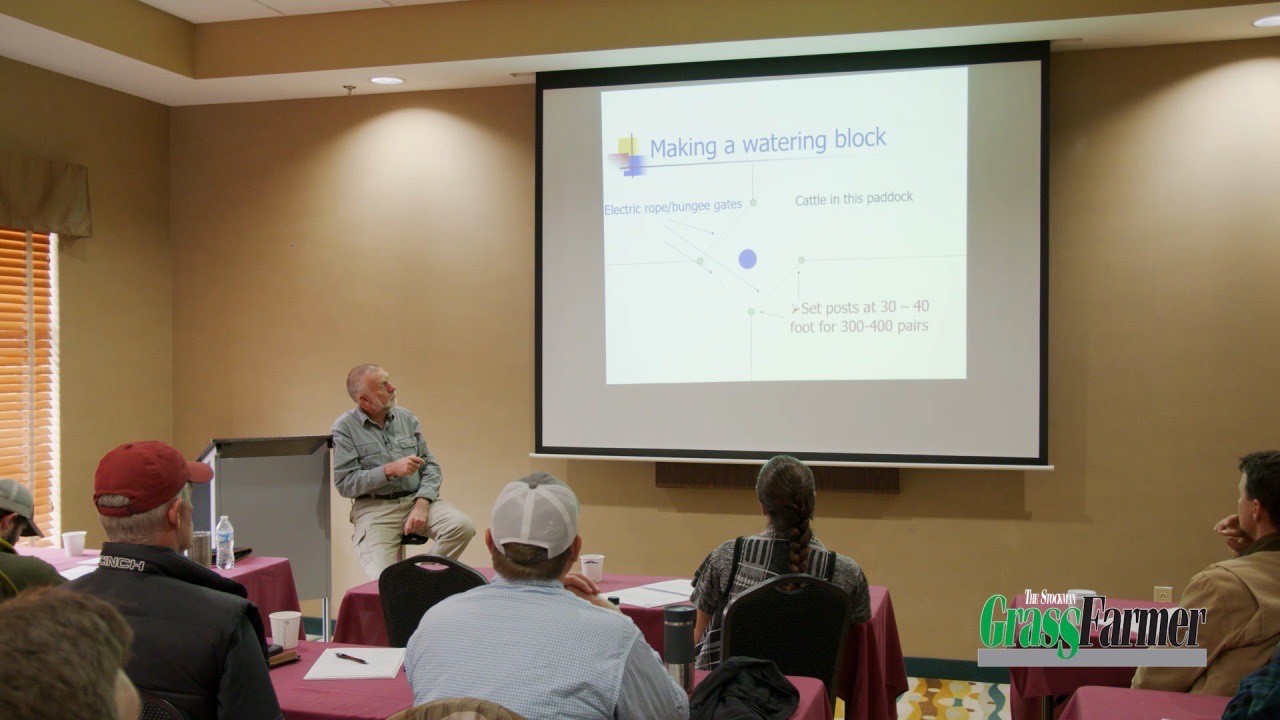
* Build an educational fence by the water. I like to put a strong two wire fence close to the water where Icanhookuponeasahotwireand one as a ground wire. When they hit both wires together, they get a full shock. We are not relying on the frozen soil as the ground for the fencer. I also like to plan to be able to add a second wire out on the cross fence if need be. One hot and one ground.
* When strip grazing, always have a back up fence set up. If you are leap frogging down a paddock, you need to have a second cross fence. Always put up the back up fence as soon as you take it down. This way the cattle are pre occupied with fresh feed when you are setting it up. If you wait to set it up later, not only do you not have a back up fence in place, but as you set it up, the cattle will be pushing on the first cross fence eager to get to fresh feed. You are asking for a wreck.
* Never move in the dark. Way up north in Canada, this can be an issue as we lose light early in the winter. The cattle have trouble seeing the hot wire in the dark so if I have to move them, I like to unroll a bale first as a supplement. This distracts them for a while so I can go take down and set up a cross fence. Then they wander into the new bale grazing strip slowly.
* Never give them a reason to reach under the fence. I like to leave enough space between rows so that they are not tempted by feed to reach under the fence. This may leave a gap in the “waste” coverage but you can always come back the second year and fill in the gaps.
* I like to hear a snap. It is good if the fencer is close enough that the herd can hear the tick of the fencer. Either at the water or by a common area that they need to walk by. What is even more effective is I will purposely try to have a wire “snap” somewhere. As long as it does not short out the fence, a good snap will remind them that the fence is hot. Even though the cross fence barely has a tickle, they are still scared to touch it.
* If you are struggling to keep cattle in, the bi-polar fencer is an option. With this type of fence, you will need to run two wires.
One wire sends out a half positive charge and the other wire sends out a half negative charge. If the cattle touch either wire, they will get a half hit, but if they touch both wires at the same time, they will get a full charge. Again, this system does not rely on the frozen soil to conduct the return pulse.
Maybe bale grazing is not for you. Maybe you will need to take the idea and adjust it to fit your context. In wetter environments, it might take a bit more management in order to protect the soil from too much animal impact. You don’t have to bale graze all winter. How many months or weeks out of your winter is the ground dry or frozen? Bale graze when you can, and feed when you have to. And in the words of Joel Salatin, “If something is worth doing, it is worth doing poorly first.”
Bale grazing is a skill. Don’t expect to get it right the first time. I have made many mistakes improv- ing my technique over the years. I have determined that it is more of an art form. As long as your labor and equipment costs are low and you’re putting the “waste” in a good spot. You did it right. It is a mind- set shift. Go ahead and “waste” a little feed, you will gain a lot more in the long run.
Steve Kenyon ranches in Busby, Alberta, Canada, and can be reached at skenyon@greenerpastureranching.com. Www.greenerpasturesranching.com or on Facebook at Greener Pastures Ranching. His book The Calendar of the Year-Round Grazier is available from the SGF Bookshelf.
Stay connected with news and updates!
Join our mailing list to receive the latest news and updates from our team.
Don't worry, your information will not be shared.
We hate SPAM. We will never sell your information, for any reason.