Being a Guardian for Your Sheep By Will Winter, DVM
ALBANY, Minnesota
The three main aspects to any and all successful livestock operations are genetics, proper management, and nutrition.
Genetics includes careful study and selection to pick the right breed for each application. Typically the hair sheep tend to be the strongest, most parasite-resistant and reproductive of all the breeds, followed by the black-faced woolies and lastly the white-faced woolies. Each breed also differs in traits for resistance as well as adaptation to forages, weath- er conditions, epigenetics, and variables from one operation to another.
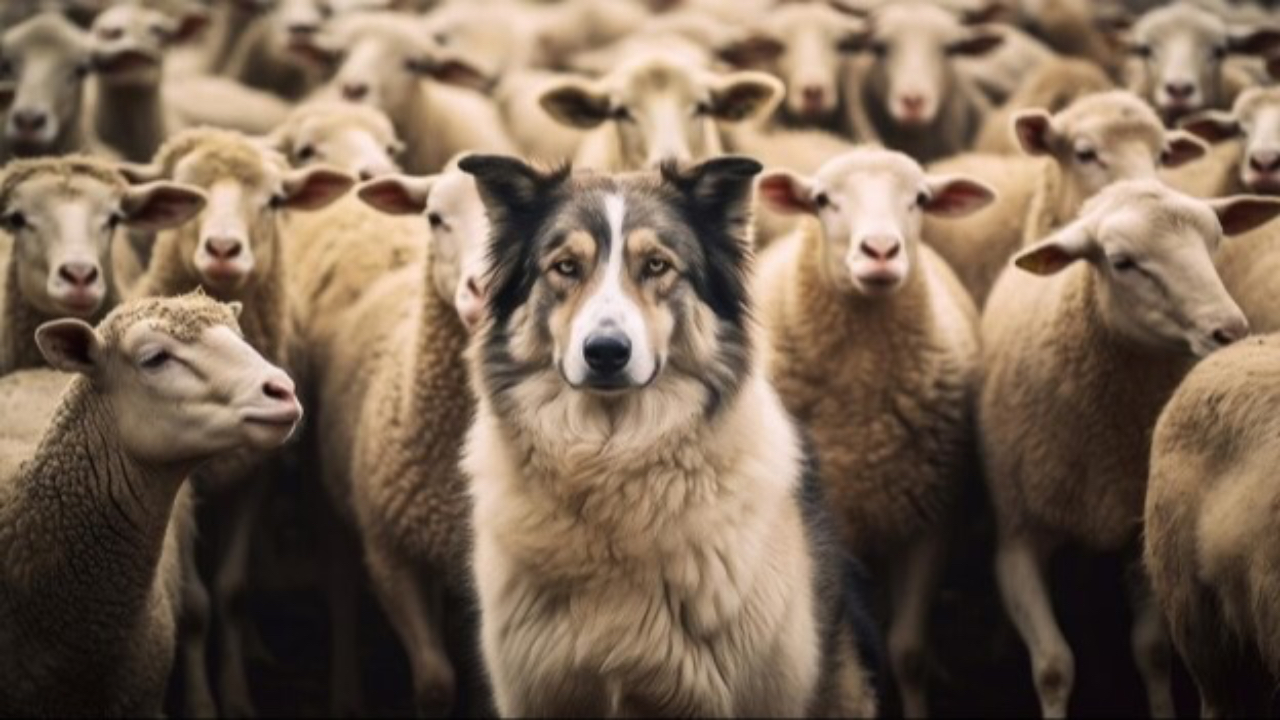
Proper Management is best when a shepherd is on site with the flock. Ditto guardian animals. Guardians can be dogs, donkeys, or llamas; they all have advantages and disadvantages. Whatever you prefer, they are basically essential for almost every flock. Herding dogs can also reduce stress for the animals and streamline handling proce- dures. Management variables include keeping them out of hot sun, or freezing rain and cold, protecting them from dan- gerous predators, toxic weeds or other killers. Lambing at the precise window to avoid weather losses and to capture maximum nutrition yields big gains in vitality and health.
Nutrition. The standard maxim for selecting the best feeds for grazing animals is: Cattle need 20% browse (woody shrubs and forbs, shoulder-height or taller) and 80% polyculture pasture grasses and legumes. Goats are the opposite: 80% browse, and 20% soft grasses. If left to their own choosing that’s what they will usually select. Sheep are right in the middle, so we try our best to provide them with a 50-50 mixture of browse and grass-grazing.
Those are the broad strokes. You can vary these ratios for awhile, but if it continues too long, health and well-being suffers. Within two to three years of continuous grazing, often less, on the aver- age farm the sheep and especially the goats have gotten rid of all the browse! When diverse and typically over-grown farms and ranches are exposed to this kind of “weed eradication program” they begin to resemble a domesticated golf course! Then it’s time to seek out more weeds and brush for the sheep and goats.
Incidentally, many seed houses now provide intense seed cocktails of warm-season and cool-season grasses, legumes, brassicas and forbs for proper nourishment of sheep, and they are highly recommended. No matter which type of pasture mix is used, it’s critical to add controlled moves of livestock using portable fencing. It’s equally important to avoid over-grazing of any pasture at any time. Sheep are particularly sensitive to moldy or poorly-preserved hay, baleage or silage. Ideally toxin-binders should always be available (see below). Perhaps the hardest part of successful sheep-rearing is providing a year-round source of all the micro-nutrients. Remember that all wild ruminants were free to roam and migrate, giving them vastly superior forages, as well as access to mineral licks and salt licks. Wild herds and flocks also have far lower production demands. For all living things, if only one essential vitamin or mineral is missing, the death and sickness rates will begin to climb. Subsequent generations from animals that are malnourished get weaker, dumber, and less profitable!
When adequate levels of the aforementioned good genetics and good management are present, it’s still possible to go broke raising livestock if the nutrition isn’t up to par (and why settle for just par?). I estimate that 80-90 percent of all parasite and disease losses can be averted completely with nutrition. This includes stemming the loss from reproductive failures, lambing difficulties and lamb strength at birth through weaning.
MINERALS AND VITAMINS FOR ALL SHEEP
Of the 16 or so minerals that are absolutely essential for life, the main ones are Zinc, Selenium, Iodine and Copper. What? Copper you say? Most people think sheep can’t have copper which is untrue. Actually, like all other mammals they can’t live without it. To make that work, however, it’s essential to say that it must be the right kinds of copper, the right amount and in the right proportion to other companion minerals.
Maintaining the correct levels of molybdenum and sulfur in the mineral mix keeps it safe. Copper is used for wool production, red blood cells, skin pigment, hoof tissue, stress resistance, development of antibodies, resistance to parasites and much more. Whenever cattle and sheep or goats and sheep are grazing together, the level of copper in a proper “sheep mineral” mix is totally adequate for the other ruminants.
On the other hand if the cattle-goat mineral mix is used, it could be dangerous for the sheep. This is important, so to repeat, always use the sheep versions of mineral mixes when they run with cattle or goats.
Likewise, there are at least 13 essential vitamins, A, C, D, E, K and 8 B vitamins. It’s critical to include protective levels of the fat-soluble vitamins especially the ones most likely to be missing, A, D3 and E. This is even more important in the winter months when plant levels are low or non-existent.
OPTIONAL
In situations where, for whatever reasons, we need to provide even more energy than forages or the ACV provide, two great options exist: CANE MOLASSES (It mixes well with ACV and can be used in various rations. When mixed at a ratio of three parts ACV and one part molasses, it provides flavor encouragement for consumption as well as the caloric/digestive benefit.); LASSAHOL (Sheep need about 1/4 oz per day and it mixes well with ACV, mak- ing it even easier to measure out this tiny dose.)
One good means of providing a “natural” parasite deterrent, is to offer a 50-50 mixture of KELP and Food Grade DIATOMACEOUS EARTH (DE). Do this at least twice a year for about a week. During this time, remove the other sources of minerals and make it easily available. Reviews show that Thorvin kelp is an excellent choice, as is the Permagard brand of DE. ■
Will Winter is a retired veterinarian, holistic herd health consultant and livestock nutritionist as well as traveling teacher focusing on sustainable livestock production and traditional nutrition. Reach him at willwinterdvm@ gmail.com or www.grassfarmersupply.com.
Stay connected with news and updates!
Join our mailing list to receive the latest news and updates from our team.
Don't worry, your information will not be shared.
We hate SPAM. We will never sell your information, for any reason.